Amtrak opens new Maintenance and Inspection Facility in Seattle
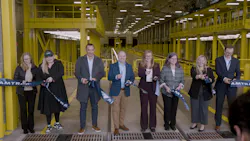
The ribbon has been cut on a new $250 million Amtrak Maintenance and Inspection Facility in Seattle. The new facility is designed to support the new Airo fleet that debuted on the Amtrak Cascades route last month. Delivered on time and $50 million under budget, Amtrak says the facility will open in phases through the end of 2026.
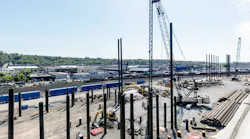
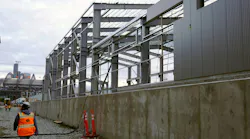
The nearly 100,000-square-foot building is the first maintenance facility of its kind for Amtrak, featuring three tracks for inspecting, servicing and performing heavy maintenance on a full trainset all under one roof.
“This new facility represents a major step forward for Amtrak and our customers in the Pacific Northwest,” said Amtrak Capital Delivery Executive Vice President Laura Mason. “By providing our teams the modern tools and space to maintain an entire Airo trainset at once, we can work more efficiently while continuing our commitment to safe, reliable and comfortable service for the next generation of Amtrak Cascades customers.”
At approximately 700 feet long, the building can accommodate an entire Amtrak Cascades Airo trainset, enabling more modern and efficient maintenance. Amtrak’s legacy fleet of individual railcars must be moved in and out separately for maintenance at the existing facility onsite, a process that Amtrak calls time-consuming and burdensome—a process that does not enable as efficient maintenance as this new facility.
Inside the maintenance facility, Amtrak notes that specialized equipment includes a drop table and split rail system, overhead bridge crane, monorail crane, sanding system and diesel in addition to wayside water and air hose reels, sanitary and vacuum waste hoses, head-end power cabinets and a fall protection lifeline system. The broader project also includes a new parking deck for employees and covered storage for maintenance materials.
Seattle is part of Amtrak’s broader investment in new and upgraded maintenance facilities across the country to support today’s fleet and the next generation of trains. Like that in Boston, New York, Philadelphia and Washington, D.C., these modern facilities allow full trainsets to be inspected and serviced together, helping reduce downtime, improve efficiency and keep trains ready for customers. These modern facilities allow full trainsets to be inspected and serviced together, helping reduce downtime, improve efficiency and keep trains ready for customers.
“It’s exciting to be celebrating this opening today, since it comes on the heels of our recent introduction of the new Amtrak Cascades trains just a few short weeks ago. Together, this facility and our eight new trains and two new locomotives represent a half-billion-dollar investment in passenger rail service for the Pacific Northwest. It’s a new era for train travel in the Pacific Northwest,” said Washington State Department of Transportation External Relations Senior Director Allison Krutsinger.
More than 40 subcontractors supported construction of the facility, many based in the Pacific Northwest.
Major project highlights include:
- Two-level, 39,000-square-foot parking deck for employees and material storage
- 4,000 linear feet of rail
- 16,000 cubic yards of concrete
- 2.4 million pounds of concrete reinforcement
- 12 million pounds of structural steel
- 439 driven piles (11 miles in length)
- 132 drilled piles (three miles in length)
The new facility continues Amtrak’s long-term investment in the Seattle Rail Yard, following previous completion of other, smaller maintenance facility improvements, new administrative building space and a car wash in 2013, 2019 and 2025.
About the Author
 Noah Kolenda
Associate Editor
Noah Kolenda is a recent graduate from the Craig Newmark Graduate School of Journalism with a master’s degree in health and science reporting. Kolenda also specialized in data journalism, harnessing the power of Open Data projects to cover green transportation in major U.S. cities. Currently, he is an associate editor for Mass Transit magazine, where he aims to fuse his skills in data reporting with his experience covering national policymaking and political money to deliver engaging, future-focused transit content.
Prior to his position with Mass Transit, Kolenda interned with multiple Washington, D.C.-based publications, where he delivered data-driven reporting on once-in-a-generation political moments, runaway corporate lobbying spending and unnoticed election records.