Government of Ontario, Denver RTD fund mobility projects designed to expand access
The government of Ontario and the Denver Regional Transportation District (RTD) are making investments into mobility services where typical fixed-route options may not be as available.
Government of Ontario invests C$16 million (US$11.4 million) for reliable transit in small and remote communities
The funding comes from the Ontario Transit Investment Fund (OTIF) and will help assist remote and small communities in building reliable and safe transit services. The government of Ontario says this investment will support five projects benefiting 30 communities.
“Our government is investing in safe and reliable transit that keeps people moving, strengthens communities and supports a stronger, more resilient and self-reliant economy,” said Ontario Minister of Transportation Prabmeet Sarkaria. “No matter where you live, Ontarians deserve access to transportation they can depend on. Through the Ontario Transit Investment Fund, we are expanding transit options that connect people to jobs, housing and essential services.”
The OTIF is set to support the start-up and expansion of transit projects, like new bus services, on-demand rideshare services and door-to-door transportation. The program is designed to help municipalities, Indigenous communities and non-profit organizations deliver reliable transportation services across the province, particularly in rural communities. This year’s funding will support new and expanded transit services across the province, including C$3.4 million (US$2.4 million) for the region of Waterloo to introduce or expand transit services in Woolwich, Wellesley, Wilmot and North Dumfries, Ontario.
“Through OTIF, our government is providing communities across the province with stable, predictable funding for transit services that will transform how people travel for years to come,” said Parliamentary Assistant to the Minister of Transportation Ric Bresee. “Today, we’re demonstrating our commitment to supporting communities and non-profit organizations across Ontario as they deliver reliable transit services.”
The government says that this investment builds on the province’s plan to strengthen transportation in rural, northern and underserved communities, including doubling annual OTIF funding to $10 million in the 2026 budget and bringing back the Northlander passenger rail service to northeastern Ontario.
Denver RTD announces fourth round of Partnership Program pilot funding
Denver RTD allocated its fourth round of Partnership Program funding on Aug. 1, with nine pilot projects being selected throughout the Denver metro area, designed to improve mobility for communities.
In 2023, Denver RTD established the Partnership Program to aid communities in meeting local mobility needs through transportation pilots designed by those communities to meet their specific needs. Denver RTD says the Partnership Program provides opportunities for local governments and transportation management associations and organizations within its service area to apply for funding for services or enhancements that complement existing transit services or fill a transit gap.
The 2026 call for projects, open between April 1 and April 29, 2026, made $6 million available annually for 2027, 2028 and 2029 – twice as much as last year and the most in the program’s history, according to Denver RTD. Local governments and transportation management organizations and associations were eligible to apply. Denver RTD notes it will fund up to 80% of project costs for up to three years initially, with applicants able to request up to $1.8 million annually in funding and responsible for 20% of project costs.
The nine selected recipients from eight entities and their pilots are:
- BERT (Englewood Trolley) extension: Continues existing fixed-route circulator within the city of Englewood, Colo., connecting the Englewood Station with destinations in downtown Englewood and the Medical District while making operational enhancements. Funded $120,000 annually for 2027 and 2028.
- Brighton on-demand local transit expansion: Continues existing on-demand service within the city of Brighton, Colo., while adding Friday evening and Saturday service. Funded $800,000 annually for 2028 and 2029.
- Commerce City, Colo., microtransit: Launches an on-demand service within core Commerce City for residents, employees and visitors along with connections to the 40th, Colorado and Commerce City and 72nd stations. Funded $858,800 for 2027, $1 million for 2028 and $1.1 million for 2029.
- Erie Bee: Continues on-demand service covering approximately 20 square miles in the town of Erie, Colo., along with supporting future connections to the I-25 and CO 7 Mobility Hub. Funded $648,600 for 2028.
- Link-on-demand, Highlands Ranch, Colo.: Supports on-demand service within Highlands Ranch along with connections to and from the Littleton-Mineral Station. Funded $400,000 annually for 2027, 2028 and 2029.
- Link-on-demand, Lone Tree, Colo.: Continues existing on-demand service within Lone Tree and the Meridian community along with facilitating connections to Lincoln Station and other key destinations. Funded $700,000 annually for 2028 and 2029.
- Link-on-demand, Parker, Colo.:Supports on-demand service within the town of Parker. Funded $1.1 million annually for 2027, 2028 and 2029.
- Pecos Connect: Launches an on-demand service in southwestern Adams County along the Pecos Street corridor for residents, employees and visitors along with connections to the Pecos Junction Station. Funded $615,141 for 2027 and $582,341 annually for 2028 and 2029.
- RIDE Longmont extension: Continues existing on-demand service and deploys additional service vehicles within the city of Longmont, Colo. Funded $1.3 million in 2027, $941,000 in 2028 and $1.8 million in 2029.
“In 2025, eight active on-demand and fixed route services supported through the Partnership Program collectively provided more than 300,000 boardings, demonstrating the program’s role in advancing [Denver] RTD’s mission to make lives better through connections,” said Denver RTD General Manager and CEO Debra Johnson. “By leveraging local partnerships, the program continues to strengthen service delivery and expand system access to customers across the Denver metro region. These collaborations provide additional cost-effective mobility options that respond to evolving travel needs.”
The nine projects funded in the fourth round of the Partnership Program include new pilots, as well as enhancements and service improvements to previously awarded projects. Denver RTD says riders will benefit from new on-demand service options that improve local travel and regional connections in locations such as Adams and Douglas counties, along with reduced wait times and extended service hours in Longmont and Brighton, respectively.
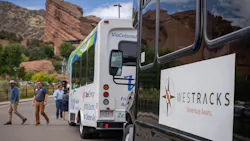
Other initiatives supported by prior Partnership Program Calls for Projects include on-demand services such as the Denver Connector and Aurora Rides, fixed-route services such as the Westracks Shuttle and a micromobility incentive pilot at the University of Denver and Knox stations.
Applications were evaluated on the following factors:
- Alignment with Denver RTD’s Strategic Plan
- Local support and ability to meet local needs
- Provides service where there is a gap in existing service
- Provides service to equity zones
- Potential ridership
- Project readiness
About the Author
 Noah Kolenda
Noah Kolenda
Associate Editor
Noah Kolenda is a recent graduate from the Craig Newmark Graduate School of Journalism with a master’s degree in health and science reporting. Kolenda also specialized in data journalism, harnessing the power of Open Data projects to cover green transportation in major U.S. cities. Currently, he is an associate editor for Mass Transit magazine, where he aims to fuse his skills in data reporting with his experience covering national policymaking and political money to deliver engaging, future-focused transit content.
Prior to his position with Mass Transit, Kolenda interned with multiple Washington, D.C.-based publications, where he delivered data-driven reporting on once-in-a-generation political moments, runaway corporate lobbying spending and unnoticed election records.