2026 Mobility Outlook Miniseries: Zero-emissions Transition

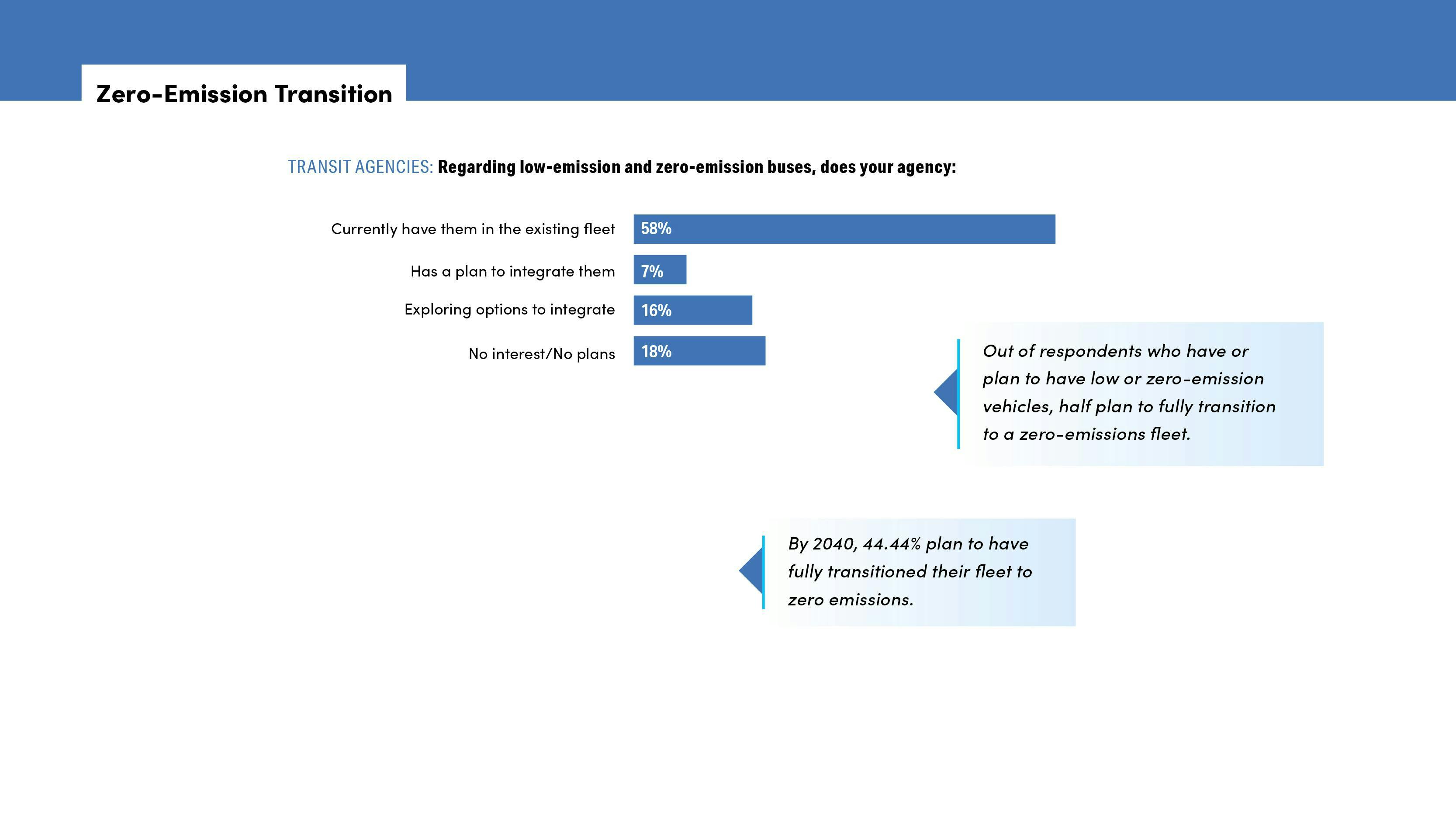
Since 2020, Mass Transit has been asking our subscribers about their plans for transitioning their bus fleets to low and zero emissions as part of our Annual Mobility Outlook Survey. Six years ago, about 48% of transit agencies responded they currently have low- or zero-emission vehicles in their fleet, and 15% said they were exploring integration options. Now in 2026, those numbers have seen modest increases: 58% and 16%, respectively. Another 7% of respondents this year said they already have a plan to integrate these types of vehicles.
These numbers are supported by the number of agencies who have ordered clean fuel vehicles and who have reported operating a fully transitioned fleet. And according to the American Public Transportation Association’s 2025 Vehicle Database’s listing for active buses, there are:
- 1,027 biodiesel vehicles
- 8,660 compressed natural gas (CNG) vehicles
- 7,364 diesel and electric battery vehicles
- 1,480 battery-electric vehicles
- 127 hydrogen vehicles
We can expect these numbers to grow based on our survey responses. Of the survey respondents who indicated they plan to procure buses in 2026, 35% said it was to support low- and zero-emission goals. Specifically, 30% are looking for hybrid vehicles, 16% are interested in CNG vehicles and 37% are wanting battery-electric vehicles. Additionally, out of survey respondents who have or plan to have low- or zero-emission vehicles, half plan to fully transition to a zero-emissions fleet. By 2040, 44% said they plan to have a fully transitioned fleet.
Driving the transition
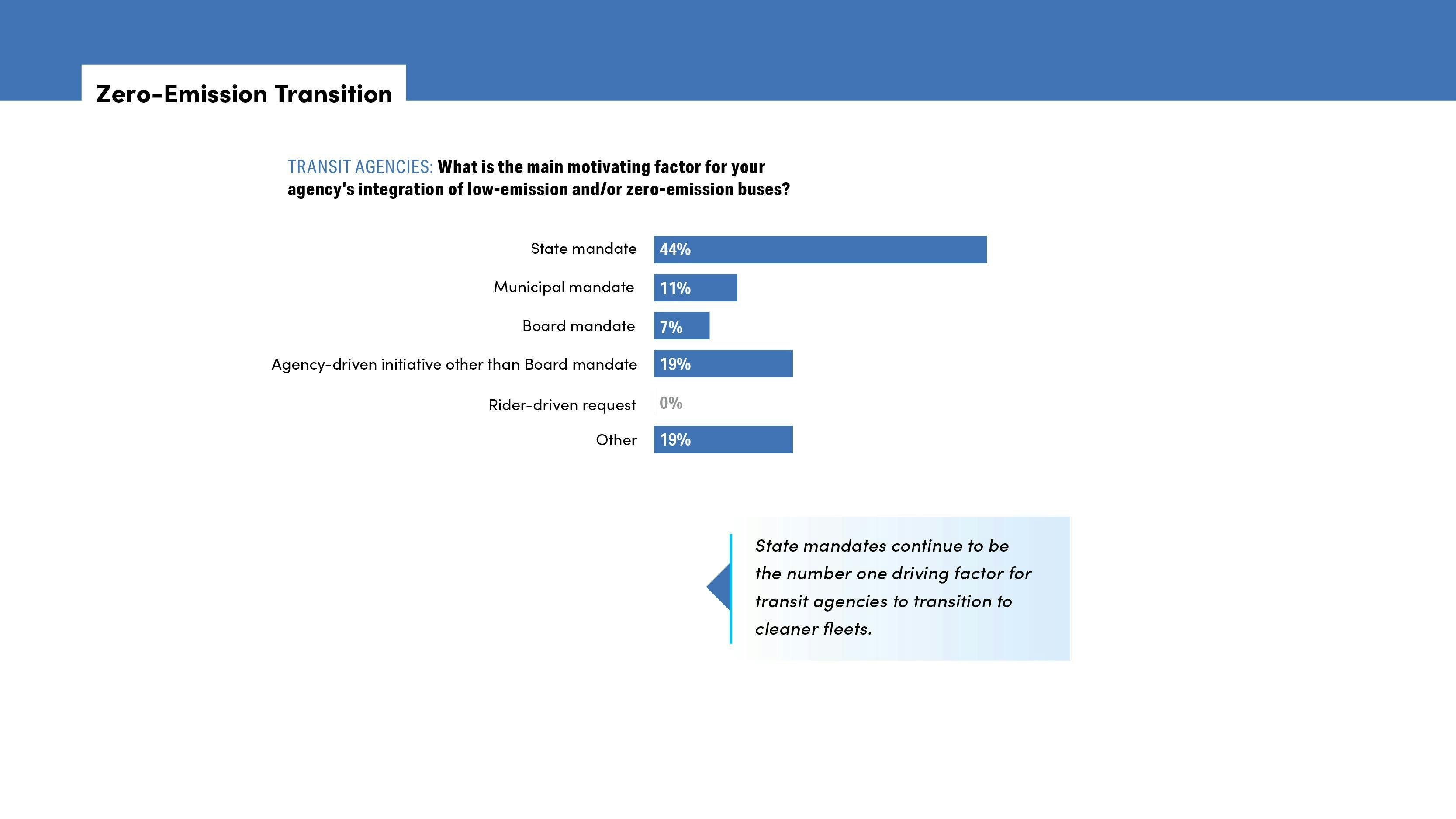
Around 44% of transit agencies said state mandates were the top factor for transitioning their fleets to cleaner fuel. This was also the primary driver in 2025. However, it wasn’t until last year when state mandates outpaced agency-driven initiatives—outside of board mandates—as the top reason for wanting to transition to cleaner fuels.
For 2026, nearly 19% cited agency-driven initiatives as the main motivating factor for integrating low- and zero-emission vehicles.
In 2025, we covered several stories announcing low- and zero-emission vehicle orders, deliveries and service launches. The New Jersey Transit Board of Directors authorized the purchase of 26 zero-emission buses and 260 40-foot clean diesel buses. The San Francisco Municipal Transportation Agency ordered three 40-foot battery-electric buses (BEBs) and three 60-foot articulated battery-electric buses (BEBs) from Solaris. Six new 40-foot BEBs from GILLIG arrived in Broome County, N.Y.
Out in Florida, two new services launched with BEBs: The Pinellas Suncoast Transit Authority’s Spark express service and Miami-Dade County’s Metro Express Bus Rapid Transit service. Finally, Santa Maria Regional Transit announced it completed its transition to a 100% BEB fleet.
Obstacles to implementation
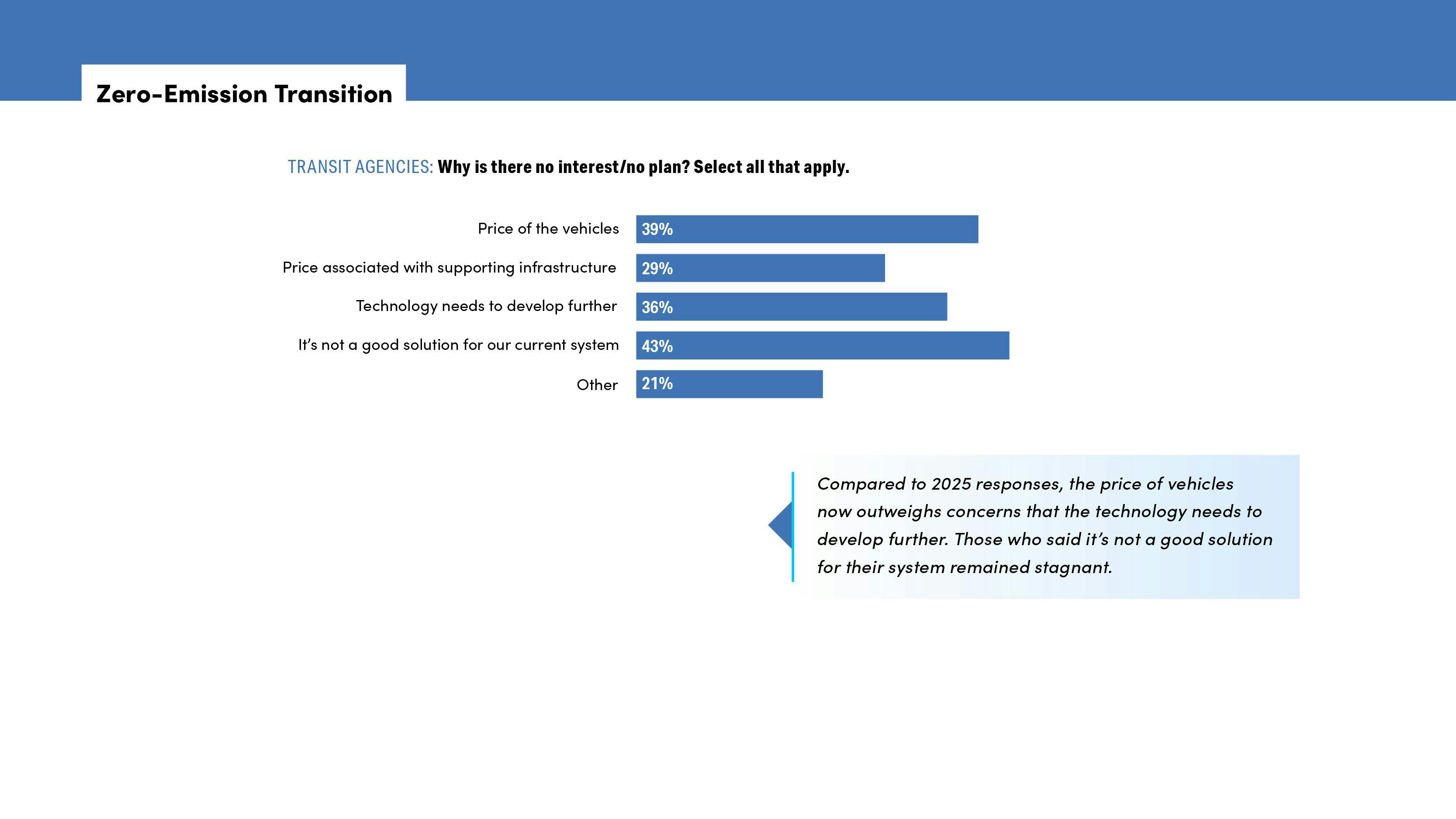
This year, around 18% of respondents said they had no interest or no plans in place to transition their fleet. While this number has fluctuated over the years, it’s never been higher than 20% of the responding agencies.
Similar to 2020 and 2021, the majority—42%—of those who don’t plan to transition to low- or zero-emission vehicles said these vehicles aren’t a good solution for their current system. Compared to 2025 responses, the price of vehicles now outweighs concerns that the technology needs to develop further. Back in 2020, only 14% of agencies selected this response.
Other answers provided on not wanting to transition their fleets cited lack of hydrogen availability, not wanting to use one bus type, difficulties due to intense fluctuations in weather and lack of infrastructure support.
More 2026 insights
Want to read more about our outlooks for 2026? Check out our 2026 Mobility Outlook Miniseries: The Rider Experience and our 2026 Mobility Outlook Miniseries: Cybersecurity Trends.
See all of our insights in the 2026 Mobility Outlook: The Year Ahead.
About the Author
 Megan Perrero
Megan Perrero
Editor in Chief
Megan Perrero is a national award-winning B2B journalist and lover of all things transit. Currently, she is the Editor in Chief of Mass Transit magazine, where she develops and leads a multi-channel editorial strategy while reporting on the North American public transit industry.
Prior to her position with Mass Transit, Perrero was the senior communications and external relations specialist for the Shared-Use Mobility Center, where she was responsible for helping develop internal/external communications, plan the National Shared Mobility Summit and manage brand strategy and marketing campaigns.
Perrero serves as the board vice president for LIT, the second vice chair of the American Public Transportation Association’s (APTA) programs and communications committee and is a member of APTA’s Marketing and Communications Committee. She holds a bachelor’s degree in multimedia journalism with a concentration in magazine writing and a minor in public relations from Columbia College Chicago. Her work has been recognized with a first place AdWheel Award, AZBEE Bronze Regional awards, an AZBEE Regional Gold Award and an AZBEE National Silver Award.