MTA, SEPTA to make accessible improvements to historical stations
The Metropolitan Transportation Authority (MTA) and Southeastern Pennsylvania Transportation Authority (SEPTA) are making station improvements.
MTA to rehabilitate Chambers Street J/Z Station
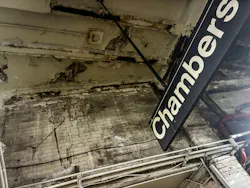
MTA is seeking contractors to design, construct and rehabilitate the Chambers Street J/Z Station, which opened in 1913 and is one of the most historic stations in the subway system. MTA says the renewal project will rebuild structures, replace tiles and upgrade stairways. The project is part of the MTA’s 2020 – 2024 Capital Plan and is made possible by funding from congestion pricing.
“Chambers Street has stood for decades as a living monument of generations of underinvestment in our transit system..Now, thanks to funding from congestion pricing, that finally changes,” said New York Gov. Kathy Hochul. “I promised New Yorkers that congestion pricing would not just clean our air and speed up traffic, it would unleash billions in investments to improve the lifeblood of our city. Advancing this project and giving Chambers Street the rehabilitation it so desperately needs will show New Yorkers what is possible when we invest in transit.”
MTA notes Chambers Street is on the register of National Historic Places as declared by the U.S. Department of the Interior and serves 18,196 riders on an average weekday. The MTA will award the design-build contract by the end of the year. The Chambers Street station is among the most urgently in need of repair and rehabilitation in the entire subway system, with water damage and decades of structural decay diminishing the customer experience.
“Chambers Street is the poster child for dilapidated subway stations. Thanks to congestion pricing, we're finally able to give it the comprehensive makeover it needs to enter the 21st century,” said MTA Chair and CEO Janno Lieber.
President of MTA Construction and Development Jamie Torres-Springer said, "The historic Chambers St station is long overdue for rehabilitation. This is the latest example of the critical state-of-good-repair work that the congestion pricing program is facilitating across the system."
The scope of the project includes:
- Painting the station.
- Providing new floor finishes at select areas of the public mezzanines.
- Replacing or modifying existing station elements, including station stairs and doors.
- Replacing damaged station finishes and restoring historic station finishes, including ceramic tiles, mosaics, terra cotta decorations, base tiles, concrete and marble bases and trims.
- Performing structural repairs, water leak mitigation and ceiling improvements.
- Installing new station lighting, new cameras and updating the existing CCTV system.
- Performing preparatory work for the installation of new artwork.
The MTA recently also announced the award of a contract for the construction of Americans with Disabilities Act (ADA) accessibility upgrades at the 3 Av-138 Street and Brook Avenue 6 subway stations in the Bronx and issued a request for proposals for accessibility upgrades, including elevators at five Brooklyn subway stations. The stations were selected to improve geographic coverage of accessible stations throughout the system. MTA says both projects are being made possible with funds from congestion pricing.
SEPTA to modernize L station
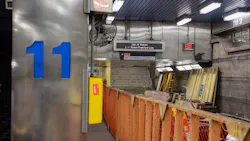
SEPTA is set to break ground later this month on a project at 11th Street Station that will make the L [Market-Frankford Line] Station fully accessible. The agency notes more than 9,400 L riders pass through 11th Street Station each weekday.
The agency notes the 11th Street Station will be closed to the public from Sept. 5, 2026, through Aug. 30, 2027. L trains will bypass the station during this time. The concourse will be closed from 13th Street to 11th Street for the duration of the project.
According to the agency, the typical duration for similar projects is approximately 35 months. Bypassing the station for 12 continuous months is expected to reduce the project duration by at least 10 months and save up to $3 million. SEPTA notes customers who normally board or exit at 11th Street can use 8th-Market or 13th Street stations, which are both ADA accessible.
The agency notes a key element of the $44 million project is providing elevator access from the street level to the eastbound and westbound platforms. The two new elevators will make 11th Street Station fully ADA compliant.
“We are excited to begin this work that will result in a better experience for riders of any ability who use this station,” said SEPTA General Manager Scott A. Sauer. “We have made great strides in recent years to bring SEPTA closer to our commitment to make the system accessible to all.”
In addition to the new elevators, other planned improvements to the station include:
- New lighting
- Communications system upgrades
- New employee bathroom
- New cashier booth
- New floor and wall tiles
- New wayfinding signage
- Structural repairs and waterproofing improvements
SEPTA’s fiscal year 2027 budget includes funding to bring full-height fare gates to an additional 13 stations, including 11th Street. At the 10 stations where the new gates are installed, fare evasion has been cut roughly in half.
The agency says that by the time construction at 11th Street Station is completed, 27 of 28 L stations will be fully accessible. The project is supported by a Federal Transit Administration All Stations Accessibility Program competitive grant award.
SEPTA is investing more than $1 billion in making Metro and Regional Rail stations accessible over the next 12 years. As a result, more than 95% of trips on SEPTA will go through an accessible station. The agency says the investments complement a bus network that is already 100% accessible.
About the Author
 Brandon Lewis
Brandon Lewis
Associate Editor
Brandon Lewis is a recent graduate of Kent State University with a bachelor’s degree in journalism. Lewis is a former freelance editorial assistant at Vehicle Service Pros in Endeavor Business Media’s Vehicle Repair Group. Lewis brings his knowledge of web managing, copyediting and SEO practices to Mass Transit magazine as an associate editor. He is also a co-host of the Infrastructure Technology Podcast.