NYC marks one year of congestion pricing with faster travel, cleaner air, safer streets and more revenue than expected
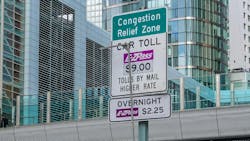
Jan. 5 marked the one-year anniversary of New York City’s congestion pricing, the nation’s first congestion relief program that charges drivers an additional toll for entering high-traffic areas—Manhattan on or below 60th Street.
After 12 months of camera-based enforcement, state and city leaders, advocates and commuters say the program has been a resounding success in addressing traffic, transit ridership, pollution, safety, noise and a myriad of other issues.
“The results are in and it is clear that in just one year, congestion pricing has been an unprecedented success in New York,” said New York Gov. Kathy Hochul. “By every measure, this program has met or exceeded expectations: traffic and gridlock are down substantially, people are moving faster, air quality is improved, streets are safer and our economy is stronger… And there are even more benefits to come: $15 billion in transit upgrades with major projects already underway, improving the commutes of millions of New Yorkers.”
The program was implemented to reduce traffic congestion and promote transit ridership; in turn, speeding up buses and decreasing air pollution while funding capital projects with the toll revenue—and the data shows the outcomes in action.
Since the start of congestion pricing, the Metropolitan Transportation Authority (MTA) notes that traffic is down 11% in the congestion relief zone, with 27 million fewer cars entering the zone in 2025—or 73,000 fewer cars entering the zone each day. As for the cars that still entered the congestion relief zone, they saw speed improvements of up to 51% on bridges and in tunnels while aiding the agency in generating more than $550 million in revenue, allowing the MTA to advance more than $15 billion in capital transit improvement projects.
“It’s going to bring us more benefits, more than just less congested streets” said MTA CEO Janno Lieber at a Jan. 5 press conference celebrating the anniversary. “It’s the new train cars that you’re making possible, the new signals, more ADA elevators. We’re changing the city by making the system truly accessible for the first time.”
The program funds will support a variety of projects for the MTA, including:
- Accessibility upgrades at more than 20 stations.
- Signal upgrades on the A/C and B/D/F/M lines.
- Hundreds of new electric buses and requisite infrastructure upgrades.
- Second Ave Subway Phase 2 extension to East Harlem.
- Projects throughout the system to ensure a state of good repair.
The program benefitted the operation of the city’s bus and rail services, too, getting more riders on quicker-moving transit. A joint study conducted between the Regional Plan Association (RPA) and Hunter College found that both subway and bus ridership were both up 7% in December 2025 from the same time in 2024. Further, bus travel speeds are up 5% in the congestion zone.
Beyond transportation, congestion pricing has contributed to other quality of life improvements. A Cornell study of pollution in the congestion relief zone published six months after the start of the program found a 22% decrease in air pollution caused by particulate matter, as well as a 6% reduction in greenhouse gasses.
Additionally, the program has increased safety in the zone. The RPA study found a nearly 9% reduction in persons seriously injured in crashes in the congestion relief zone. The study also recorded decreases in complaints of illegal parking and noise complaints from inside the zone.
“As we are here, celebrating these cameras staying on thanks to the governor’s commitment despite tremendous pressure, we also celebrate what this has meant for New Yorkers,” said New York City Mayor Zohran Mamdani during the Jan. 5 press conference. “Whether they are driving, whether they are biking, whether they are walking, taking a bus, taking the train—whether they are just breathing the air in the city they call home—this is a program that has been successful no matter how you measure it.”
The only metric that didn’t see positive movement was complaints of illegally parked cars outside of the congestion relief zone. Those complaints went up 17% from the same time in 2024.
Legal troubles with the program
The program also continues to face legal challenges, though already beating several in court. The MTA next meets the U.S. Department of Transportation (USDOT) in court later in January after it began trying to end the congestion pricing program last February, suggesting it would depress business and traffic in the area, even as recently as November 2025.
“New York City is getting KILLED by her ridiculous CONGESTION PRICING, where people have to pay a fortune to come into Manhattan - So they just don't come! The place is a ghost town,” President Donald Trump wrote in part in a Truth Social post on the eve of the November 2025 elections.
The MTA is now seeking permanent injunctive relief and a summary judgment that would block the federal agency from stopping the program after it was granted a temporary injunction last year.
The transit agency also faces a bevy of other legal challenges from other state governments, local governments within New York, assembly members and advocacy groups.
The state of New Jersey filed an amended suit against the USDOT trying to stop the program due to concerns of spillover traffic and how the cost would impact its residents. The initial suit failed, instead resulting in clarification from the Federal Highway Administration on how it came to some of the decisions it made in program calculations—answers that are still being mulled over in court.
Other lawsuits include:
- One that was filed by Assembly Member Jake Blumencranz (R-NY-15), who is suing on behalf of Oyster Bay residents for largely the same reasons outlined by the Trump administration.
- A lawsuit filed by the town of Hempstead, N.Y., against the Triborough Bridge and Tunnel Authority that takes issue with the cars that are stored within the congestion relief zone and suggests the fees are an eighth amendment violation.
- A lawsuit from the Trucking Association of New York (TANY) aimed at the MTA over a perceived violation of the Commerce Clause of the Constitution, citing that the higher fee doesn’t reflect the smaller percentage of traffic they make up and that the Federal Aviation Authorization Act of 1994 prevents the MTA from doing anything—including tolling—that causes trucking companies to change their routes or services.
Blumencranz’s case will be taken up after a decision is made in the agency’s suit against the USDOT. The case from the town of Hempstead, while still active, has an uncertain future as similar moves in other jurisdictions were dismissed and the last known filings were in August of 2025. As for the TANY dispute, while its initial claim was dismissed, an amended version of the case has seen both sides file motions for summary judgement, though a hearing date has yet to be set.
“We've got a pretty good record,” Gov. Hochul said at the Jan. 5 press conference. “Every time it's gone before a judge, the judge says 'no no, the state's right. The MTA's right. They're on the right path. They're doing this legally, and so, why are we here?' And again, later this month, guess where we'll be? We'll be back in court defending our program once again, but we'll just keep on winning. We'll be winning so much, we'll be tired of winning."
Mass Transit magazine will continue to follow the developments of the legal challenges against and the results from congestion pricing as the story progresses.
About the Author
 Noah Kolenda
Noah Kolenda
Associate Editor
Noah Kolenda is a recent graduate from the Craig Newmark Graduate School of Journalism with a master’s degree in health and science reporting. Kolenda also specialized in data journalism, harnessing the power of Open Data projects to cover green transportation in major U.S. cities. Currently, he is an associate editor for Mass Transit magazine, where he aims to fuse his skills in data reporting with his experience covering national policymaking and political money to deliver engaging, future-focused transit content.
Prior to his position with Mass Transit, Kolenda interned with multiple Washington, D.C.-based publications, where he delivered data-driven reporting on once-in-a-generation political moments, runaway corporate lobbying spending and unnoticed election records.