CTA, SacRT complete station upgrades to improve accessibility, rider experience
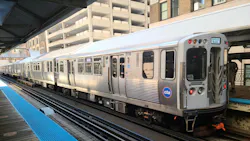
The Chicago Transit Authority (CTA) and the Sacramento Regional Transit District (SacRT) have completed station upgrades to improve their systems for riders and prepare a station to accommodate new rolling stock.
CTA reveals full accessible Austin Green Line station
The CTA has unveiled the upgraded, fully accessible Austin Green Line station. The agency says the $25 million project achieves a milestone in its All Stations Accessibility Program (ASAP) and advances the shared goal of making public transit in Chicago accessible to everyone.
CTA’s ASAP Strategic Plan was released in 2018 and serves as a blueprint for making all rail stations fully accessible by 2038. With the opening of the Austin station, 110 of CTA’s 146 rail stations (75%) are accessible to those who use mobility devices. Austin is among the 14 stations recently opened or currently funded and in various stages of planning, design or construction to become fully accessible.
“Public transit is about connecting people to opportunity, and every accessible station brings us one step closer to a Chicago where everyone can travel freely,” said CTA Acting President Nora Leerhsen. “Reaching 75% accessibility—along with recent breaking ground on the historic Red Line Extension—is a huge milestone for our city and the surrounding communities. I’m incredibly proud of our team’s dedication, but we won't stop here. We’re fully committed to working with our partners to secure the funding needed to reach 100% accessibility for every rider over the next decade.
Funding for this critical infrastructure project was sourced through the federal government’s Surface Transportation Program (STP) and Illinois Gov. JB Pritzker’s Rebuild Illinois Capital Plan. STP provided $20.3 million in funding, and Rebuild Illinois provided $5.3 million for a total budget of $25.6 million.
“Investing in Illinoisans means investing in the public transit that connects them to jobs, schools, businesses and opportunity,” said Gov. Pritzker. “The renovated Austin Green Line station delivers the safe, accessible and reliable experience every rider deserves. And together with our passage of [the Northern Illinois Transportation Authority] (NITA), it represents our broader commitment to building a stronger, more equitable transit system for communities across the region.”
The Austin station serves as a regional transit hub, providing connections to the #91 Austin route, as well as three Pace Suburban Bus routes—the #309, #313 and #315—which connect to several Metra stations and popular destinations including Midway Airport.
The CTA says that the original street level Austin station opened in 1899 and had not been upgraded since it was rebuilt in 1962. Work included the installation of a new elevator and escalator connecting to the platform; reconstruction of the outside station stairs and a new ADA compliant ramp to enter the station; plus, other station enhancements.
Currently, CTA has secured funding for all four remaining stations identified in Phase One and five of the eight stations in Phase Two of the ASAP Plan. CTA has secured $37 million in funding for elevator replacement and/or modernization efforts, which were also part of the ASAP Plan.
“Building the safest, most affordable big city in America means investing in accessible public transportation that serves the needs of every Chicagoan,” said Chicago Mayor Brandon Johnson. “When we remove barriers to transportation, we expand access to employment, education, healthcare and the everyday opportunities Chicagoans need to thrive.”
The agency notes that funding remains the biggest impediment to achieving a fully accessible rail system. Since the launch of the ASAP Plan, the CTA says it has secured $740.8 million in funding, with design and construction underway for nearly all non-accessible stations identified in the first two phases of the plan. CTA continues to seek out additional sources of funding for the remaining stations in Phase Two, as well as funding for stations in phases three and four of the program.
SacRT completes station upgrades to accommodate new rolling stock
SacRT has completed major platform construction work at the 4th Ave/Wayne Hultgren Station and City College Station on the Blue Line ahead of schedule. Originally planned through Aug. 15, the work was completed early, allowing SacRT to restore full light-rail service in the area beginning Aug. 11.
SacRT says that the early completion ensures that Sacramento City Unified School District students, including those attending McClatchy High School, will have uninterrupted light rail access on the first day of school.
Since July 27, SacRT has operated a temporary bus bridge between Broadway Station and Fruitridge Station to support riders during the construction.
The construction work raised the station platforms by eight inches to accommodate SacRT’s future fleet of Siemens S700 low-floor trains, arriving on the Blue Line in 2027.
Key features of the incoming S700 low-floor light-rail vehicles include:
- One train car can fit up to 187 people sitting and standing.
- At-platform boarding and easy access for all riders.
- Temperature control for a comfortable ride.
- Digital signs inside the trains show the next station and update when approaching stations.
- Audio announcements announce approaching stations.
The agency says the upgrades will improve accessibility and speed up boarding for all riders, including seniors, people with disabilities, families with strollers and passengers with mobility devices. The agency is making the upgrade so that it no longer needs to use the mini-high ramps at the end of the station platforms, instead offering level boarding once the new stock deploys on the line.
About the Author
 Noah Kolenda
Noah Kolenda
Associate Editor
Noah Kolenda is a recent graduate from the Craig Newmark Graduate School of Journalism with a master’s degree in health and science reporting. Kolenda also specialized in data journalism, harnessing the power of Open Data projects to cover green transportation in major U.S. cities. Currently, he is an associate editor for Mass Transit magazine, where he aims to fuse his skills in data reporting with his experience covering national policymaking and political money to deliver engaging, future-focused transit content.
Prior to his position with Mass Transit, Kolenda interned with multiple Washington, D.C.-based publications, where he delivered data-driven reporting on once-in-a-generation political moments, runaway corporate lobbying spending and unnoticed election records.