CTA breaks ground on Red Line Extension Project
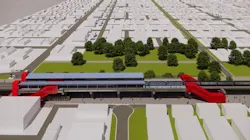
The Chicago Transit Authority (CTA) broke ground on the Red Line Extension (RLE) Project. The REL Project will be the largest construction project in CTA history, connecting the Far South Side of Chicago with rapid rail transit for the first time via a 5.5-mile extension to the Red Line from 95th Street to 130th Street, including building four new Red Line stations at 103rd, 111th, Michigan and 130th streets.
“This historic CTA project finally delivers on the transit promises made to the residents of Roseland, Pullman, Washington Heights and surrounding neighborhoods decades ago,” said CTA Acting President Nora Leerhsen. “We are grateful to our many partners in federal, state and city government, who have fought alongside our agency to make this transformative project a reality. It will provide tremendous opportunity and access to employment and education for hundreds of thousands of residents on the Far South Side.”
Beyond the new track and stations, the project with also see the building of a new rail yard and related rail facilities near 120th Street to improve operational efficiency for the entire Red Line and CTA system and to ensure the new extension is fully capable of serving the community it’s connecting.
“Today’s groundbreaking demonstrates our shared commitment to transit equity and opportunity for every Chicagoan,” said Chicago Mayor Brandon Johnson. “Far South Side residents have waited decades for this crucial rail service to come to life. My administration never wavered in our determination to finally secure this project and will continue to direct investments in housing and neighborhood development to support transit-oriented revitalization of the surrounding communities.”
Project benefits
- The Red Line Extension Project will provide a new, more direct connection to the Red Line—aiming to offer easier trips and less time commuting.
- Once the extension opens, it is expected to provide up to an hour of time savings roundtrip to riders traveling between the future 130th station and the Loop.
- Stations will offer plaza areas that will include seating and other amenities to create welcoming spaces for residents
- All stations will receive commissioned artwork that will be developed with feedback from people in the neighborhood areas around the stations.
- More than 12,500 construction jobs and an estimated 59,800 indirect jobs are expected to be created through the extension project.
- Because of the improved transit options, an estimated 25,000 additional jobs are to become available within an hour commute or less, according to the agency.
Project timeline
CTA notes that advance construction work has been underway to prepare the project for construction, including demolition of properties acquired to build the project and relocation of utility poles and other equipment where the new track will be built.
With construction beginning in spring 2026, upcoming work will include:
- Drilling where new elevated track columns will be located.
- Pouring concrete to create the new track foundations followed by track columns.
- Station construction will begin in 2027.
The new extension and stations are expected to be completed and in service in 2030.
Training and career opportunities
CTA has employed design-build contractor, Walsh-VINCI Transit Community Partners, to create pathways for residents to receive training and access to jobs on the RLE Project. To accomplish this, CTA has contracted with workforce assistance agencies Chicago Women in Trades, HIRE 360 and Metropolitan Family Services to help prepare individuals to pursue their careers.
Walsh-VINCI’s workforce goals for the contract as a percentage of total labor hours includes:
- 10% of the total design hours
- 10% of total trade labor hours
- 35% of total trade labor hours
- 15% of total trade labor hours
CTA notes that it included goals in the Walsh-VINCI contract to ensure that small businesses certified as disadvantage business enterprises could bid on sub-contract work on the RLE Project. Those goals are 25% for project design and 22% for project construction.