NYC DOT completes redesign of Flatbush Avenue center bus lanes
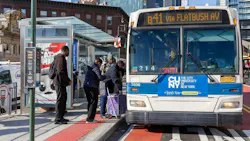
The New York City Department of Transportation (NYC DOT) has completed the major redesign of Flatbush Avenue in Brooklyn, bringing faster bus service and safer streets to a corridor serving 120,000 daily riders.
According to NYC DOT, the project delivers 1.9 miles of new, physically protected, center-running bus lanes, six concrete bus boarding islands and safety upgrades to improve service and accessibility. The city notes buses on Flatbush Avenue historically drive at four mph, even as the corridor serves the B41 – one of Brooklyn's busiest bus routes – as well as the B67, B45 and B103.
The redesign is a key commitment of Next Stop: Fast Buses, Better Service, New York City Mayor Zohran Mamdani's partnership with New York Gov. Kathy Hochul and the Metropolitan Transportation Authority (MTA) to make bus service faster and more reliable across 175 routes, nearly 75% of the city's bus network.
"Flatbush Avenue is the foundation for the future of bus service in New York City," Mamdani said. "With center-running bus lanes, new boarding islands and safety upgrades, we are speeding up rides for New Yorkers today and laying the groundwork for our city's first world-class bus rapid transit corridor. Bus riders are tired of waiting – waiting for the bus that never comes, waiting for the bus to crawl through traffic and waiting for government to care about their precious time. We are changing that. On Flatbush Avenue and across the city, we're building the fast, reliable public transit that New Yorkers deserve."
NYC DOT notes that in communities where 69% of households do not own a car, the project prioritizes faster buses, safer streets and more accessible pedestrian space.
"New Yorkers deserve a world-class transit system, and the Mamdani administration is delivering it first right on Flatbush Avenue with bus lanes that are fully protected from traffic so riders can get where they are going quickly and reliably," said NYC DOT Commissioner Mike Flynn. "NYC DOT was able to deliver this transformative upgrade quickly, in just a few months, as the first building blocks for future bus rapid transit on the corridor. We will be using the coming months to monitor the project's success as New Yorkers adapt to the new patterns and will make any adjustments needed."
The project adds 29,000 square feet of new pedestrian space through concrete bus boarding islands and painted curb extensions at intersections, 36 bike racks, as well as bus shelters, benches and leaning bars at bus boarding islands. Additional improvements include dedicated loading zones and updated parking regulations along the corridor to allow commercial and passenger vehicles to use metered parking in parking lanes. NYC DOT says approximately 45 new signal poles will support improvements such as left- and right-turn signals, accessible pedestrian signals, pedestrian countdown signals, new signal installations to accommodate bus boarding islands and new street lighting.
"I'm thrilled to have partners across city government who understand that millions of New Yorkers rely on buses to get them where they need to go and are dedicated to doing their part to make our buses faster, more reliable and safer," said MTA NYC Transit Buses Executive Vice President Frank Farrell. "Projects like this one in the heart of Downtown Brooklyn, combined with other efforts outlined in the Bus Action Plan like expanding ACE and purchasing new buses will help us do just that."
Throughout 2026, the Mamdani administration has advanced major projects to speed up bus service and improve street safety across all five boroughs.
About the Author
 Brandon Lewis
Associate Editor
Brandon Lewis is a recent graduate of Kent State University with a bachelor’s degree in journalism. Lewis is a former freelance editorial assistant at Vehicle Service Pros in Endeavor Business Media’s Vehicle Repair Group. Lewis brings his knowledge of web managing, copyediting and SEO practices to Mass Transit magazine as an associate editor. He is also a co-host of the Infrastructure Technology Podcast.