New York Gov. Hochul, Mayor Mamdani unveil action plan to speed up bus service across NYC
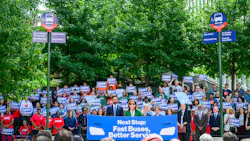
On July 8, New York Gov. Kathy Hochul and New York City Mayor Zohran Mamdani unveiled a bus action plan to build the next generation of bus service in New York City.
The plan, Next Stop: Fast Buses, Better Service, identifies 50 priority bus corridors for improvements across the five boroughs to shorten commutes, improve reliability and expand accessibility in partnership with the New York City Department of Transportation (NYC DOT) and the Metropolitan Transportation Authority (MTA).
“Every day, millions of New Yorkers rely on buses to get around this city, but for far too long, making their journeys faster and their lives easier has seemed out of reach. That all changes today,” Hochul said. “New York is in the midst of a transit renaissance, with historic investments being made to improve the lifeblood of our city. Now, working with Mayor Mamdani, we are advancing a bold and ambitious plan to move buses faster, dramatically expand bus priority, reduce delays and make our bus system the envy of the world.”
Five corridors in Brooklyn, Queens and the Bronx have been selected as the first phase of the plan. The corridors were selected because they connect New Yorkers to jobs, schools, subway service and major destinations while supporting current and future housing and economic growth:
- Tremont/Cross Bronx in the Bronx
- Northern Boulevard in Queens
- Flatbush Avenue in Brooklyn
- Utica Avenue in Brooklyn
- Kensington-JFK in Brooklyn and Queens
“For working New Yorkers, every minute matters, but for too long, our buses have been stuck in traffic instead of keeping pace with the city that never sleeps,” Mamdani said. “When a commute stretches longer than it should, that’s less time with your kids, less time with your loved ones and less time enjoying the greatest city on earth. Together with Gov. Hochul, we’re investing in faster, more reliable buses because New Yorkers deserve a transit system that respects their time. This plan will make it easier to get to work, school and home—and build a city that works better for the people who keep it running.”
The NYC DOT and the MTA will advance the projects with dedicated, protected bus lanes, frequent all-day service, upgraded stations with sheltered waiting areas and public space improvements. The MTA will purchase approximately 2,500 new buses, replacing 40% of its aging fleet. Funding for the buses will come through the 2025-2029 Capital Plan.
“Too often, New York City’s bus riders have felt like an afterthought. The Mamdani administration is putting the city’s one million daily bus riders front and center through this historic partnership and investment,” said NYC DOT Commissioner Mike Flynn. “Bus service shouldn’t be treated as a second-rate option at the mercy of traffic congestion. It should be a world-class system for a world-class city: fast, comfortable, reliable and convenient enough that every New Yorker sees the bus as a great way to get around. Next Stop: Fast Buses, Better Service provides the blueprint for transforming our bus system, and we are deeply appreciative of Gov. Hochul and the MTA for their strong partnership.”
The MTA will also implement all-door boarding in 2027, with the complete transition to tap and ride.
“For years, we at MTA have wanted more bus lanes, more enforcement of cars and trucks blocking bus lanes. Faster buses. Congestion pricing. But it’s no secret we didn’t have support at the local level. That is not the case anymore,” said MTA Chair and CEO Janno Lieber. “Our partners today—this governor, this mayor and this NYC DOT—all want to make sure that riding the bus is always faster than walking. They want to follow through on long overdue commitments to build bus lanes and busways. They will ramp up traffic enforcement to keep streets moving. Buses can only move as fast as traffic allows, so if you are a bus or a bus rider, this is terrific news.”
To make bus stops safer, more comfortable and more accessible, NYC DOT and the MTA will:
- Expand the bus stop accessibility program to reach 65 stops per year by 2030.
- Install 300 new bus shelters by 2028.
- Add seating at 875 bus stops annually, ensuring every feasible stop has seating by 2035.
- Plant 30 trees at bus stops in 2026 and pilot shelter design improvements for mitigating extreme heat at bus stops.
- Install 90 new real-time passenger information displays in 2026 and expand to 2,900 displays citywide by 2030.
According to the MTA, automated camera enforcement (ACE) has increased bus speeds by as much as 30% while reducing collisions by 20%. NYC DOT and MTA plan to:
- Expand bus-mounted ACE to 25 additional routes each year in 2026 and 2027.
- Install 200 additional stationary bus lane cameras by 2027, an effective program to capture vehicles illegally driving in bus lanes.
- The New York City Police Department will expand targeted bus lane enforcement from 14 to 20 corridors beginning in 2026.
Under the plan, NYC DOT and the MTA will hold community events, conduct surveys and partner with advocacy organizations and community groups before the projects begin, working alongside the NYC Mayor’s Office of Mass Engagement and other city agencies. Public education campaigns will help riders understand upcoming improvements and service upgrades.
To ensure accountability, NYC DOT and the MTA will publicly release performance data within six to 12 months after projects are completed, measuring impacts on travel times, reliability and rider experience while identifying opportunities for further improvements.
The plan builds on MTA’s Queen Bus Network redesign, which launched last summer as part of an initiative to modernize NYC’s bus network across every borough.
“More than 800,000 Queens residents ride an MTA bus each day – rivaling the average daily usage of Chicago’s entire mass transit system,” said Queens Borough President Donovan Richards Jr. “For far too long, however, our borough’s working families have rarely received the fast, reliable and efficient service that they have always deserved. At least, until now. From the Queens Bus Network Redesign to the action plan we’re announcing today, we continue to make historic investments in the speed and reliability of our buses. Thank you to Gov. Hochul, Mayor Mamdani and all our agencies involved for your partnership in prioritizing these 14 vital corridors in Queens. I look forward to the work ahead of finally giving Queens residents that quick and effective bus service they have always deserved.”
About the Author
 Brandon Lewis
Brandon Lewis
Associate Editor
Brandon Lewis is a recent graduate of Kent State University with a bachelor’s degree in journalism. Lewis is a former freelance editorial assistant at Vehicle Service Pros in Endeavor Business Media’s Vehicle Repair Group. Lewis brings his knowledge of web managing, copyediting and SEO practices to Mass Transit magazine as an associate editor. He is also a co-host of the Infrastructure Technology Podcast.