Infrastructure Technology Podcast: Recapping 2026 general election results for public transit
Key takeaways
- Transit ballot measures had a strong year in 2026: Brandon, Jessica and Noah recap some of the key measures for public transit on the 2026 ballot. Of the 66 transit-related measures put before voters throughout the year, 56 passed, bringing approximately $31 billion in funding to public transportation.
- The Bay Area's regional funding measure passed despite a complicated approval process: The Connect Bay Area measure needed approval across four counties and the city of San Francisco. It received 57% support as of Nov. 6, clearing the simple-majority threshold established for the citizen-initiated measure.
- Seattle voters approved a major expansion of transit funding and service: Proposition 1 doubled the city's sales tax rate from 0.15% to 0.3% for 10 years. The measure is expected to generate approximately $138 million annually, with 86% dedicated to transit service.
- Arlington County used a transportation bond to support the Washington Metropolitan Area Transit Authority (WMATA) and other projects: Voters approved up to $70 million in general obligation bonds for transit, pedestrian, road and transportation improvements. Approximately $46 million is designated for WMATA-related projects, with additional funding supporting paving and other transportation needs.



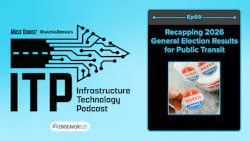 Episode 60 graphics.
Episode 60 of the Infrastructure Technology Podcast examines the results of the 2026 transit ballot measures and what they mean for the future of public transportation funding. Brandon Lewis, Jessica Parks and Noah Kolenda discuss a year in which 56 of 66 transit-related ballot measures passed, bringing approximately $31 billion in funding. The conversation takes a closer look at three examples: the Bay Area’s regional funding measure, Seattle’s Proposition 1 and Arlington County, Va.,’s transportation bond.
The hosts explore how these measures are helping agencies address operating deficits, maintain and expand service, support capital improvements and meet regional transportation needs. They also discuss why some ballot measures succeed while others fail, how taxes and bonds provide different approaches to funding transit and why agencies often begin planning well ahead of an election.
Here is a transcript from the episode:
BL: And welcome to the Infrastructure Technology Podcast. I am Brandon Lewis, the associate editor of Mass Transit magazine. No, I am not Gavin Jenkins, who today is dealing with, unfortunately, construction noise outside his building. So he will not be joining us today. But I do have, you can see with us on camera, I have Jessica Parks, the staff writer of Roads and Bridges, and Noah Kalenda, the other associate editor of Mass Transit magazine. Jess, Noah, how's it going today?
NK: Doing good, doing good. Thank you.
JP: It's going great. Gavin is suffering some of the consequences of our industry today dealing with construction noise, but I'm sure he has a smile on his face knowing that people are out working and the job is getting done, right?
BL: For sure. And let me tell you guys, the leaves are falling here on the East Coast of the country and the midwest. It is fall outside. The cups at Starbucks have turned red, and that means it's time to talk election and ballot measures, and that's why we have brought on Noah today. Of course, sometime this summer, Noah released for Mass Transit, the ballot measure tracker, which was an incredible amount of work, and he did such an amazing job, not only with the work on the ballot measure, but coming on the podcast and explaining the entire process. So if you guys want to go back and listen or watch that podcast, you can. But Noah, today we're actually going to talk about the results of what happened earlier this month.
NK: Yes. So we have finally concluded a year of transit ballot measures. We've had the general election a couple of weeks ago now once this is finally releasing and pretty much all of the results should be poured in by now and most official. But in this discussion, we are to put it in place discussing a week after the midterm elections so any vote totals we may discuss are subject to change as vote counts finish and everything like that, but all of the measures we're going to talk about have been officially called in some capacity. Their totals may not just be completely finalized, so I just wanted to start with that little note. But on Tuesday, we had 27 transit ballot measures on the ballot and 22 of those passed, and for the year, the total, we had 66 ballot measures for transit being voted on and 56 of those passed. So through this, about $31 billion of funding came in for transit through ballot measures this year, according to the American Public Transportation Association's Center for Transportation Excellence. So a huge amount of funding has come in for transit this year.
BL: For sure. And now let's start, and let's dive into a little bit of the couple of measures that I know you wanted to talk about.
NK: Absolutely. So to close a loop from our first podcast on this topic, I just want to say that the Charleston, South Carolina, measure has passed as we discussed. We just weren't going to talk about that one at length in the episode today, so I did just want to close that loop. But circling back to another measure we discussed in the previous episode, the Bay Area Regional Transportation Measure, this was the Connect Bay Area campaign as it was known pretty widely on social media and things like that, and this one passed. This was quite the momentous passage, I will say, because it was contingent on passing in five regions, so four counties and then the city of San Francisco, and so if it failed in one of those places, the measure just failed, but thankfully it passed across the entire district in which it was being voted on. And so this measure was aiming to prevent major financial crises from multiple transit agencies in the Bay Area who were facing physical cliffs that were charted out by the MTC and various other advocacy organizations and watchdog groups. And so overall, while the totals have tightened a little bit since election night, this received 57% of the vote for yes, last updated as of November 6th, and this measure typically in California would have needed a two-thirds majority to pass, but was able to pass with a simple majority due to a combination of having the state legislature kind of clear a path for the measure. And also because at the end of the day, this was a citizens initiated ballot measure. So the campaign had to go out and collect signatures and collected over 300,000 signatures to make sure that this got on the ballot.
JP: That's interesting. And I mean, overall, I do see that a lot of these measures are dealing with funding, of course. What led to the need for funding, if you kind of know? Is it an overall issue that a bunch of trans agencies are experiencing, which is what it seems it is, but why is that?
NK: Yeah, absolutely. So it's a combination of things. First and foremost, a lot of these measures are updating funding that has been in existence for decades in some cases. In other cases like this one here, there was a few competing factors at play, rising costs, ebbing and flowing global conditions and also just conditions within the agency that were lacking budget raises, I guess is the best way to put it. And so this was trying to fill state funding gaps. This was trying to cover rising costs and also to ensure that they could afford new technologies and commit to those zero-emission goals that were being made in the area and also just to sustain service. So without this measure being in place, the MTC showed 2027 deficits in the several million. So for AC Transit, they saw a $73 million potential deficit. For BART, it was going to be nearly 400 million. Caltrain was 65 million. SFMTA was 322 million. And so this measure looked to really fix a structural budget shortfall in the Bay Area. This wasn't just one agency facing a problem, this was a whole region in a bit of a transit funding crisis. And so this money now that they've implemented this, and I will say for context, it's a half-cent sales tax measure in the four counties and then a full cent sales tax in San Francisco city limits. And so that funding will help these agencies continue service, prevent them from losing track mile, prevent them from having to decrease frequencies, prevent them from having to close down lines and like I said earlier, help them fund some of their zero-emission targets, capital programs, stuff like that, future-proofing the agencies, as well as preventing them from falling over these fiscal cliffs.
JP: And it's interesting too, because in the Roads and Bridges industry, a lot of our projects are funded by the gas tax and stuff like that. That goes back into the roads and everything, and it hasn't been updated in years, the amount of tax, and then people aren't buying as much gas, so it's leaving major shortfalls, and I'm sure that's kind of the same thing on the transit side, it's just that these revenue streams have not been updated to meet current pricing.
NK: That's been a major focus this year, actually. One of the other ones that we're going to talk about today actually in part of its renewal doubled to make sure it could keep up with those costs, and that was something that we saw across the board. A lot of these measures, while they were fortifying funding in the general sense of making sure it continued to flow at all, they were also looking for increases to make sure that they could keep up with those rising costs and the new technologies that we're having to fund. Zero-emission buses cost significantly more than just your standard diesel or combustion buses do. And so having to fund those projects is part of the reason why a lot of these agencies are looking for more funding alongside these renewals.
BL: Well, and this is also too, another part of the Bay Area really coming together when it comes to transit. A lot of these same agencies in the last year have all synced their schedules, easier transfers, more service opportunities. Obviously we know how large of a state California is. A lot of these agencies did obviously up their service prep for the World Cup, which we talked about earlier this summer. And so keeping that frequency I think is a big part of this measure, as well as you talked about, Noah.
NK: Absolutely. And this measure too isn't just about funding, it also brings some regional governance into the picture to make sure that the transit agencies are able to use this and keep growing and not need to end up in a place where another measure like this has to save them from peril, so it's not just here's more money, it's here's more money and here's how we're going to help make sure that this doesn't happen again, so a very interesting measure. It really, it was quite the effort. Like I said, they collected over 300,000 signatures across a very vast region, and you're also contending with a lot of different types of voters here, too. You're contending with the transit reliant, but then also with regions that are very card dependent and may just not really think about transit in their daily life, so this one was very interesting because of the wide breadth they had to reach and all of the voters that they had to pull together to coalesce around this measure and so very interesting for sure.
JP: One of the things I wanted to ask is I understand that, okay, so there's San Francisco and then there's four counties around it that voted. And so their regional systems, do those kind of feed into the San Francisco system? Do you know what I'm saying? The bus service in, is it in Alameda, does that feed into San Francisco? Do they finish their stop in San Francisco, essentially when they're done riding the bus that day? Is that why these counties were in support of it?
NK: Yeah. So a lot of the transit out there is regionally connected. There are a lot of transfer opportunities, and if I remember correctly, I think they have either just completed or are in the process of doing some type of payment unification across some of these agencies too under the MTC. And so most definitely, yeah, this was a regional effort because of the interconnectedness and you in a way can't have one without the other. And so I think another part of it too, and this is kind of more speculatory, but without bringing all of the agencies under the umbrella, you might have lost some of those connections because some of the track mile was up for consideration if the budget scenarios had to go to that pullback idea, so I really think, yeah, this was a regional effort because of the interconnectedness of these systems. And again too, that's another piece of why the regional governance component was added in here as well, is because they work so closely together that they can kind of be governed together too. And so yes, to answer your question, very much so because of their interconnectedness.
JP: Definitely.
BL: All right. Shall we move on to the next measure then?
NK: Yes, absolutely. So the next one, we're headed a little bit north to Seattle for Proposition One. So this one was pretty interesting because like I mentioned earlier, this was one where alongside renewing the funding, the city council and city government opted to double this tax from 0.15 to 0.3 mils percent. I'm looking at my notes, I believe it was percent. But to raise this tax to ensure that they could continue their service that they're already conducting with this funding, but for also the opportunity to add an additional 275,000 bus trips a year to the city, almost 100,000 more than they already offer. So measures that are able to increase the funding aren't always looking to necessarily fund a massive capital project or something like that. They are also existing just to fortify existing services, like I said, bring more bus trips in, expand the hours and frequency of service. This measure is also committing more funding to allow for more orca passes for disabled and low-income riders to ensure that they're able to access the system at either a cost reduced or free access. And so this measure really, at the end of the day, brought in more funding to keep the lights on and make sure that the transit was still trending or the transit priorities were still trending in the direction of the city's ST3 proposal and various other transit priorities that are being made in the city. Okay, yes, a 0.3% sales tax. This one was extended for 10 years, and it's estimated to raise $138 million a year, with 86% of the funding going to transit service, and this replaces a tax that was implemented in 2020, which expired next year. And like I said, it's coming in at double the rate, and this was a very procedural measure to go on the ballot. This was referred by the mayor, adjusted and ran through subcommittees and city council. It was approved 9-0 in the city council and went to the ballot where it passed pretty easily. And this too funds King County Metro buses under the agreement with the city of Seattle, and it uses its transit tax to pay Metro for the extra trips inside the city limits, so it's funding their transit projects, but also more service, so it's a wide measure that covers a lot of good things for transit. Sorry, that was very intensive explanation.
JP: No, it was great. And just a fun fact is that Seattle's Metro Gold Line bus lanes won our top 10 roads of 2025. I don't remember what number it was on, but it was in that top 10, so they are putting a lot of that, a lot of funding and time into expediting, well, making their bus service more efficient. So I'm sure that that was kind of easy to pass because people can see the benefits right there. I mean, you get a straight shot through Seattle faster than you ever could have on wheels, so I think that's interesting that it passed it pretty seamlessly.
NK: Yeah. And Seattle's just a very transit focused city. They've had a lot of recent project completions. They're doing a lot of innovation with the Link Light Rail Bridge, and they have a very transit-oriented mayor now, and Seattle is really going in with the transit stuff. It's very exciting time to be a transit fan in Seattle.
BL: No, I was going to say that too. Seattle's been through a couple of mayor changes too in the last few years, and both mayors are very transit friendly. I've joked on this podcast before that if you want to live somewhere where you don't need a car, it's probably Chicago, New York and Seattle, at least in the U.S. They are putting in so much investments, and again, it's not just buses. To your point though, it's all the Link light-rail extensions. We're seeing King County Metro come out with the Metro Flex, the Rapid Ride BRTs. You have other agencies in the area like Community Transit and the city of Everett that's now going to merge and come into one as well to provide better transit for the people out there in the city of Everett. It is a true advancement of they want to make sure that wherever you need to go within the region, there is some sort of transit for you to get there quickly and efficiently, I think is the most important aspect of that.
NK: Absolutely agree there, for sure. And too, to your point, the mayor of Seattle called this the largest expansion of transit service in the city's history, and while I haven't independently verified that, it is a very big step for the city to double this revenue stream, to bring in all of the additional trips, to be able to fund part of the work in ST3, to be able to send extra funding to Seattle Streetcar, to offer more ORCA passes and passes to the Seattle Housing Authority residents. There are just so many good things that are rolled up into this measure for transit. It was a very interesting one to watch, and it passed, I'm looking for the totals here, but it passed pretty easily if I remember correctly. Yeah, 72.5% as of election night, and while that is, like I said, election night and vote totals are subject to change, this one had it pretty handily right away.
BL: And I want to clarify just for maybe the Roads and Bridges audience real quick, because Noah, you've mentioned ST3 a couple of times. That stands for Sound Transit 3, and it was basically a voter-approved funding measure. It's been a decade now, I believe it was 2016, that's helped fund a lot of these projects that we have just been recently talking about.
JP: I did not know that. Thank you.
NK: Yeah, that was one thing too, was to contend with there were so many transit measures that have already taken place here and have so many projects that have been voted on by the citizens that keeping it all straight was a little tough, but it was really interesting to see how involved citizens are in transit in this city and how, yes, they are voting on just a measure in this case, but the Sound Transit 3, I don't know of many other places where you get such a detailed plan that voters get to weigh in on like that. So very interesting transit city for sure.
BL: And I think part of it is I have heard from, I know one or two people in my life that have lived in Seattle, and they just said traffic there is horrendous.
JP: I will tell you one little funny thing is that I had a friend that would ride the bus in Seattle to Olympia a lot, I think, and you take the bus, this was back in 2010 or so, and he would have the most interesting stories to tell from the bus line. He created an Instagram page to share all of his Seattle bus stories. It's not running anymore, but it's also an interesting, entertaining bus line from my understanding.
NK: So any final thoughts on Seattle before we head out east?
BL: I think the West Coast, we are pretty covered. They're doing a lot of good things out on the West Coast. What are they doing out there on the old East Coast?
NK: Sounds good. Well, in Arlington County, Virginia, the Metro, or I guess WMATA, transportation bond passed. So this one passed with 81.5% of the vote, and voters approved in this election all five of the county bond questions which were available to them in Virginia. Just thought that was a really interesting fact, which totaled $264 million in additional funding for the city. However, this measure specifically was not a new tax. This one was a general obligation bond, which means this is borrowing against future revenue, so the county will repay the bond from its general fund. And this vote, the reason I wanted to talk about it is because this one shows that these measures don't always just swoop in to save transit agencies. The bigger story to me is that this bond doesn't solve Arlington's WMATA obligations. It's just a kind of measure to give them breathing room to figure out that funding while being able to still make the commitments that they have. And so this will provide up to $70 million in general obligation bonds for capital projects for the Washington Metropolitan Area Transit Authority and other transit pedestrian road and transportation projects in Virginia. So about 46 million of this is going to WMATA, 25 million for paving and smaller amounts for transportation maintenance and stuff like that, and this was another one of those government initiated measures. So the county manager proposed it as part of the fiscal year, excuse me, 2027 to 2036 capital improvement plan, and the county board adopted a $4.9 billion county improvement plan in July, hence the need for the funding. And this is also not something that's necessarily new for Arlington. They put transit bonds on the ballot regularly about every two years, and in 2024, it approved $72 million with 79% support, so this is not new for the area nor is something that they have historically struggled to pass. Residents seem down to fund the transit infrastructure by these bonds.
JP: One of the questions I want to ask is the other measures are kind of raising sales tax and this one is to approve bonds, so what does that distinction, is there a distinction there on how that money can be used as opposed to using sales tax to fund projects?
NK: So from my understanding, it's more that you just have to have a plan in advance. You can't just say, ‘Hey, we want $70 million in bond money. End of sentence’. I think it's, ‘We want $70 million in bond money, so we can fund X, Y and Z’, and that seems to be what was at play here because instead of front loading the money with a new sales tax and saying, "All right, this sales tax money is specifically going for this thing, this thing and this thing, and we aren't going to have to backfill that in any way.’ That's how a lot of these measures are going right now, whereas this one is kind of borrowing against the future, essentially. It's like taking out a loan in a way to be able to cover these obligations because they, like I said, have a $46 million obligation for various WMATA projects. And so this is kind of their way to get that money upfront as opposed to having to split it out over years or to collect a new tax when they may be able to have all of the money available in five years or two years or what have you, but just not in a single fiscal year.
JP: Yep, definitely.
BL: So this is actually one of those places that I have been to, believe it or not. I ended up, when I was in D.C. last December, I took WMATA out to Arlington to go have breakfast out there. Beautiful place, I will say. Arlington, Virginia. The scenery is incredible, though very hilly, surprisingly, once you get out there. But yeah, I mean, this is another transit measure that I think shows the ability for transit agencies to come together, and I think DC is unique, and WMATA is unique in the fact that, like you said, Noah, not only does it cover the D.C. region, but it's also covering Virginia, which is technically two different states or districts, if you will.
NK: Yeah. And that's the other thing I find really interesting about this is because of the unique geography and the unique setup of Washington, D.C., it's really interesting when you get off of a WMATA subway stop in Arlington, for instance, and you're like, ‘Oh, this looks like a regular old D.C. subway stop, and I'm actually in Virginia’. That continuity of service is really something that I don't feel like you can get really anywhere else exactly, feeling like you're plugging into different states from the exact same system. And so that's a really cool thing here, too, and I really appreciate that they're so willing to take this up because it's not necessarily in their state borders. And to continue to have access to the system and to continue to be able to provide transportation into D.C. for its residents are taking this up and so aggressively too. They're on top of this. Like I said, they run bonds every two years pretty much. They historically pass very well.This is something that residents are very passionate about, and that is really great to see, like I said, because it is not a system that the bulk of which is in their city or in their state even. And so it's a really heartwarming thing to see.
JP: Definitely. And I think, yeah, Arlington is essentially greater D.C., so it's like everybody's going into work from there. D.C.'s impossible to park. I mean, it has real benefits of funding this and keeping it going is the way it is and just working in a seamless way between Arlington, D.C., does it continue into Maryland?
NK: I think the system does, but I'm not sure how much. Whenever I was using it and heading out of, I was always going towards Virginia and George Mason University and stuff like that. And so I don't think I trended towards that side of the system very much, but I think it does.
JP: The dark side of the system. No, I don't want this kid.
BL: I would imagine. I think there's transfers to the Maryland Transit Administration.
NK: Yeah, you're right. Now that I'm thinking through it more. And so for this one too, it wasn't necessarily the craziest high stakes either. The stakes in the near term were rather low. Rejecting a bond wouldn't necessarily stop projects, but the county would just have to locate another mean of funding them, and there was slight opposition, but there wasn't anything I could find specifically for this measure and why there was opposition. Groups were just opposing all five measures on the ballot. And they also did want to get it done in 2026 because from what I could find, an odd year vote of this kind would just break tradition. Arlington usually holds these votes in even number years when turnout is higher for a midterm or a presidential general, and low turnout, from what I could read, would likely help opponents, so they typically try and send these to the ballots in even numbered years. But yeah, otherwise, Arlington, it was a pretty straightforward one. They really just got a bond through to make sure that they could keep paying their share of WMATA expenses and various other $25 million of various other or 35 million of various other state transportation and road paving needs. So yeah, keeping the lights on basically.
BL: I just want to touch a little bit, I think, for the Roads and Bridges audience about opposition, because we talked very early on at the start of the show about how typically in transit, what is it now? I think 87% or something like that of measures pass. And just for, I guess the audience is a little bit unfamiliar with why something wouldn't pass, it's not that people don't understand the value of a road paving or public transit. From my understanding, It's more of the cost would be the main reason why someone would oppose a new line or a new measure.
JP: Yeah. And I think it's interesting too, because with the Seattle measure, that is going to equate to cost for low-income families where it affects them the most. But however, they are seeing that benefit of those ORCA passes. They are seeing the benefit of that hopefully, so I think it kind of counteracts a little bit of that hardship put on them is that they might see reduced bus fares or free bus fares.
NK: Yeah. And something I will add too, we talked about this in the previous episode on ballot measures. Not all of these measures have to do with funding too at the end of the day. Some of them are deciding whether or not they want to stay in their system. There was another vote like that in the general election even. And so when you're looking at those totals, a no vote may not mean that an area didn't get more transit funding. It may simply mean that a region decided to stay a part of its current transit network and not make changes. And so that is a part of this, too. We had a couple of regions or municipalities reject leaving the DART system early this year, and that's part of the past totals. And so it doesn't always necessarily come down exactly to transit funding. And I would like to add, in the areas that it doesn't pass, a lot of the time the sentiment is that a majority of people that would be paying these taxes, because a lot of the times they are property taxes, don't feel that they would see the return on investment that they're paying because service may not come out to where they live or it may not be very frequent near where they live or their only option may be something on demand that's a lot more rigidly scheduled than a bus route that they can just walk up to that's going to show up every 15 minutes, and that is also part of the impact as well when some of these no votes do roll in.
BL: And part of that has to do with county lines, right? Because in certain areas where maybe you are technically a part of the county, but because it's in a rural area or somewhere where there's not a lot of transit access, maybe a certain training system doesn't go to that specific part of the county as well.
NK: Yeah. And a lot of these regions too are kind of strangely split up. And so if one of these municipalities decides, for instance, to leave an agency or to leave a network, that network may still go through that county to complete its route because there are other counties neighboring it or bordering it that still stay at the surface. And so it's a very interesting map to look at when you're considering the transit service breadth and how different voters may be impacted in the exact same system.
JP: So one of my questions is do you see these measures as stop gap measures and are they going to need to be renewed essentially in a certain period of time? What happens when the funding is up? Will these leave them in a better place when they need to find new funding again or in the future or do you think it's kind of just a temporary bandaid, we're just going to be in the same place in X amount of years?
NK: So it definitely differs from place to place, that is for sure. A lot of these measures are written pretty differently. Some are giving funding or setting these taxes for 30-year runs and so it's not something they're going to have to worry about again until the literal 2050s. But then in other places, like in the Seattle measure we discussed, they passed that in 2020, and it was set to expire next year in 2027. And so the timelines for these measures can ebb and flow a lot, too. And most of the time the goal is to just renew or continue the tax measure as that is just one of their funding streams that they plan to have indefinitely. It isn't necessarily just a stop gap measure, it's a structural component of the agency. And further too, with the Seattle one, it would have expired next year, I believe at the end of next year. And so if it didn't pass in the general election, they would have a little bit of time to go back to the drawing board as a city council, see what needs to adjust, say, ‘Okay, do we need to revert to just our original 0.15% tax or could we eke by with a 0.2% tax or do we take out the extra bus service or do we not fund ST3 or what have you and then bring it back to the voters’. Typically, they tend to pad this out so that there are six or eight possible elections between when they initially start trying to get a measure passed or on the ballot and when the funding would actually expire. And not even necessarily six or eight general/primaries. In a lot of states you can call special elections for minimal reasons. And so they may be able to call one for transit funding, but they typically, like I said with other measures, like to have more turnout from primaries, from generals, from midterms, from presidentials instead of just a special election turnout where only the most keyed in voters are going to show up for something like that, and where it would be easier for somebody who is in opposition to say, ‘Look, this is a special election. We know that there's not going to be high turnout. Let's rally.’ And so they typically try to avoid special elections and they typically try to avoid waiting until the very last minute, especially in cases where they're looking for a raise. They tend to start those earlier because they have a bigger fear that those could fail.
JP: And then my last question for you is for the San Francisco one, the Bay Area one, I think it's for the next 14 years, you'll see the one cent and half cent tax. So when that 14 years is up, do you see technology being a play in maybe eventually reducing costs like, ‘Oh, okay, this one cent will fund these technological advancements that will help us reduce costs here’. That's kind of how I see it is making these investments now to modernizing the network could have dollar savings in the future. Do you see that transit agencies putting any focus on that, I guess?
NK: I think so, especially too, once you consider a lot of these zero-emission goals and zero-emission targets and then bring in the context that a lot of these agencies alongside making sure that they have the charging infrastructure to charge the buses and what have you, are also creating microgrid solutions and are adding solar arrays to their buildings to make sure that they can produce a lot of this energy. And so in my head, yes, because they're able to use this funding to say stand up that solar array and stand up a battery backup or a battery reserve so they can store all of that energy they're pulling in. And then yeah, in 15 years they may have much lower costs because they're not having to buy fuel. They're not having to replace as many consumable maintenance items on a bus because electric buses just require inherently less maintenance. And so as a lot of those things get rolling and really exit the pilot stage and just become the way of life at a transit agency, I can very much see some of that funding pulling back. And in the same vein too, some of these measures do include sunset clauses. And so if nothing is acted or if nothing's done to extend them or replace them or what have you, they will just go away. And two, we were talking about in the Arlington one, while it's not a sales tax measure, it kind of illuminates what a lot of agencies are trying to do with this funding, and that is really just buy themselves more time to figure out other revenue streams or to figure out cost saving measures or to get more structural funding at the state level or any number of ways to create more funding that they're using that time bought with these measures to find, to seek out. And a lot of the times too, it's not just, ‘Okay, the state gave us more funding. It's the state gave us more funding or fortified our funding’, but also said, ‘Look, you need some type of regional governance or some type of oversight to ensure that this doesn't happen again, or if you are trending this way that we can catch the problem way sooner and stop it before it becomes catastrophic’. And so this one wasn't necessarily tied to a citizen or a ballot measure per se, but if you look at how transit is trending in Chicago, that's now being managed under a new regional governance structure, the Northern Illinois Transportation Authority, which is kind of rolling up a lot of the very top end governance of the regional transit agencies there to ensure that they don't get into a similar funding and governance bind that they found themselves in before this new structure came into play, and that's a lot of the time what they're looking to do with the time they're buying with these measures is get more funding and create policies and structures so that they don't get into this bad way again.
BL: The other aspect on funding real quick, and again, just for clarification for the Roads and Bridges audience, so a lot of these agencies do have budgets that are yearly based, January through December, but a lot of these agencies also have what they call fiscal year budgets, and those are oftentimes they start in July, so they go from July the previous year to July of the next year. Sometimes they start in October. So those fiscal budgets, which could be for operating or capital budgets, which can fund various different projects, they sometimes are not on a year to year timeline basis. They're more on whatever timeline and year the agency starts its year, if that makes sense.
NK: Yeah. And a lot of these plans too aren't just a single year. We were talking in the Arlington one about how that capital improvement plan is going to cover five years. And so you're shoring up funding for the next year, but also for the longer term future too, to ensure that you can cover the major plan that you've bought up. So very interesting how all of these puzzle pieces fit together for sure.
JP: Definitely. And I love talking about the ballot measures with you because I feel like from ballot measures, we're able to branch out to discuss so many different facets of the industry and just the overarching themes of transit today, so I love these conversations with you.
NK: Yeah, they're very interesting, and it's a really fun thing to watch in the elections because nothing really, to my knowledge, passes at a rate quite like transit. I don't know of any other style of ballot initiative that passes at a rate of over 80%. Pretty much every year you look at the numbers, so that's just amazing.
BL: So speaking of that, as we get ready to wrap up today's show, I want to give Noah a shout out real quick. This man came onto Mass Transit a little bit over a year ago, and not only has he raised our editorial standards at Mass Transit, but I have never seen someone so dedicated to numbers and election coverage as Noah Kolenda. Noah on election night, he told me he had, what did you have, a speaker in your apartment?
NK: Oh, it was bad. It was bad.
BL: You had earbuds in, you had two phones, you had the TV on. This man lives and breathes for election coverage. So Steve Kornacki in about 20 years, I know he's coming for your job.
NK: Yeah, he would've been proud, that's for sure. I had coverage on my TV. I had two phones going. I had an AirPod in too, so I could listen to coverage from two different networks. I had two different maps up on my computer. I was going crazy. Election night, it was truly a scene in my public apartment.
BL: It is his Super Bowl.
NK: Yes, it is.
BL: All right. Well, I want to thank Karina Mazakina, the lovely Karina, who of course makes us sound so great on audio and video. I want to thank you, the listeners. If you have any questions about any of these ballot measures, you can email us at [email protected]. Next week on the show, not only do I have an interview with Jake Bebee and Tom Pharbs, they're going to discuss technology that's being used right now in Hawaii that deals with roadway hazards and how it impacts both of our industries. But on next week's show, we also do have a special announcement. Gavin has been teasing that we have been in the chamber in 2027, thinking of all the great ideas that we're going to bring you guys, and we have a special announcement to bring to the show next week. But Noah, Jess, anything else that you guys want to add?
JP: I'm excited for next week's episode because we're going tropical on the ITP heading down from the... I think it's our first time venturing from the mainland on our podcast.
NK: That sounds so fun. Can't wait to listen to it.
BL: Well, for Brandon Lewis.
JP: For Roads and Bridges, I'm Jessica Parks.
NK: And for Mass Transit, I'm Noah Kolenda.
BL: Thank you guys. Have a great week. We'll be back next week on the ITP and goodbye.
About the Author
 Brandon Lewis
Associate Editor
Brandon Lewis is a recent graduate of Kent State University with a bachelor’s degree in journalism. Lewis is a former freelance editorial assistant at Vehicle Service Pros in Endeavor Business Media’s Vehicle Repair Group. Lewis brings his knowledge of web managing, copyediting and SEO practices to Mass Transit magazine as an associate editor. He is also a co-host of the Infrastructure Technology Podcast.