Infrastructure Technology Podcast: Technology trends in the industry in 2026
Key takeaways
- Predictions for 2026: Brandon, Gavin and Jessica kick off Season 3 with their technology predictions for their brands in 2026, ranging from improvements in artificial intelligence (AI) to school-zone safety.
- Federal funding uncertainty looms large over future infrastructure projects: A major discussion point centers on the anticipated expiration of the Infrastructure Investment and Jobs Act in September 2026. The hosts predict significant political challenges to reauthorization, which could disrupt long-term planning, slow project pipelines and exacerbate cost pressures across transit and infrastructure sectors.
- Transit agencies are reframing technology around the customer experience: Brandon interviews HNTB’s Joanna Pinkerton and former Dallas Area Rapid Transit (DART) Chief Development Officer Dee Leggett, who emphasize how agencies are using data, AI analytics and customer journey mapping to better understand rider behavior, improve safety, enhance communication and deliver more seamless, reliable experiences—regardless of which agency operates a given mode.
- Accessibility in the nation’s capitol: The episode concludes with Brandon Lewis discussing his trip to Washington, D.C., over the holidays and what he called an ‘eye-opening experience.’
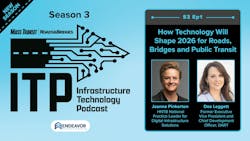




The Season 3 premiere of the ITP kicks off with a forward-looking conversation on where transportation and infrastructure technology are headed next. Gavin, Brandon and Jessica share predictions on AI adoption, smart roads, real-time traffic management and the uncertain future of federal infrastructure funding. The episode also features an interview with leaders from HNTB and DART, exploring how transit agencies are leveraging data and AI to improve safety, operations and the rider experience.
Episode length: 1:01:53
About the guests
Joanna M. Pinkerton is HNTB’s national practice leader for digital infrastructure solutions, where she is advancing programs focused on digital transformation of public infrastructure, including infrastructure, integration of AI, the use of advanced analytics and how technology can be deployed to serve communities more efficiently. She has previously served as president and CEO of the Central Ohio Transit Authority.

Dee Leggett is the former executive vice president and chief development officer at DART. She is a nationally recognized transit leader with over 20 years of experience in the planning, development and operation of public transportation projects across the country. At DART, Dee directed and oversaw the development department of DART, which includes Capital Planning, Service Planning & Scheduling, Engineering & Technical Services, Real Estate & Economic Development, Capital Design & Construction and Development Program Support.

Here is a transcript from the episode:
GJ: And welcome to the Infrastructure Technology Podcast. I'm Gavin Jenkins, and with me as always, we have Brandon Lewis, Jessica Parks. We are the ITP team, Mass Transit, Roads and Bridges, all under the umbrella of one Endeavor, B2B, and we are coming to you with Season 3. Brandon, what do you think?
BL: How are we doing, guys? It's 2026. I can't believe we're at Season 3. Gavin, me and you have been doing this for over a year now. Jessica came on right at the end of Season 2, and I'm very excited for what Season 3 is going to bring here in the new year.
GJ: Jessica, how you feeling?
J. Parks: Yes, I'm feeling great. I had a great start to the new year, and I'm really excited for all the things we have stored for you in 2026 for Season 3.
GJ: It is 2026, and I got to tell you, look guys, I'm 45, and it is just so weird to me to be, I never thought I'd see 2026, not that I had a death wish or anything weird like that. It's just that whenever it was, 1996, I never thought to myself, ‘I wonder what 2026 will be like’. Never thought of it. Didn't have that kind of vision. I didn't have a crystal ball. But let's look at the year ahead. Let's pretend as if we are sight seers, and we can see into the future. I'm just curious. We'll start with you, Brandon. What do you see? Do you have any predictions for the new year?
BL: So I do, Gavin and Jessica, and I don't think it's going to be this crazy like, ‘Oh my God, AI is going to take over completely the public transit industry’ because as you'll hear in my interview later today, transit agencies are still trying to figure out what to do with AI and how to implement it in their systems, so I do think we're going to see it be more implemented in infrastructure projects. We've talked about bus lanes, rail tracks on this show before. I think the biggest impact will be on the mobility game, the autonomous vehicles helping with routing, whether it's bus or railroads, getting more real time information. I think AI is going to really help with that, and I think developing those tools to get people where they need to go more accurately and faster, but I don't think it's going to be this game changer where it's going to be implemented in every single project that pops up this year.
GJ: Interesting. I think the mobility aspect is fascinating, and yeah, I mean, obviously we can’t just sit here and just be like ‘AI, AI, AI’, but it's a little bit more nuanced than that. Jessica, what do you think? What predictions do you have?
J. Parks: One of my predictions was I believe that we're going to see kind of more non-static traffic infrastructure as just data informing decisions in real time. We've already seen, I just wrote about yesterday, variable speed limits where in real time DOT’s can reduce the speed limit in the event of a poor weather conditions or construction. We also see variable toll pricing that alleviates traffic in those areas by raising the prices to deter people from going in there and actually keeping that traffic, keeping the traffic flow there, so I think we'll see that more utilized throughout the year in different ways. I'm not exactly sure which ways, but I do predict more real realtime traffic decisions in that being seen.
GJ: Yeah, I absolutely agree. I mean, already we're seeing that that technology is becoming better. If you go onto Waze or Google Maps, they'll tell you when there's a backup, and it is getting to a point where the cars will just tell you. They’re just getting so much smarter. My predictions, I have a few. Let's start with politics. We don't get too political on this program. This isn't Pod Save America or the Joe Rogan Experience, but let's just talk about politics in terms of the IIJA, the Infrastructure Investment and Jobs Act, it comes to a conclusion on September 30th, 2026. Now there are some who want to see it reauthorized, and I would be one of those people. I think that it needs to be reauthorized. We've only scratched the surface on the bridges that need to be fixed in this country. We've only scratched the surface on the roads that need fixed, the highways that need expanded. We've only scratched the surface on making our internet, our spreading WiFi, putting up more towers in rural areas. We need all of that. But however, my prediction is it won't get reauthorized, and what will happen is our president will try to turn it into a negotiation, and that will turn into chaos. It will run out, and we will not get a reauthorization and then we'll start having those Infrastructure Week things again where nothing gets done. That is my prediction. It's a sad prediction, but I think that the bipartisan infrastructure law was pushed through at a time where they were able to get some Republicans to get on board, and I don't see that happening again, and I think that Democrats now won't get on board with Republicans because they'll want to completely disregard environmental concerns. They'll want to disregard expanding EVs and all the red tape that Democrats love to put in will get disregarded, and they won't be able to get an agreement, so that's my first prediction for 2026. Responses before I go on.
BL: I'll just say I agree, and I'll leave it at that.
GJ: Alright, Jessica, do you agree?
J. Parks: I agree, and I'm interested to kind of see how this affects projects that are already taking place in the release of federal funding. I know that a lot of projects are going to seem to be skyrocketing in price, and with the lack of federal funding, it's going to have serious implications across the industry.
GJ: Yeah, well I imagine that the money that's already been earmarked from the IIJA, we will continue to go through the pipeline beyond September 30th. Okay, so that's my first prediction. My second prediction is that the connected the connectability smart roads, I think that's going to be a rise. I think you're going to especially see that there's been project pilot programs in Indiana and other states, but Indiana was really leading the way. I think you're going to see that in school zones. You're going to see smart roads popping up in school zones, and there's going to be a real push to have cars that are automatically just slowed down in school zones whether you like it or not, so if you have a newer car, it just automatically drops to 15 miles per hour in a school zone, and I think that's going to start becoming the norm in 2026. I said I have a few, but those are the only two I have. I have two.
BL: I think it could become the norm, by the end of 2026. I think most of our predictions, like I said, I think 2025 was sort of the, ‘Hey, AI is here’ stage. I think 2026 is sort of the evolution of that and then I think we're going to really start seeing the impact of it in 2027 is sort of my prediction.
GJ: The thing with AI, if we can dig into that, is it moves so fast and is moving fast. I mean, it is even moving faster than we even know what's going on behind closed doors at Meta or X or DARPA, especially DARPA, which is the Defense Departments. It's moving so fast, we have no idea, so I mean we could have humanoid construction workers by the end of 26, who knows. It moves that fast.
J. Parks: I have a question for you. So you know how you said you believe that the speeds will automatically be reduced in school zones. What do you think about just city driving in general in New York City? The speed limit’s 20. As a driver, I think it's very hard to drive at 20 miles per hour so do you think that would be expanded into just city driving as a whole? Reduce speed limits?
GJ: I think that if certain people had their way that downtown city driving would just be really reduced. What you'd have is only deliveries, essential deliveries into downtown areas and bicycles, and there would be, you'd get taxed for going into cities, and I know that's actually been a really successful program in New York where if you went into certain parts you got billed. I think that we will see more of that in 2026 where, I mean, if you're in a car, and if you're anywhere near a city city, there's cameras on you, so I think that sooner or later they're just going to be, ‘Oh, did you just cross that bridge? You've just been charged $5, you've just been charged $10’.
J. Parks: $5 in New York City? It's going to be like $30.
GJ: Right, but that kind of billing is going to happen because they're just going to read your license plates. That kind of technology is already here, and I would imagine more cities, more urban downtown areas really start doing that.
BL: Which is why it's important to use public transit.
GJ: Yeah, absolutely. Alright, well that was fun. That was some cool predictions. Brandon, tell us, who do we have on the show today?
BL: So we have two guests today. We have Joanna from HNTB, we've talked about that company on the podcast before. She is advancing programs focused on digital transformation of public infrastructure, which includes the integration of AI and then we also have Dee from DART, she's the executive vice president and chief development officer at DART, and we talk about sort of their predictions in 2026 about AI and how DART and HNTB are working together, and DART, as I already mentioned, is trying to figure out how to best use AI to better the customer experience, and that's what we talk about today.
GJ: I think that the listeners are going to hear a different voice when Brandon comes on. Your voice now sounds rough. You were sick recently, and I think it's clear in your voice. And then whenever we play the interview, it's going to be a much different voice.
BL: Yeah, there's a reason for that, and we'll talk about that on the other side.
GJ: Alright, well let's take it away. Here's Brandon's interview. We'll see you on the other side.
BL: We wanted to let you know that this interview was recorded in late 2025 and Dee Legett is no longer with the Dallas area Rapid Transit. Thank you and enjoy the debut episode of the ITP.
BL: Joanna, welcome to the Infrastructure Technology Podcast.
J. Pinkerton: Thanks, Brandon. It's nice to be here with you today.
BL: Dee, also welcome to the Infrastructure Technology Podcast.
DL: Thanks. Excited for the conversation.
BL: Yes, I am as well. So as I mentioned already in the intro, Joanna Pinkerton is a national practice consultant at HNTB and Dee Legett is the executive vice president and chief development officer at Dallas Area Rapid Transit, also known as DART. And today we're going to be talking about how modern technology is being involved in transit agencies and how this technology can really help transit agencies use data to get better information. So the first question I have for you guys today is how does modern technology help transit agencies gather data in real time and then what kind of data are they gathering?
J. Pinkerton: That's a really big question. Dee, do you want to take that one first?
DL: Yeah, I think it is a big question, and it's one that agencies of all sizes struggle with because what we're facing now is modern technology means we have tons of data at our fingertips. Everything we do right now is collecting data. Vehicles are collecting information on vehicle health. We've got cellular data tracking how people move across our systems, so it's not about having the lack of data. The biggest challenge is for agencies like DART is figuring out what do we do with that information. How do we synthesize that information across various platforms to make meaningful, actionable insights into how do we improve the customer experience, how do we invest in modernization and state of good repair in a smarter way? And then how do we leverage that data to operate more efficiently? Joanna, I don't know if you have anything you want to add.
J. Pinkerton: I think you summed that up really well, Dee. Brandon, the question is so broad and when Dee started listing off all of these different systems: vehicles, cameras, passenger counters, smart, fair bucks, there's the generation of data. We're at a place now where that's just a standard operating procedure for any transit agency, and like Dee mentioned, it's really how do you understand what data you have, what do you do with that data she mentioned? How do you synthesize it? So then, how do you begin working with it, so you can inform your decisions and actually begin taking all of these legacy systems because every transit agency has them, and how do you map out what you have and start figuring out how to translate that data into a useful operation where you can be more efficient with the new knowledge that you've gleaned from that data?
BL: For sure, and I think something that is completely changing how we think about data and how we think of technology in general is this little thing we've been talking about called artificial intelligence, also known as AI. I think, as I have said multiple times on the ITP, I have compared AI to 22nd century technology that is already here. I think that it's something that in 2025 I never expected to be talking about at this great length, and transit agencies and firms have already started working together and implementing them in some spots. So in general, maybe Dee, this is more of a question I guess for you and DART, but how and if the transit agency is using AI?
DL: Yeah, who knew two little letters like AI could be such a game changer for the industry and also so overwhelming. I mean AI is a powerful tool, but it is also is scary and intimidating for public sector agencies. So first, we've got to figure out what is our governance approach to AI to balance innovation, but then also make sure we're protecting privacy and security concerns for the organization as well. A couple of places where we're starting to kind of dip into AI is more on the trespasser detection side of our right of way on the Silver line, which is the new commuter rail project that will connect our suburban cities into DFW International Airport. We've got a lot of tight right of way sections that interface with both roadways and adjacent neighborhoods and so we've got some trespasser concerns, but we don't have full visibility because of sound walls and developments along that right of way, so we've installed AI enabled cameras and LIDAR along the right of way to detect activity in that right of way and then diagnose that activity through artificial intelligence of is it normal activity that would occur at a crossing or is it abnormal activity that warrants some type of response? Maybe it is a law enforcement response. Maybe it's an operational response such as slowing of the train or sounding the horn. So for us, that is an easy way to enter into the AI universe to provide safety and security of our system without necessarily risking privacy concerns such as AI enabled facial recognition cameras. We are looking at how can we use cameras to provide additional security on our buses, trains, and platforms, but we think we need to get a policy structure in place before we fully embrace that technology. I think another way that we are leveraging AI is back to data analytics. You got an abundance of data. How do you analyze that data quicker to draw conclusions? We just partnered with HNTB to do a customer journey mapping exercise, so we collected tons of feedback from customers. We made tons of observations of pain points on a customer journey, whether it's at a bus stop or at a rail station or crossing a street to get to a bus stop or a rail station, and we've put that into a power AI tool to start drawing some connections and help drive some decisions quicker than would've normally been if humans had to interface with that level of data at the beginning.
BL: Joanna, do you have anything else that you would like to add about that project specifically?
J. Pinkerton: Well, that project specifically, I'm glad that Dee brought it up about the data analytics that were involved and as a result of this customer mapping, so I'd like to take you back to what's the priority for any transit agency? So DART is really focused on customers safety, opening a new line, they're really looking at their system. So when you pick a topic, and in this case, it was the customer mapping, what kind of experience are they having? I remember Dee saying something along the lines of the rider doesn't really care what logo is on the side of the vehicle, they just want a good safe journey that they can rely on, and so in the process of going through collecting that type of information results in a lot of data, so then you have to analyze it and say, ‘What are the trends? What is it telling us?’ And then how do you report that information to the planners and executive management who have certain goals for their transit agency? And I think it's a really important concept that Dee brings up with the analytics side, and you started by asking about artificial intelligence, Brandon. It's all related, and I think you heard Dee mention governance so the reason it might be a little scary for anyone, for a private company, for a public agency, is it's a new tool. It's accelerating our capabilities, but you really have to have your data aligned. You have to have a governance structure that allows your employees to know what are the boundaries? What service am I working in around this? What are my limitations? In certain states, you may have laws or rules that actually govern this. And then go a step further to say, ‘What data do we have? Do we have a data management strategy? Do we have a data management plan’? And then have we developed the AI governance model for our employees to use? And so I think Dee mentioned to me when we first met, you're dipping your toes in the water there. You have certain projects where you're going all in on data but overarching as an enterprise across the whole agency, you're like, ‘Okay, we're going to start on this governance and make sure we're doing this uniformly across the agency’, and we're seeing that a lot, not just in transit, aviation DOT’s, toll authorities, ports, everybody's getting on board and trying to understand how AI can help them operate more efficiently.
BL: And I think to both of your guys' point, we can get data from pretty much anywhere, and I think sometimes we all get excited. It's like, ‘Oh my God, here's all this data’, but it's how do we use the data in the most effective way? And one of those ways is, as Dee, you mentioned, and Joanna as well is the rider experience. There's so much data out there, but to a rider, all they see is a bus, all they see is a train. They don't know the behind the scenes of what goes into actually making a successful transit agency. But a lot of agencies, especially since the pandemic, have really started, in my opinion at least, to value, I'm not going to say more, but I guess put more of an emphasis on that rider experience. As we know, COVID changed everything about the industry, so how are agencies using the technology that's currently at our disposal to help the rider experience?
DL: Yeah, I think for DART, I mean we just adopted last year our Strategic Plan and part of that Strategic Plan focuses on the rider experience. It is very much focused about providing quality service through seamless connections. And so if you think about the fact that North Texas has multiple transit agencies, we are one of the largest regions of the United States, both in terms of population and geography, so we have to really be intentional about providing seamless customer journeys to maximize that rider experience. Back to it doesn't matter whose logo is on the bus or train, it matters that we're getting an individual from point A to point B and so how do we leverage data to understand how people are traveling across North Texas? You've got cellular data that shows how people move. You've got vehicle miles travel data to show how people move across a roadway networks. We have passenger count data that shows how people move. And then you also have your fair collection. You've got your tap cards. You have a regional Go pass system, so there's a lot of data that tells us how our customers navigate the transit system and also navigate other modes as well, and so then it's important to us as a transit agency and then our council of governments and our cities and our DOT partners to be intentional about then what we do with that data to do short, mid-term and long-range planning to make sure not only are we addressing today's needs, but we're addressing future needs and figuring out where additional investments need to be made, whether it's and in what mode those investments should be prioritized.
J. Pinkerton: Yeah, Dee mentioned a really important part of transit, which is people use multiple modes. Like you used a mode to begin your transit journey. It may have been walking to the transit stop or maybe you biked, maybe you took a ride share, a friend dropped you off, maybe a parking ride, maybe you drove yourself there. And so crossing those modes generates different types of data, and I think we're also seeing, I know in Central Ohio when I was with the Central Ohio Transit Authority, much like Dallas now, not quite as big as the region, our population wasn't near as robust as Dallas, but experiencing the largest growth spurt they've had in half a century, and when you add a million people to any population, there's going to be changes in how people live, how they work and how they move and so all of the data sources that Dee mentioned that are generated by transportation, we also began an initiative with the employers with the economic development community. She mentioned the councils of government, the cities to understand where are new building permits being issued. Where are new housing units being generated? What are the plans that are being filed for zoning? What kind of information is coming out of zoning regulations? And then some interesting ones that you may not think of, but they really can help inform transit agencies. Financial transactions, where are they happening? Anonymized of course, but credit card transactions or a lack of credit card transactions, that tells you a lot about what people are doing when they're writing the system and what they need to be accessing. So back to data governance and how it is that you're using all this data, a transit agency may not be accustomed to taking inputs from the state job and family services or the council of governments planning, but they should be now, and that means they're going to have to think about how they use the data and what tools they're using to translate it for their employees.
BL: So Joanna, you kind of alluded to it, but I want to follow up with my next question, which is, let’s make it, it I guess as simple from a rider’s perspective as possible. If I'm a rider on a system, let's say, and I use a virtual or a card to swipe on a digital fair reader, what data then and what information am I giving back to the transit agency?
J. Pinkerton: Well, certainly you're giving financial information as far as what's your balance rate, as far as do I need to reload my card for my next trip or have I reached a limit? Like a lot of agencies now I think are doing fair capping where once you hit a certain amount each month, then you ride the rest of the month, it's already included in your cost. What you're also giving is a touch point. It's not that it's Joanna or Dee, but you go into an aggregated system that says there was a trip and then transit agencies can reconcile that with automatic passenger counts. We want the information to be accurate, so there's a reconciliation that goes on so that you can accurately say this was our ridership and then it, depending on, some people use phones to board, they tap with their phone instead of tapping with a card. So depending on what they prefer to share, they may say, ‘Yeah, come on Google, let me know what's along the route. Where can I stop to shop’? I've even been on systems before in Europe where a coupon pops up and it says, ‘Hey, 25% off when you come back’. They're assuming that you're making a round trip on your transit journey depending on your privacy preferences. Yeah, I think that's where, and I bet Dee has worked on this a little bit with her customer journey. It's so important for a public agency to be on the front end of transparency to say, ‘What do you want to share? Do you want to opt out’? I mentioned at the very beginning of that statement about Google. You can choose to opt out of certain things, so in that case, I didn't really know I was going, so of course, I opted into everything, and so I was just being flooded with messages. I have most of those turned off now that I'm back in the United States, but there's a whole host of information that's being provided to the transit agency, including some demographic information about age and ability. In Columbus, I know we had a really robust paratransit program, so we knew if a paratransit customer was using the system and what does that tell us? It tells us there's an entirely different care level of care that's needed for that person, so that's used to actually train operators and to train supervisors to know that this person is going to require assistance with locking their device down when they come onto the vehicle, so a whole host of information, but financial is the first that happens when you tap when you get on board.
DL: But I think what's interesting about where we are right now with technology is not only does it tell us a lot about our customer, but it gives us tools to better engage with our customer. We now know more about how they're traveling and how they're navigating our system, but it also gives opportunity to communicate with them in a better way. I mean, we track social media of what people say about DART to understand sentiment, to understand how we need to adjust our messaging to improve how we're listening to our customer, where we use technology to push out information. We're also using technology to listen to our customers in I think a more meaningful way than we've ever done in the past. I comment, or what I mean is we use an AI platform to track customer sentiment. I mean, when DART is mentioned in the public space, then we then measure. We have a system that measures the degree of positive or negative of that sentiment and then was it about the Silver Line opening? Was it about an issue that we had downtown, so that we know what is being said about DART and how we need to adjust our narrative around DART? Do we need to push more safety and security messages out there? Do we need to better inform about Route 22 because maybe there's some misunderstanding about where it's serving or where it isn't? Do we have public meetings coming up, and we're not doing a good job getting that message out there about public meetings? So it's using your traditional tools but then it's also leveraging the non-traditional tools to understand what people are saying in a way that wouldn't necessarily be immediately transparent to the agency.
BL: I have a question about this AI tool real quickly. So is it set around, let's say if you're, let's use that wonderful platform, everybody calls X now. If they do like @dartdaily, or is it like #DART or do you just type in the four letters of D.A.R.T., what actually populates when you put in that data?
DL: I mean a little bit. It's an algorithm that kind of measures all and tries to filter out the irrelevant kind of talking about. There's a Reddit string that talks about dart boards, and then there's a Reddit string that talks about our DART board so how do you filter out whether or not you're talking about a dart board at a pool hall or the DART board that sits at 1401 Pacific Avenue in Dallas? So the algorithm is complex. It's measuring the context of the sentence to understand, yes, it's talking about DART, the transit agency in Dallas that operates buses and light rails, so it's not just reading whether or not they link their comment to dart.org or @dartmedia I think might be our X address. It's looking at what is being said, where it's being said. Is it within the DART service area and is it relevant to the types of services that DART provides? And then starts drawing conclusions. Again, it's technology, it's moving, its brain moves a lot faster than my brain ever could to start diagnosing that. Yes, they're talking about DART. Yes, they're talking in a positive way about DART and specifically they're talking about the opening of the Silver Line.
J. Pinkerton: This is such an important issue that Dee brought up. Brandon, I'm glad that you're letting us dig down into it a little bit more because this is kind of a development that transit agencies either have or can really jump on board. We all did or do these mandatory triennial customer surveys. It's really just your basic asking people questions while they're riding, but Dee's talking about using technology, which is what this whole podcast is about, and in particular, AI, which just in the past couple of years has developed this sophistication to sort through the clutter by using algorithms and to know that it's talking about DART and Dallas or COTA or any city and to say there's a trend, and there's something going on that you may not be aware of, something that you're not going to pick up just because the previous methods of collecting feedback were so slow, and in the past, you would collect information either at the end of the day or three times a year, and you're looking at the past, you're looking at something that's already happened, and this is more real time, so it's what are people saying? And we did something similar to what DART did at COTA in Columbus where, and actually we won a grant for this from the federal government a few years back, and we actually tied it into our transportation services. So our transportation demand modeling and that social media impact we found people's behavior has changed. Sometimes they will tweet about a wreck before they will call 911, which might sound shocking to all of us. I see Dee smiling, and heaven forbid we get to the point where someone takes a selfie with it. But so these trends that are happening, we incorporated those through AI into our dispatch, and we found we were able to predict that there was an incident and reduce response time for first responders by almost 20% in some cases where we would have major traffic issues, so you're talking about getting people to the scene faster for transit. If it's a bus, it's rerouting, sending people another way, so that they're not stuck in traffic, so it's really about getting up to speed with what technology tools are available to you right now and kind of changing your way of thinking. It's a culture change within any agency to say, again, ‘What tool can help me be more efficient and more innovative?’ And so as much as AI might be scary, we don't know what all it's capable of. There's a lot of use cases out there. I know DART is doing a great job with it, but in Texas, we talked about Texas DOT has actually adopted a strategic plan on AI as well, and the number of use cases where it might be able to help with operations or maintenance or capital programming are endless, so I think it's really up to us to tiptoe into it and figure out where there might be uses.
BL: Well, guys, today we talked a lot about the great technology that is either outing or coming our way, but what is the biggest challenge about all this technology as we wrap up our recording today?
DL: I think it is a mindset shift for all of us, both in terms of we should be thinking about how to better utilize this technology every time we deliver something or thinking about how we're going to deliver a capital project or make an investment to improve customer service outcomes. We need to think about how can technology achieve this work more efficiently? And I don't think we necessarily approach every project with technology in mind, but we should moving forward, and change is hard, especially for the transportation industry that has been doing a lot of this work for a long time, largely the same way. So how do we as an organization establish better practices that embrace technology? We just did an organizational assessment, and they found that while yes, we're collecting lots of data, we're not collecting it and using it in a meaningful way. So how do we restructure that data collection? What processes and procedures do we put in place to improve how we leverage data and use technology? And that is a cultural change in the organization that we've got to make. I think we also, I think another challenge is the procurement of technology. I mean, that may sound like a boring topic, but technology, the people that are smartest about technology are the technology developers are the technology companies. But oftentimes we want to go out and buy a widget that is well-defined and by putting too much definition around it, we're limiting the innovation that could be achieved creating early, getting that technology partner to the table early on. So how do we then change not only our institutional practices at DART, but maybe state and federal practices that may be driving that kind of conservative procurement that's limiting, leveraging the private sector that's limiting innovative outcomes because we're just so used to buying things in a very traditional way.
J. Pinkerton: Dee was right to start with. The philosophical change is hard. No matter what industry you're in, change is hard, but there is in public agencies, a lot of, we've done it this way, and I want to be clear that that's not a criticism. It's an acknowledgement that there's a very low risk tolerance for changing things because our number one issue is safely transporting people safety, so you do not want to change things and cause a poor outcome, cause an unsafe outcome. So helping a culture that has been steeped in, we've always done it this way. We're very procedural and helping people be innovative and think creatively is always the number one issue for agencies. I know I've worked at multiple agencies and that's always the thing I've focused on, which is listening sessions and helping understand what the employees are dealing with, but then translating that to things like procurement, which is so important. I'm so glad Dee brought that up. We use the same procurement laws, procedures and structures to buy pens and paper that we use to buy new technology that's not even totally developed yet. That just doesn't make sense, and there could really be a self-assessment done. We see this with a lot of clients we work with across the nation, which is what kind of provisions do you have in your procurement that may prohibit you from being flexible? I know at COTA we had some where we could not work with companies that had been in business for less than five years. Well, that was meant to work with parts suppliers and heavy capital purchases. It didn't enable us to work with the new startup AI company that developed our new transportation demand model, so we made exceptions for those kind of things, but then you look at your state procurement in Ohio, the laws were written in the 1800s for transit, so we actually got a provision slipped in a capital bill at one point that gave us flexibility to buy new technology. But then looking at the federal level as well, things are very systematic. They’re our programs, they have requirements. And in the past, technology was an exception to the rule, and we're very hopeful that through APTA and ITS America, to a lot of the trade associations, we can have conversations with Congress and the DOT Secretary's Office to say, in the next transportation bill, how great would it be if you can allow innovation and efficiency through technology to occur through formula funds and fully funded grant programs as opposed to it being an exception that you have to apply for a waiver through the formula funds or apply for a waiver through the grant, and I think there's some traction for that in this administration who's really focused on innovation, inefficiency and safety. I'm going to add just a third one real quick, Brandon, which is you have to communicate with your community about this, and I see this huge smile on Dee's face. She gets it. You have the public, you have your ridership, you have the economic development community, the business community, you have elected officials and you have to be able to explain this technology is going to benefit us and do X, Y, Z. We're not spending it just because it's cool, or it's fun, or it's new. It's because it's going to lead to a better outcome for our customers.
BL: Well, that was Joanna Pinkerton from HNTB and Dee Leggett from DART, Joanna and Dee, thank you so much for joining me today on the Infrastructure Technology Podcast.
GJ: And we are back. Brandon Lewis, that is a great, great interview you just did. Tell me what some of your takeaways were.
BL: Well, thank you Gavin. And yeah, I mean Dee and Joanna, they talked a lot about trying, as I mentioned earlier, trying to figure out how to use AI in the transit space, whether it's the use of cameras. They talked a lot about data when it comes to safety and fair collection, being able to use that real time information to get those fares collected quickly and also make sure passengers are safe. And again, they total the benefit of the passenger experience in using surveys and a bunch of different data with these AI intangibles to really figure how to best make sure that people have the best experience when riding transit.
J. Parks: I thought it was really interesting that the data they discussed, that they have access to find where people are going and when and what time and just really analyze traffic patterns. I also thought it was interesting when she mentioned that when she used her phone to buy a ticket for a train in Europe, it came up on her phone that the next ride was 25% off. I've never heard of something like that. She just talked about, I thought the technology and data side of transit was really interesting.
GJ: And we should also shout out HNTB, which is just a great friend of the pod and a great friend of both of our publications. Audrey Swain, senior communications manager, is just excellent to work with, and as a company, HNTB really knows how to sell what they do by telling stories, whether it's through print or through audio. They do a great job of explaining the applications of technology to, whether it's construction or the mass transit industry. They're really great. So, okay, Brandon, since the last time we had a show, you took a trip. You are based out of Cleveland, Ohio. Suburban area. Cuyahoga County, correct? And what part of Cuyahoga County? What town?
BL: So it is the west side. I'm located in Rocky River, Ohio.
GJ: So you are from the western side of Cleveland, and you took a trip to our nation's capital, Washington, D.C. The swamp. You took a trip there. Was that in December?
BL: I did. So it was over December 11th, 12th and 13th. We've talked about my love of wrestling on this podcast before. I embarked on a journey to go see the last match of the person that some of you may know now more as an actor, John Cena's last wrestling match ever.
GJ: How were your seats?
BL: Our seats were amazing. It was an incredible show. There's a reason why I no longer have a voice if you're listening to me today on this pod.
GJ: I thought it was because you were sick. You were sick over the holidays. It was because you lost your voice screaming at John Cena. Then you got sick and now you're recovering.
BL: That is correct. And then I caught something in D.C. because I was at an airport for 10 hours, people. I had to come back to Cleveland because we got delayed four times.
GJ: Which airport?
BL: It was the Dulles airport in D.C.
GJ: Do you know who Dulles airport is named after?
BL: I do not know.
GJ: Okay. Alright, keep going with your story.
BL: But I was just saying that it was incredible. We did a lot of sightseeing, got to go to the top of the Washington Monument, which was really cool. It's unbelievable. You have to get tickets for it, and there's people outside waiting in line at like 8:45 in the morning, just waiting, and it's incredible experience. But anyway, while I was there, I ended up renting a power wheelchair that only had about three working wheels on it, so I was spitting about half the time.
GJ: The wheelchairs have, how many wheels does a wheelchair have?
BL: They have four wheels, and it had four wheels, but the one wheel was not working at all. It was just spinning sideways.
GJ: So the two in the front are smaller?
BL: Yes, but I wanted to talk about the accessibility of D.C. because it was really eye-opening compared to what I have here in my lovely hometown of Cleveland, Ohio, with the best infrastructure in the world, which if you guys aren't seeing me on camera, that was sarcastic.
GJ: See, I thought you were being dead serious, and I was going to point out that that Cleveland is not,
BL: I mean, the most perfect sidewalks, nothing was ever broken. Really wide accessibility. The people, by the way in D.C., shout out to the people. You guys are so nice, very kind people. I would go back in a heartbeat. It was an incredible experience. Very, very eye opening, very accessible, and I didn't know what to expect in D.C, but I enjoyed it a lot more than I thought I would.
GJ: Yeah, I mean, D.C. is known as one of the most accessible cities in the country, and if you look, there's actually a really great blog about this, the World Blog. And it has an ultimate guide to Washington, D.C. and places to stay and basically all of the national monuments and all of our museums like the Smithsonian are accessible. But especially just the sidewalks in D.C. It has really big flat sidewalks and what you have in places like Pittsburgh and Cleveland, a lot of those sidewalks are bumpy and uneven because of trees, and that is not the case in Washington, D.C.
BL: No, and like I said, first time really, I've ever been away from Cleveland. I went to D.C. one time with my class in eighth grade, and I don't remember any of it. I had pink eye the whole time, so this was an amazing experience.
J. Parks: It was an eye-opening experience.
BL: Yes, it was eye-opening experience.
GJ: Brandon, for those who, you got a little personal during Season 1 and told the audience about your health history, can you remind our listeners again about yourself?
BL: Yeah, so I have cerebral palsy, so I walk with a walker and then I use a power wheelchair as well. And again, just the challenges with traveling with that is more difficult than I think anybody could ever imagine until you're in that situation. But being in DC, I mean as soon as we got there immediately, just the openness. And again, the free range that I had was really eye-opening.
GJ: Well, let me ask this: What was the most eye-opening part? Was it getting on and off of buses or was it just going from point A to point B in the city?
BL: I mean, it was mostly point A to point B. I really was impressed with the trains having the low-floor and the ability to just roll up. And then we ended up not taking any buses. It was almost all trains and walking, and I guess I was impressed too with how close everything was and the ability to use the Metro, WMATA, a great system. We talked about WMATA for Mass Transit before and just the ability to get to point A to point B very quickly and accessible.
GJ: Where did you stay in D.C.? Do you know what neighborhood you were in? Were you In the foggy bottom?
BL: So we were in Chinatown. We were right downtown. We were at a three-minute walk away from the Capital One Arena, which is where the Capitals play and the Wizards play and all their big sporting events, and we stayed at the, I think it's the Motto if I remember correctly, downtown there.
GJ: Okay. Jess, what do you think? Have you been to D.C.? Did you notice any accessibility?
J. Parks: So I went to D.C. in March or April of last year. I got really cheap flights because of the airplane crash, so I got flights for like 50 bucks.
GJ: Really?
J. Parks: Yeah. From Boston, and I just stayed with my friends out there.
GJ: You mean, wasn't it a helicopter crash? Are you talking about?
J. Parks: Yeah, that plane and the helicopter crash. Yeah. Wasn't it a plane? I thought they hit a plane.
GJ: You’re making me Google.
J. Parks: So my friend's actually an air traffic controller in D.C.
GJ: Oh, wow.
J. Parks: So I was like, ‘When are you working so that I can fly’? Because yeah, but he actually left. He had just finished his shift and then that crash happened.
BL: Oh my God.
J. Parks: Yeah, he'd just been walking out the door.
GJ: Yeah, that was on the 29th of January in 2025, and it was a Bombardier CR RJ 700 airliner operating as an American Airlines flight 5342 and a United States Army. Sikorsky, UH 60 Black Hawk helicopter.
J. Parks: Yeah.
GJ: Just read that off the interwebs.
J. Parks: They actually did a really interesting New York Times article recreating what you could see from the windows of the Black Hawk because you don't really know, so they used audio footage and just what they had accessible to them to recreate the scene from the windows of the Black Hawk. I thought it was really interesting. But yeah, I did definitely notice. They're really wide sidewalks. It is very flat. So just all over this, from where I was in the city, it seemed a lot of it was flat. I mean there definitely were a lot of some hills and areas. I did a lot of walking around, and yeah, I did some exploring. I've done the National Mall 20 times I feel like.
BL: So I did not do the National Mall.
GJ: So Brandon, according to this wheeltheworld.com, it says about the Metro system in D.C., the underground train system connects the city and the suburbs. It's got extensive coverage with multiple stations giving you access to the monuments, museums and historical sites. Almost all Metro stations have elevators, giving you easy access to the platforms, and there are also wheelchair ramps. And on each train you'll find larger spaces designated for passengers and specific special seating, so you used the elevators, and you had no problems getting on and off the trains?
BL: The only time we had a problem was one time and the shaft of the elevator was not working, so we u had to take the train and ride to the other side and then get back on the elevator.
GJ: Oh my, you know what? I had an elevator mishap over Christmas. My mom, who is 81 years young, lives on the fourth floor of an apartment building, and we put her in the apartment building because she's not good with stairs anymore, and the elevator broke on Christmas morning.
BL: Oh my God.
GJ: She needs a knee replacement. She's already had a hip replaced. And so I was walking down the stairs backwards four flights in front of her with my hands up. ‘You can do it, mom’. And she was going one at a time, one at a time, one at a time, all the way down with a cane and the railing. And then we joked all Christmas Day that she was just not going to be able to go home again until the elevator was fixed, and she started to get really mad. And then we joked around that we were going to put her in a chair and carry up the steps, and I was going to have to throw her over my shoulder, and she's a very stubborn Irish woman who did not like any of these jokes that we were making in front of the entire family. And then she went up four flights of stairs Christmas night, one at a time, one at a time. And my brother stood behind her and took pictures and she made it. The elevator took over a week to get fixed.
J. Parks: Oh, no.
GJ: But I called her the next day, of course, and she was just like, ‘Well, my one leg hurts’. She was doing all the work with her right thigh, so yeah, I mean when elevators go down, it is a problem.
BL: It’s a crisis.
J. Parks: But I just had a similar situation. My dad got a hip replacement, and he has to go up stairs to get to his apartment, and he is 6’6, and I had to…
GJ: Your dad’s 6’6?
J. Parks: Yes, and I had to stand behind him while he went up the stairs, and I was like, ‘This could very well be my last day on earth if he falls because he is going to crush me’. He's extremely tall. I'm 5’9.
GJ: Really? You’re 5’9?
J. Parks: Yeah.
GJ: Wow.
J. Parks: Yep. My mom's five, I think my mom's like 5’2 or 5’3, so I kind of live inbetween.
BL: Wow.
GJ: Did you play basketball?
J. Parks: No. My dad, so I, everyone asked. I did not play basketball. I have lucky shots in basketball because of my height, but I have no skill in basketball. My dad didn't play basketball. He was a football player.
GJ: So your dad played football in high school and stuff like that. So 6’6. What leads you to need hip replacements? What position did he play?
J. Parks: I have no clue. I don't even understand football. I have no clue. I do not know what's going on in football.
BL: Well if you guys go back to season one, we did guess our heights.
GJ: Yeah. How tall do you think Brandon is, Jessica?
J. Parks: Are you like taller? Shorter than me? 6’1?
BL: 6’1? I'm way shorter than you. Oh my God. I'm way shorter than you. I'm closer to your mom.
J. Parks: Okay. 5’4?
BL: Yeah.
J. Parks: So as a tall woman at 5’9, it is very hard to meet men that are taller than me. It's a huge thing. It's like there's no one taller than me. I feel like it's just awful.
GJ: Don't overlook the short kinks.
J. Parks: How tall are you, Gavin? I think I feel like you are taller than me.
GJ: Not my much.
J. Parks: Six feet?
GJ: I'm 5’10.
J. Parks: 5’10. Interesting. I still wear heels. I still wear my heels, boots. I don't care.
GJ: More power to you to wear heels. All I know is that if I was a woman, I would never wear heels. They look like the most uncomfortable thing in the world. That's just me. I have plantar fasciitis problems. I feel like just being on my tippy toes would just make it even worse.
J. Parks: Yeah, definitely.
GJ: That's just me. Alright, we have gotten way off track. We were talking about accessibility in our nation's capital and Deli's airport, which is Dulles airport and it is named, Brandon, for your information, after Alan Dulles, who was the head of the CIA and many people, he famously was fired by JFK and then JFK was assassinated, so I'm not saying there's a link there, but when you fire the head of the CIA and then you get mysteriously killed, people are going to talk. And then of course Dulles was in charge of the Warren Report, which examined the assassination of JFK. Thank you for listening. If you've gotten this far in the episode, I'm Gavin Jenkins and with me as always, we have Brandon Lewis and Jessica Parks. Stay tuned for next week when we will have another edition of the Infrastructure Technology Podcast and we'd like to thank Endeavor B2B as our parent company. As always, stay tuned for next week's episode. It's going to be a good one. And until then, we will see you later. Goodbye.
About the Author
 Brandon Lewis
Brandon Lewis
Associate Editor
Brandon Lewis is a recent graduate of Kent State University with a bachelor’s degree in journalism. Lewis is a former freelance editorial assistant at Vehicle Service Pros in Endeavor Business Media’s Vehicle Repair Group. Lewis brings his knowledge of web managing, copyediting and SEO practices to Mass Transit magazine as an associate editor. He is also a co-host of the Infrastructure Technology Podcast.