WMATA, DDOT add new benches, bus stop shelters to system
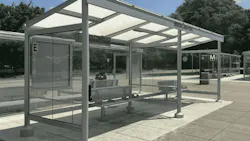
Transit agencies and city departments of transportation are working to upgrade and add transit shelters throughout their regions to improve the passenger experience. The Washington Metropolitan Area Transportation Authority (WMATA) is adding new, modular bus shelters created by Tolar Manufacturing Company (Tolar Manufacturing) throughout the Washington, D.C., Maryland and Virginia region while the Detroit Department of Transportation (DDOT) is adding hundreds of new bus stop shelters and benches through 2027 within the city of Detroit.
Tolar Manufacturing receives eight-year WMATA contract for modular bus shelter hardware
Tolar Manufacturing has been selected to build new modular bus shelters for WMATA for the next seven years. The new shelters aim to give riders brighter, safer and more accessible places to wait for WMATA buses and trains. Tolar Manufacturing notes that it supplies the shelters under an annual, renewable eight-year contract, manufacturing them at its Corona, Calif., facility for installation at WMATA stations.
“Every trip starts at the stop and the shelter is the first thing a rider sees and the last place they stand before the bus arrives,” said Tolar Manufacturing Business Development Manager Scott Williams. “Our goal was to give WMATA a modular design that stands up to daily use, protection from inclement weather, installs quickly and makes the wait safer and more comfortable for the people who count on [WMATA] every day.”
Tolar Manufacturing notes that the shelters are built in two modular sizes—12 feet and 24 feet—scaled to each stop’s ridership. Both share an identical, interchangeable design, allowing for what Tolar Manufacturing notes are consistent components, making installation and repairs more streamlined and allowing maintenance crews to move quickly from station to station in an effort to reduce the cost of deployment and long term maintenance. Each shelter features 3/8” clear tempered glass walls and roof panels for increased visibility, integrated LED security lighting, seating with an ADA-compliant clear space and WMATA’s Metro branding.
The aluminum construction is Build America, Buy America Act compliant, with materials and manufactured products produced in the U.S.
Tolar Manufacturing notes that it produced and supplied 31 shelters during Phase One in 2024 and 2025, supplying full station replacements at the Fort Totten, Brookland and Rhode Island Avenue Metrorail stations. Phase Two expands the program to 195 shelters, of which 119 have been delivered to date. Tolar Manufacturing notes it has supplied shelters for recently completed installations at the Twinbrook East, Shady Grove East and West, Medical Center and Grosvenor stations, with work continuing across additional WMATA stations.
The shelters come as part of WMATA’s Bus Stop and Shelter Improvements Program, launched in 2023 under the agency’s Better Bus initiative to replace the oldest shelters in the system, some of which had been in place for nearly 50 years. WMATA says the new aluminum design delivers significant cost savings over previous versions while improving weather protection, lighting and accessibility for riders.
DDOT, Detroit Mayor reveal push to install hundreds of new stop shelters and benches
The city of Detroit has recently completed installation of more than 100 new bus stop shelters across the city with another 100 planned for next year. Crews have reportedly completed installs of the last of nearly 80 new bus stop benches along city streets, with another 120 planned for later this fall and into 2027.
This brings the number of bus stops that are receiving either new or upgraded shelters or added benches to more than 400.
"DDOT has been undertaking major improvements to keep more buses on the road and improve service with the addition of 49 new buses and funding in place for the purchase of another 80, as well as the opening of a new $165 million Coolidge Terminal,” said Detriot Mayor Mary Sheffield. “While buses are arriving in a timelier manner, it is a major priority to make this customer-focused investment at hundreds of bus stops across the city to help improve the experience of waiting for your bus to arrive.”
Shelters are being funded with a combination of federal and state grants and city funds while the 200 benches are paid for entirely through the city’s general fund. The benches and shelter being installed fall into the following categories:
- AD Shelter Project: This project aims to place 110 shelters that each includes an advertising panel as part of a partnership with Brooklyn Outdoor (BKO). The city pays for the shelter, site design and concrete—then BKO installs, sells advertising and cleans, repairs and maintains the bus stops.
- 100 Shelter Project: The city already has installation and concrete installation contracts in place.
- Bench Project: This project is to add 200 benches at bus stops that score high in DDOT’s evaluation process but lack the space for a full shelter buildout. These locations are those that have not had any shelter or official DDOT bench in the past. Installation is now complete with the 80 locations that are along city-owned roads. The city has approval for locations on Michigan Department of Transportation roads that will be completed and installed in the next two months. Additional benches along Wayne County Roads in Detroit are expected to take place in 2027, and the program may be expanded beyond the initial 200 sites as funding allows.
“With over 5,000 DDOT stops in and around the city, every additional shelter or bench makes a difference many Detroiters experience every day,” said DDOT Transit Executive Director Robert Cramer. “Efforts to improve the appearance and amenities of bus stops along corridors throughout the city benefit current and perspective transit customers and positively impacts businesses and neighborhoods.”
DDOT notes that several of the new shelters were installed along East Jefferson Avenue as part of a pilot project to install 21 elevated bus boarding platforms along that corridor. The installations aim to enhance safety, efficiency and the overall rider experience. DDOT says the platforms, placed at high volume bus stops, allow passengers to board and de-board more quickly and safely, improving both travel times and safety for riders. The department also says the elevated stops reduce time needed for buses to pull in and out of traffic.
The department says that this work supports DDOT Reimagined, the agency’s long-term vision for a better public transit system, targeting comfort, safety, accessibility and speed. Enhancements like new benches and shelters are prioritized based on ridership, sidewalk space and coordination with other city improvement efforts.
DDOT says its goal is for 75% of passenger boardings to occur at sheltered stops as funding permits, with continued improvements being rolled out citywide.
About the Author
 Noah Kolenda
Noah Kolenda
Associate Editor
Noah Kolenda is a recent graduate from the Craig Newmark Graduate School of Journalism with a master’s degree in health and science reporting. Kolenda also specialized in data journalism, harnessing the power of Open Data projects to cover green transportation in major U.S. cities. Currently, he is an associate editor for Mass Transit magazine, where he aims to fuse his skills in data reporting with his experience covering national policymaking and political money to deliver engaging, future-focused transit content.
Prior to his position with Mass Transit, Kolenda interned with multiple Washington, D.C.-based publications, where he delivered data-driven reporting on once-in-a-generation political moments, runaway corporate lobbying spending and unnoticed election records.