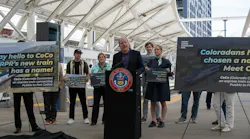
CO: Analysis: Changing voter boundary likely helped pass ‘Coco’ train tax
Seven months before the general election, policymakers at the state Capitol officially changed the boundaries of a district whose voters went on to pass a proposal to increase the sales and use tax in order to pay for a commuter rail system along the Front Range.
The Front Range Passenger Rail District backed the legislature’s move.
That change in the electoral map shrunk the number of voters in the district to roughly half.
That gamble appeared to have paid off on Tuesday night, when the results showed significant support for Issue 7A, which seeks a permanent 0.333 percent sales and use tax projected to raise $295 million a year and up to $580 million in debt to expand Colorado Connector passenger rail service from Fort Collins to Pueblo.
Unofficial returns through Friday night showed the “yes” vote leading, 56%-44% — a comfortable favorable gap of almost 130,000 votes.
District leadership described the result as a landslide, with the numbers showing a solid majority among the voters the legislature has defined as eligible.
That voter base is substantially smaller than the one created in 2021.
The original boundaries had covered roughly 4.4 million residents along a continuous linear strip.
Senate Bill 26-172, signed in May 2026, replaced that description with a fixed list of about 30 municipalities, plus the Sterling Ranch metropolitan districts, creating a bubble-style map that reduced the population to roughly 2.6 million.
Station selection drove the exclusions, district officials insisted.
Earlier planning documents had treated a Castle Rock station as part of the base concept. Later documents selected Sterling Ranch, instead, placing the stop just outside Castle Rock’s municipal boundary.
In a July briefing, Front Range Passenger Rail District General Manager Sal Pace said the station alignments were done based on modeling and ridership and that the district needed to meet the characteristics of intercity passenger rail, adding that too many stops could make the project ineligible for future federal funding.
In fact, no Federal Railroad Administration rule imposed a hard prohibition on the station spacing that would have blocked a Castle Rock or Monument station, according to FRA regulations for intercity passenger rail.
Greeley’s exclusion follows from the 2023 selection of the BNSF northwest corridor.
Colorado law generally requires special taxing districts to be contiguous, but the Colorado General Assembly created the original 2021 district boundary via a new statutory article that didn’t have that restriction. The original boundary was contiguous up and down the I-25 corridor, but SB 26-172 authorized the non-contiguous bubble structure.
In Senate Transportation and Energy Committee testimony, Pace described the chosen map as having “some of the highest — but not the highest — tax base” among the scenarios explored and said it “appeared to be the fairest one that we were able to come up with.”
The communities left outside the revised map included Castle Rock, Monument, Lone Tree and Greeley.
Reporting at the time described these as more conservative communities with weaker support for passenger rail. Critics have characterized the revised boundaries as gerrymandered to improve the odds of passage by excluding areas of lower support.
Results through Friday showed reliably progressive areas backing the tax hike. In Denver, for example, almost 66% of the voters backed the measure — a lead of roughly 93,000 votes. In Boulder, the proposal led by 31,798.
Notably, in Douglas County, that Sterling Ranch “bubble” gave the proposal a slight edge of 240 votes.
Meanwhile, in El Paso, the “no” vote is slightly ahead 4,720 votes.
Also, the measure lost support in Jefferson, Arapahoe, Las Animas and Adams counties. It won support in Weld by 64 votes as of Friday morning out of some 300 votes in that area. The district’s boundary included Longmont in Weld County.
That change in the electoral boundary resulted in roughly 800,000 registered voters in Adams, Arapahoe, Douglas and Weld counties receiving ballots that incorrectly contained Issue 7A because the district failed to notify the counties of the late change to the bubble-district boundaries. Only votes cast by residents inside the SB26-172 boundaries were counted.
Nonresidents do not vote on the tax, but those who make purchases inside the district still pay it.
Special districts that tax only areas expected to receive service are a common structure, and SB26-172 contains an opt-in path for excluded municipalities.
At the same time, the district’s station and route decisions shaped the boundaries subsequently approved by the General Assembly, which excluded several communities from voting on the permanent tax later referred to voters by the district board.
© 2026 The Gazette (Colorado Springs, Colo.).
Visit www.gazette.com.
Distributed by Tribune Content Agency, LLC.