CO: Initial tally shows Front Range Passenger Rail passing
The proposal to raise sales taxes in certain jurisdictions along the Front Range in order to fund a commuter rail system was leading on Tuesday night, the early and unofficial results showed.
Ballot Issue 7A seeks to establish a new 0.333% sales and use tax in order to generate $295 million a year and permit the jurisdiction to take on $580 million in debt to build a passenger rail line connecting several communities along the Front Range.
With results reported from all 12 counties, the “yes” vote stood at 55.1%, with 44.9% in opposition. The margin was 80,632 votes, according to the latest unofficial returns from the Secretary of State’s Office.
The last county to report, Arapahoe County, voted against the measure, with 41,757 opposed and 36,036 in favor in its 8:30 p.m. update. The county’s results narrowed the districtwide margin of approval to 10.2 percentage points.
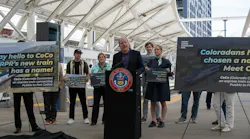
Front Range Passenger Rail District General Manager Sal Pace welcomed the apparent victory in an election-night interview.
“It means that we’re going to be connecting all of Colorado instead of allowing division to define us,” Pace said. “We’re going to bring Pueblo to Colorado Springs and Colorado Springs to Denver and Denver to Boulder and Fort Collins.”
Pace said he would resume negotiations with BNSF Railway next week on an agreement allowing passenger trains to use the railroad’s tracks.
“So we’re starting work right away,” he said.
The district plans to begin its first phase of service by 2029, Pace said, with trains reaching Colorado Springs within five years. He said two stations are planned in Colorado Springs, with trains capable of carrying about 500 passengers each. Initial service would include three round trips daily, eventually increasing to 10.
Asked about critics who questioned the project’s cost and ridership projections, Pace credited them with improving the proposal.
“Well, the critics made us stronger and made the plan better and allowed us to refine and improve on the project,” he said. “I’m grateful to them for holding us accountable.”
Jon Caldara, president of the Denver-based Independence Institute, criticized the rail district’s boundaries and tax proposal. A longtime critic of the rail proposal, he denounced the district’s boundaries and the tax burden on residents who would not use the trains.
“A crooked system and gerrymandering certainly do what they wanted them to do,” Caldara said, adding that officials should double-check the boundaries before sending out tax bills to avoid confusion about who must pay for the service.
The measure authorizes a permanent 0.333 Percent sales and use tax projected to generate $295 million a year and $580 million in debt. The money would extend Colorado Connector service south of the already-funded Denver—Fort Collins starter segment.
Roughly 800,000 voters in Adams, Arapahoe, Douglas and Weld counties received ballots containing the measure but were ineligible because of a May boundary change. Only residents of the municipalities listed in Senate Bill 26-172 cast ballots that will be counted.
Starter service of three daily round trips between Denver and Fort Collins remains scheduled for 2029 using existing Regional Transportation District and Colorado Transportation Investment Office funds.
Starter service between Denver and Fort Collins proceeds independently of the outcome.
Ballot Issue 7A asked eligible voters to raise Front Range Passenger Rail District taxes by $295 million a year and debt by $580 million. The repayment cost is listed at $785 million.
The money will build and operate Colorado Connector service linking Pueblo, Colorado Springs, Sterling Ranch, Littleton, Denver, Westminster, Broomfield, Louisville, Boulder, Longmont, Loveland and Fort Collins.
District officials described the need for the new rail service on its website.
“As communities grow, a new passenger train will connect Front Range Coloradans to opportunities, adventure and each other. Are you ready to leave delays and heavy traffic behind?” according to the website. “We are too, so we’re planning for a future of safe, reliable and climate-conscious travel.”
The 0.333 Percent tax has statutory exemptions for gasoline, food, residential utilities, prescription drugs and medical supplies. It has no sunset.
The district was created in 2021 by Senate Bill 21-238. Its original boundaries covered roughly 4.4 million residents.
Senate Bill 26-172, signed May 26, 2026, replaced those boundaries with a narrower set of municipalities nearer the planned stations plus the Sterling Ranch districts.
The revision reduced the population to roughly 2.6 million. It excluded communities such as Castle Rock, Lone Tree, Monument and Greeley.
Residents of the excluded communities do not vote. Nonresidents who make purchases inside the district still pay the tax.
The district failed to notify county clerks of the change to district boundaries. About 800,000 ineligible ballots were distributed. Only votes from inside the revised boundaries will be counted.
An April 2026 term sheet with BNSF Railway sets starter service at three daily round trips and 79 mph. The estimated capital cost is $333 million, with $156 million from the Regional Transportation District.
District materials cite roughly $1.7 billion for service to Pueblo. Leaders expect about 3,500 passengers a day or roughly 1.3 million a year at full service.
At a Senate confirmation hearing, Pace and board appointees said narrowing the district made sense once the alignment was chosen. Sen. Kyle Mullica asked about taxing residents who could not use the service. Pace said a late bill would address it.
© 2026 The Gazette (Colorado Springs, Colo.).
Visit www.gazette.com.
Distributed by Tribune Content Agency, LLC.