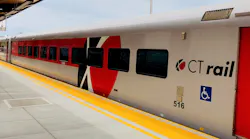
CT: CT Gov. Lamont once set a goal for a 60-minute train ride from New Haven to Grand Central. Is it possible?
When Gov. Ned Lamont gave his first “state of the state” address in 2019, he announced a goal for Connecticut rail that prompted a standing ovation from lawmakers.
“I believe in the 30-30-30,” Lamont said during speech in the hall of the state House of Representatives. “I want the following to be a reality: 30 minutes from Hartford to New Haven, 30 minutes from New Haven to Stamford, and 30 minutes from Stamford to New York.”
Nearly eight years later, that dream hasn’t become reality.
As this year’s gubernatorial race between Lamont and Republican state Sen. Ryan Fazio enters its final days, Lamont’s campaign said the incumbent governor has invested in the state’s rail system and made progress toward shortening train tips.
Lamont campaign spokesperson Lauren Gray said the New Haven Line’s “super express” trains, which Metro-North Railroad started running between the Elm City and Grand Central Terminal in 2022, now provide “the fastest rail service in generations.”
Meanwhile, major rail bridge projects and upgrades to power, signals, communication systems, tracks and other infrastructure are underway that will allow trains to travel faster, Gray said said in a statement Wednesday.
But Lamont’s opponent isn’t impressed by those efforts.
“The trains have not sped up in any meaningful way, and his promise of 30-minute express rides isn’t even close to reality,” Fazio said in a statement also on Wednesday.
Between Hartford and New Haven, “select trips” are down to 45 minutes, according to the state Department of Transportation.
From New Haven to Stamford, the average travel time is 64.78 minutes among all trains, according to Metro-North’s parent organization, the Metropolitan Transportation Authority. The average travel time among peak trains is 59.29 minutes.
In the opposite direction on the same leg, the average travel time is 72.42 minutes among all trains and 66.81 minutes among peak trains.
On the super express trains, the average travel time between New Haven and Stamford is about 47 minutes. The trains only stop in Bridgeport between the two cities.
From Stamford to Grand Central, the average travel time is 58.11 minutes during peak hours, MTA said. From Grand Central to Stamford, it’s 54.42 minutes.
'Super express' service
In 2021 — two and a half years after declaring his support for “30-30-30” — Lamont announced a new program called “TIME for CT” and a new goal of saving riders 25 minutes on the trip between New Haven and Grand Central by 2035. At the time, the New Haven Line was just starting to recover from the COVID-19 pandemic.
Along with the announcement, the Lamont administration published a capacity and speed analysis of the New Haven Line, which found that train speeds were limited by legacy infrastructure, curves, speed restrictions around aging bridges and “slow orders” caused by drainage, tie and track issues.
Metro-North began running the super express trains in 2022, with trips between New Haven and Grand Central taking as little as 99 minutes. Last year, the railroad and DOT announced that the travel time on the trains had been shaved down to as little as 88 minutes thanks to signal infrastructure improvements.
That’s still short of the goal of a 60-minute ride from New Haven to Grand Central, noted Jim Cameron, a rail-rider advocate and founder of the Commuter Action Group. And the opportunities for commuters to catch a super express train are limited, he said.
On weekdays, three super express trains depart from New Haven in the morning (at 5:08 a.m., 5:32 a.m. and 7:52 a.m.), and three depart from Grand Central in the afternoon (at 4:11 p.m., 4:55 p.m. and 6:26 p.m.), according to Metro-North’s schedule.
With the “30-30-30” concept, Cameron said in an interview Wednesday that he thinks the governor “overpromised and underdelivered.”
“He did not achieve what he was hoping for, for the vast majority of commuters,” Cameron said.
19th-century infrastructure
Fazio said that if he is elected governor on Nov. 3, his priorities will include “investing in lighter, more efficient train cars in the future, allowing faster speeds within existing safety regulations, and establishing more regular and consistent train schedules, which would help improve travel times as much as anything else.”
“These practices work in Europe and Japan and should be emulated in Connecticut,” Fazio said.
In response, Lamont’s campaign spokesperson said Fazio is overlooking “the reality of America’s 19th-century rail network.”
“While we are working to get to speeds like in Europe or Japan, that requires new tracks and costly land acquisitions,” Gray said. “Not to mention billions in taxpayer dollars.”
Cameron said the trains that run on the New Haven Line are capable of traveling faster, but they don’t have the straight shot they need to reach high speeds.
When asked about Fazio’s proposed solutions, Cameron said he doesn’t think weight is slowing down trains.
“They run slow because the tracks and the signals won't allow them to run faster,” Cameron said. “American railroad passenger cars are built like tanks. They're built to survive a serious crash.”
Long, expensive projects
This summer, the state broke ground on a $1.6 billion project called Track Improvement and Mobility Enhancement-1 or TIME-1, a key piece of TIME for CT that focuses on a roughly 3-mile stretch of the New Haven Line in Stratford and Bridgeport.
At the ceremony, it appeared that Lamont had not entirely given up on the “30-30-30” goal.
“Very soon, Stratford- Bridgeport will be as close to New York City as Stamford is today,” Lamont said. Turning to Transportation Commissioner Garrett Eucalitto, Lamont said: “The Hartford rail line, say New Haven to Hartford, there we'll be able to get that down close to half an hour, right, Garrett?”
Along the Northeast Corridor, “there are a lot of twists and turns, I know,” Lamont added. “If we were in China, we'd just take down 50 houses and straighten it out. But we're not China.”
The three-phase project in Stratford and Bridgeport includes the installation of new overhead wiring structures, bridge replacements, upgrades to track and signal infrastructure and improvements to Stratford’s train station. State officials have said that trains will be able to travel as fast as 90 mph in certain spots — up from a current maximum of 70 mph in the area — once the three phases are done.
But it will take some time for “TIME-1” to be completed. Construction is expected to wrap up in 2035, and a different governor will presumably be leading the state by then.
“Infrastructure takes a long time,” Eucalitto said at the groundbreaking in July. “Especially on the railroad, because unlike the highway, where you can have detours, (on) the railroad, there is no detour… We have to do the work while the trains are moving.”
And while the state has secured funding from the Federal Railroad Administration for the first phase of the project, it doesn’t yet have federal funding commitments for the other two phases.
“The one pitfall is going to be: What is the federal government going to do in the next surface transportation bill? Is there going to be funding for rail?” Eucalitto said.
He was referring to legislation that will succeed the Infrastructure Investment and Jobs Act, through which Connecticut secured about $2 billion in funding for multiple rail projects. The 2021 law is set to expire in December.
Some of that funding has gone toward projects to replace more than 100-year-old movable bridges along the New Haven Line, including the Walk Bridge over the Norwalk River and the Devon Bridge over the Housatonic River.
The new Walk Bridge has been under construction since 2023, and the $1.6 billion project is expected to be completed by 2031. DOT has estimated that the Devon Bridge project will cost about $3 billion, with construction starting in 2030.
Jim Gildea, who chairs the Connecticut Public Transportation Council, said it wouldn’t be fair to judge Lamont’s transit record based solely on “30-30-30.”
He pointed to increased service and projects to upgrade all the stations on the Waterbury Branch Line, the procurement of new rail cars for the Waterbury and Danbury branch lines, Hartford Line and Shore Line East, as well as the work underway as part of TIME for CT.
“There is significant and necessary infrastructure work going on behind the scenes that needs to be done before we see the fruits of that labor,” Gildea said.
© 2026 CT Insider.
Visit www.ctinsider.com.
Distributed by Tribune Content Agency, LLC.