CTA awards pair of contracts for Blue Line modernization
The Chicago Transit Authority (CTA) has made a set of contract awards for track design work on the Forest Park brand of the Blue Line and for modernization and accessibility improvements at the California Blue Line station.
CTA awards contract to AECOM for Forest Park track design work to increase speed
At its Oct. 27th meeting, the CTA Board approved a contract award for the remaining track design work on the Forest Park Branch of the Blue Line from the Illinois Medical District (IMD) station to the I-290 Bridge. The agency says this board action marks the start of the next phase of the Forest Park Branch Rebuild Project—a multi-year, multi-phased investment program that aims to reconstruct the entire Forest Park Branch of the Blue Line and make it completely accessible to those who use mobility devices.
Currently, more than 80% of the branch is categorized as a slow zone, requiring trains to operate at reduced speeds for safety. The first phase of work, which kicked off in 2023, covered track and drainage renewals between the UIC-Halsted and IMD stations, alongside a complete modernization and ADA-accessibility rebuild of the Racine station.
“I know how much fast, reliable rail service means for the people and communities we serve,” said CTA Acting President Nora Leerhsen. “This contract is an investment that will build on the improvements we’ve already delivered and moves us closer to our goal of a modernized and accessible Blue Line. We are excited to move forward in our work to strengthen this vital connection between Chicago and the western suburbs.”
The contract, awarded to AECOM Technical Services (AECOM), is for design work that covers about 70,000 feet of track, or about 13 miles between the IMD station and the I-290 Bridge. Major services in the contract include a field investigation of the entire corridor and design for new and upgraded infrastructure, including track, signals, traction power, drainage, utilities and any other facilities within the CTA right-of-way. The contract also includes a review of drainage elements along the I-290 expressway shoulders and how they affect CTA rail service.
AECOM partnered with three local disadvantaged business enterprise firms that account for more than 15% of the contract: DB Sterling Consultants, Facet Engineering and GSG Consultants.
Funding for the project comes in part from a $15.8 million grant from the Federal Highway Administration’s Carbon Reduction Grant Program. The Illinois Department of Transportation (IDOT) applied on CTA’s behalf and was awarded funding to support the design of future track work on the Blue Line Forest Park Branch. The two agencies authorized an intergovernmental agreement to transfer the funding in July.
Design work on the two-mile stretch excluded from this contract from Kedzie Avenue to Keeler Avenue has been completed and construction is expected to begin on that segment in 2027 with the support of federal funds from the Reconnecting Communities Program. The first phase of the Forest Park Branch Rebuild was completed in 2023 and featured a $268 million rebuild of three miles of track between the Illinois Medical District and LaSalle Station downtown.
The agency says this track design work is a critical next step in the ongoing partnership with CTA and IDOT to revitalize the I-290 and Forest Park Branch Blue Line corridor. CTA is a lead agency with the Chicago Metropolitan Agency for Planning (CMAP) and IDOT on the Connect 290 Blue Program that was established in 2024 to coordinate funding and rebuilding the I-290 Eisenhower Expressway and the Forest Park Branch of the Blue Line. More than four million transit riders travel through the corridor annually and the expressway is one of the most congested in the U.S.
“Rebuilding the Forest Park Branch isn’t just about upgrading tracks. It’s about providing faster, more reliable and accessible service for the people who depend on the Blue Line every day,” said CMAP Executive Director Erin Aleman. “The I-290 and Blue Line corridor is among the priority investments the region identified in its recently adopted 2026 Regional Transportation Plan. This design milestone is an important step toward realizing that vision and reflects the sustained collaboration among CTA, IDOT and CMAP needed to deliver meaningful improvements for northeastern Illinois.”
Much of the infrastructure along the Forest Park Branch of the Blue Line is original, dating back to 1958. While CTA has performed routine maintenance and made modest improvements in recent decades, most of the infrastructure is far beyond its useful life and needs replacement and upgrades to address issues affecting daily service.
CTA awards contract for modernization and accessibility improvements at the California Blue Line station
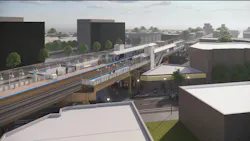
The CTA Board has also awarded a construction contract for modernization and accessibility upgrades at the California Blue Line station, with construction set to begin in the fourth quarter of 2027. The CTA says the board action showcases its commitment to the All Stations Accessibility Program (ASAP)—a move the agency notes brings it closer to its goal of making the entire system 100% accessible to riders with disabilities.
“An accessible CTA gives more people the freedom to travel independently and connects them to everything our region has to offer,” Leerhsen said. “This investment will bring that promise to life at the California Blue Line station, delivering a modern, welcoming station that better serves riders with disabilities and the entire community."
Originally constructed in 1895 and renovated in 2015, the California Blue Line station is one of the busier stations along the line with more than 1.13 million entries in 2025, according to the CTA. Following a competitive procurement process, F.H. Paschen, S.N. Nielsen & Associates, LLC, was selected to lead the overhaul of the facility.The comprehensive station upgrade will feature:
- Two new elevators serving the inbound and outbound platforms.
- New stairs and accessible doors.
- Updated signage and wayfinding.
- Platform and canopy extensions, with related adjustments to lighting, railings and windbreaks.
- Improvements to sidewalks, ramps, drainage and landscaping.
To maintain access to rail services during construction, the CTA says that crews will build a temporary stationhouse and entrance at St. George’s Court for riders to use while work proceeds on the permanent, accessible entrance.
The overall value of the contract is not to exceed $39.9 million and will be funded through a combination of IDOT and city of Chicago Tax Increment Financing funds.
Currently, CTA operates a 100% accessible bus and rail fleet and 110 of CTA’s 146 rail stations are fully accessible, or 75% of the rail system stations.
The California station is among 15 stations that have either recently opened or are currently funded and in various stages of planning, design or construction under the ASAP program.
About the Author
 Noah Kolenda
Associate Editor
Noah Kolenda is a recent graduate from the Craig Newmark Graduate School of Journalism with a master’s degree in health and science reporting. Kolenda also specialized in data journalism, harnessing the power of Open Data projects to cover green transportation in major U.S. cities. Currently, he is an associate editor for Mass Transit magazine, where he aims to fuse his skills in data reporting with his experience covering national policymaking and political money to deliver engaging, future-focused transit content.
Prior to his position with Mass Transit, Kolenda interned with multiple Washington, D.C.-based publications, where he delivered data-driven reporting on once-in-a-generation political moments, runaway corporate lobbying spending and unnoticed election records.