The public transit industry’s playbook for the next surface transportation reauthorization bill
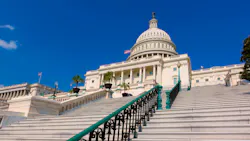
Congress is beginning work on the upcoming surface transportation reauthorization bill ahead of the Sept. 30 expiration of the Infrastructure Investments and Jobs Act (IIJA).
This upcoming reauthorization will inform the next five years of public transit funding, programming and policy, and the American Public Transportation Association (APTA) is keen on building upon the IIJA’s investments. Specifically, APTA is targeting $138 billion for public transit and $130 billion for passenger rail.
“It's our overarching goal and aim that we're striving for a continuation of really robust funding levels to take us into the next five-year period,” APTA President and CEO Paul Skoutelas told Mass Transit magazine during an interview. “We're closing out a period of great investment that our agencies and communities all over the country have been making with real tangible benefits, so that's the kind of momentum that we're seeking to continue under the new authorization.”
To help push for these investment levels, APTA adopted and published its set of recommendations, outlining the transit industry’s priorities for the next bill. Mass Transit distilled two major programs cited in these recommendations to help stakeholders easily advocate to their elected officials on what they want to see included in the bill.
In this playbook, Mass Transit broke down public transit program and passenger rail program recommendations into bite-sized sections linked with examples to help inform strategic, cohesive conversations.
Editor’s note: These are summaries based on interviews with APTA staff and the association's recommendations and shouldn't be considered endorsements from Mass Transit magazine.
Public Transit Program Recommendations
Grant program funding and formula allocations
Consolidation
Recommendation: Consolidate federal programs for funding into 40% for Capital Investment Grants (CIG), 40% for State of Good Repair grants and 20% for Buses and Bus Facilities grants. Consolidate the Federal Transit Administration’s (FTA) bus grant programs (Section 5339) into two initiatives and merge the three existing ferry grant programs (the Passenger Ferry Grant Program, the Electric or Low-Emitting Ferry Pilot Program and the Ferry Service for Rural Community Program) into a single passenger ferry competitive grants program.
Reasoning: Eliminate statutory and regulatory barriers to make it easier for transit agencies to apply for bus and ferry grants.
APTA’s take: “Allowing the fuel propulsion system allows the agency to decide which type of fuel propulsion system they would like to propose for purposes of getting a grant, say, under the competitive grant program or using their formula funds,” APTA Vice President of Government Affairs and Advocacy Ward McCarragher told Mass Transit magazine during an interview. “Let them drive that based on their local dynamics of geography and range of service as to what will work best for their community.”
CIG program (Section 5309)
Recommendation: Raise Small Starts maximum federal grant amount from $150 million to $250 million. Raise the Small Starts maximum net total project cost from $400 million to $500 million. Establish fixed federal CIG share percentages by project type.
- New Starts: 60% or less for very large projects
- Core Capacity: 80% or less for very large projects
- Small Starts: 80%
- Expedited Project Delivery: 50%
Project examples
- New Starts: Sound Transit Lynwood Link extension
- Core Capacity: Utah Transit Authority FrontRunner 2X project
- Small Starts: VIA Metropolitan Transit Advanced Rapid Transit (ART) East/West Corridor Project
- Expedited Project Delivery: Los Angeles County Metropolitan Transportation Authority East San Fernando Valley (ESFV) Transit Corridor Phase 1 Project
Mobility of Seniors and Individuals with Disabilities (Section 5310) and Rural Area formula funds (Section 5311)
Recommendation: Give states greater flexibility to reallocate Section 5310 funds to projects in small urbanized or rural areas.
Reasoning: Currently, only smaller areas with these funds can flex them back to their state.
APTA’s take: “We think it should go either way,” McCarragher said. “It provides flexibility to, in essence, transfer funds, so they can be used more effectively. It’s an example of kind of a small change but could really make a big difference in project delivery, move things more quickly at a local level.”
Buses and Bus Facilities grants (Section 5339)
Recommendation: Restore the 40-40-20 funding ratio for CIG, State of Good Repair and Buses and Bus Facilities programs by increasing the growth rate of the State of Good Repair and Buses and Bus facilities. Require FTA to report grant awards by propulsion type for transparency on how competitive bus grant dollars are being distributed amongst propulsion technologies.
Buses and Bus Facilities project examples
- Hillsborough Transit Authority: $32 million to replace diesel buses with compressed natural gas buses.
- Iowa Department of Transportation: $48 million to replace buses beyond useful life and construct bus facilities.
- San Joaquin Regional Transit District: $10.3 million to replace aging buses with hybrid-electric vehicles.
Public Transportation Emergency Relief Program (Section 5324)
Recommendation: Have Congress authorize $25 million per year in Highway Trust Fund contract authority for the Public Transportation Emergency Relief program.
Reasoning: This would make funds immediately available at the start of each fiscal year for rapid disaster response.
Policy and rulemaking
Metropolitan Transportation Planning (Section 5303)
Recommendation: Guarantee voting representation to transit providers that collectively represent at least 75% of annual unlinked passenger trips in a metro planning area. Add a middle tier to Urbanized Area Formula funding (Section 5307) for agencies operating 101 to 125 buses in peak service, allowing these particular agencies to spend up to 25% of federal apportionment on operating costs. Apply this to fixed route and demand response (excluding paratransit) and measure by vehicle revenue hours.
Create a new expedited technical capacity review process for Section 5307 recipients who qualify by meeting two criteria:
- The applicant previously delivered a capital project meeting or exceeding its budget, cost and ridership projections.
- The applicant can demonstrate it still has the staff expertise and resources needed to execute a new project.
Reasoning: Some agencies currently operate services in areas that have a population of over 200,000, but they have fewer than 100 buses, so under the current structure, those agencies can’t use any federal funding for operating costs.
APTA’s take: “We don't want agencies making decisions on the fleet size and needs of a fleet based on somewhat of an arbitrary congressional cutoff,” McCarragher said.
Public Transportation Research and Development (Section 5312)
Recommendation: Require all research findings under Section 5312 be made publicly available.
Reasoning: Ensures taxpayer-funded transit research benefits the broader public and transit industry, not just direct grant recipients.
Technical Assistance and Workforce Development (Section 5314)
Recommendation: Make Rural Area Formula grants (Section 5311) an eligible funding source rural transit agencies can use for training and education.
Reasoning: Provides rural transit agencies with the same workforce development flexibility already available to urban transit agencies.
Bus Fleet Spare Ratio (Section 5323)
Recommendation: Fully repeal the 20% bus fleet spare ratio limitation.
Reasoning: Removes a ceiling on the number of reserve buses an agency may hold.
APTA’s take: “For certain agencies, we find it to be very arbitrary in terms of the number of buses they may need because of the geography or climate or fuel propulsion they're using,” McCarragher said. “We do not believe agencies are acquiring buses that are unnecessary just to park them, so this is an opportunity to, in essence, remove an arbitrary limitation on the number of buses an agency can have in its fleet.”
Transit Asset Management (TAM) (Section 5326)
Recommendation: Have congress shield safety-sensitive TAM data from state and federal Freedom of Information Act requests and ban it from being used as evidence in both state and federal court proceedings.
Reasoning: Ensures transit agencies can honestly report asset conditions and risks without fear that the data will be used against them in litigation or made public in ways that could compromise safety and security.
APTA’s take: “An agency needs to demonstrate how they're bringing about bus replacement in an orderly fashion to make sure that they're maintaining a fleet that is functional and stays within those guidelines,” Skoutelas said. “Agencies have got to be reporting and keeping an inventory of their assets and how they go about either repairing them, maintaining them and replacing them. It's all part of how they're managing their system, and it's very important for both the federal agencies, as well as the local decision makers and boards to understand how an agency is deploying its resources and the dollars it has.”
Project Management Oversight (Section 5327)
Recommendation: Increase the threshold to define a “major capital project” from $300 million to $500 million in total project costs, determining when oversight from federal regulators is triggered. Eliminate the separate federal funds threshold while reducing the frequency of project reviews from quarterly to annually.
Reasoning: This rule change would bring the public transit industry rules into parity with the standards issued by the Federal Highway Administration for project management, reserving federal oversight for higher risk projects without discounting innovation.
APTA’s take: “This harmonizes [the threshold] to the federal highway standard, where it in essence moves it to those levels of $500 million without a federal element to it,” McCarragher said. “One of the things we've found is, particularly for an agency—some of our agencies manage both the highway side and the transit side—the level of oversight we see on the transit side is extraordinary, they find, compared to what they see on the highway side, where there is so many more bureaucratic hoops you have to go through.”
Public Transportation Safety Program (Section 5329)
Sub-recommendation 1: Codify a transit agency’s accountable executive—in most cases, the agency’s CEO—with final authority over safety risk mitigations and to serve as the sole tiebreaker in any safety committee panel dispute.
Reasoning: Smooth out project delivery timelines by avoiding federal funding withholdings due to deadlocks in safety disputes.
APTA’s take: “There is no process to deal with dispute resolution in terms of what happens when the two parties cannot agree on a safety plan, or we are aware of instances where simply people do not show up to the meetings to resolve the issue, and that withholds all federal funds until a safety plan is approved,” McCarragher said.
Skoutelas added that this didn’t mean there’d be a lack of oversight, or that an agency would just side with itself, due to the nature of the organizational structure.
“You've got a CEO that's there. They're vested with every aspect of responsibility for the system—including its safety. And it doesn't say that that person won't confer, or the committee won't act to provide recommendations,” Skoutelas said. “But ultimately, if there's a tie—a three on three, as an example—somebody's got to break the tie. You’ve got to get on with life, and you’ve got to get on to operate the system. Logically, that should be the agency head—the agency CEO.”
Sub-recommendation 2: Withhold sensitive transit data—including accident reports, safety plans and hazard analyses—from Freedom of Information Act requests and from being used as evidence in litigation. De-identified data would remain publicly available.
Sub-recommendation 3: Require the FTA to create an appeals process that would allow transit agencies to challenge findings made by a State Safety Oversight Agency (SSOA).
Reasoning: The current rules give SSOAs discretion over whether to reconsider a finding but doesn’t give agencies a guaranteed right to contest one.
Sub-recommendation 4: Establish a 12-month waiting period before a former transit agency employee can be hired by an SSOA. Establish a permanent prohibition on that employee overseeing any area they previously managed at a transit agency.
Labor Standards (Section 5333)
Recommendation: Reduce the U.S. Department of Labor initial grant review period from 15 days to five days. Update the FTA’s Transit Award Management System to only notify impacted labor unions on a given grant application instead of all unions in a service area.
Reasoning: These two changes can help accelerate grant execution.
Purchasing, procurements, sales and acquisitions
Buy America (Section 5323)
Recommendation: Issue standard waiver determinations within 60 days of an application. If a waiver for the same product was already granted within the past 36 months, issue the determination within 10 days. Launch Buy America Act-compliant construction materials within 180 days of enactment.
Real Property Acquisition (Section 5323)
Recommendation: Broaden transit agencies’ authority to acquire land before the National Environmental Policy Act review is finished by replacing the term "right-of-way" with the term "real property interests."
Reasoning: This change would give agencies earlier certainty over property needed for future projects and reduce delays and cost overruns.
Proceeds from the Sale of Transit Assets (Section 5334(h)(4))
Recommendation: Allow transit agencies to keep proceeds from the sale of retired assets instead of reimbursing FTA for the federal share, as long as those funds are reinvested in capital projects under Sections 5307, 5310 or 5311.
Innovative Procurement (FAST Act Section 3019(b))
Recommendation: Expand cooperative procurement authority to cover goods, technologies and Safety-as-a-Service applications, which is currently limited to rolling stock and related equipment purchases.
Reasoning: The change would allow agencies to use state purchasing schedules for a broader range of purchases.
Passenger Rail Program Recommendations
Financing and grant funding
Finance Recommendations — Private Activity Bonds (PABs)
Recommendation: Expand low-interest PABs for transit and intercity passenger rail by:
- Expanding eligibility to cover rolling stock acquisition (not just construction).
- Removing mass-commuting facilities from state-level PAB volume caps, consistent with how airports and ports are already treated.
- Lowering the speed threshold for high-speed rail PAB eligibility from 150 mph to 110 mph to bring more projects, including those on shared freight corridors, into qualification.
Project example
- The Brightline West High-Speed Intercity Passenger Rail project was approved for $2.5 billion in private activity bonds by the U.S. Department of Transportation (USDOT).
Finance Recommendations — Value Capture Tax Credits
Recommendation: Create two new federal tax incentives to attract new private capital into transit and intercity passenger rail. Two options are:
- Modeled on Economic Opportunity Zones, one option would offer tax benefits to real estate investors who invest near transit.
- Modeled on Low-Income Housing Tax Credits and New Markets Tax Credits, this option would let investors purchase tax credits tied to a percentage of capital investments made by transit or rail agencies.
Reasoning: This type of financing would introduce more options at the federal level. Using Low-Income Housing Tax Credits and New Markets Tax Credits will make investments viable even in markets where real estate appreciation is limited.
Project example
- California High Speed Rail Authority issued a request for qualifications for a co-development agreement to bring in private investors and developers to evaluate opportunities to invest and deliver the high-speed rail project faster and more efficiently.
Finance Recommendations — Federal Loan Programs as Local Match
Recommendation: Require (not just allow, as is status quo) USDOT to count Transportation Infrastructure Finance and Innovation Act (TIFIA) loans and other federal credit assistance toward the local match requirement across all USDOT programs.
Reasoning: This strategy has been implemented with success in projects already, allowing agencies to redeploy funds for other priority projects.
Project example
- Bay Area Rapid Transit: Awarded a $544.6 million TIFIA loan to purchase 775 new passenger railcars.
Railroad Rehabilitation and Improvement Financing (RRIF) Loans and Loan Guarantees
Recommendation: Authorize RRIF loans to count toward the non-federal share of project costs.
Reasoning: This mirrors the TIFIA fix.
Federal-State Partnership for Intercity Passenger Rail (Section 24911)
Recommendation: Shorten the congressional notification period for grant awards under the Federal-State Partnership for Intercity Passenger Rail Grant Program from 30 days to three days.
Reasoning: This change is consistent with notification timelines already in place for other USDOT grant programs.
Policy and rulemaking
Maintain a Rail Title
Recommendation: Include a dedicated rail title in the next bill.
Reasoning: Remains consistent with the Fixing America’s Surface Transportation Act and the IIJA.
Railroad Rights-of-Way (ROW) (Section 24202)
Recommendation: Allow for advance acquisition of railroad ROW before environmental reviews are complete. The rule would prohibit any development of that ROW until environmental review is finished.
Reasoning: This flexibility is already available for highway and public transit projects.
Rail Passenger Liability Cap (49 U.S.C. Section 28103)
Recommendation: Extend the window to obtain new coverage under rail passenger liability cap increases from 30 days to one year.
Reasoning: This gives commuter rail agencies time to secure coverage in a constrained insurance market without any U.S.-based offerings.
How the Commuter Rail Liability Insurance Program would work:
- Agencies would apply voluntarily. To qualify, they must already carry the first $50 million in coverage through private insurers or other means. The federal program covers liability between $50 million and the full federal liability cap (currently $323 million, rising to an estimated $399 million in 2026).
- Premiums would be set at rates based solely on commuter rail risk, not measured with losses in unrelated insurance markets.
- A revolving fund would hold premiums and pay claims. USDOT would seed the fund with an initial federal deposit. That deposit is to be repaid once premium revenue is sufficient.
- An annual working group of agencies and private insurers would assess market conditions. After year three, USDOT must report to Congress on whether private market capacity is likely to be restored by the end of year five. The program only terminates if that determination is affirmative.
Commuter Rail Liability Insurance Program
Recommendation: Create a new federal Commuter Rail Insurance Program administered by USDOT (similar to the National Flood Insurance Program) to provide excess liability insurance coverage to commuter rail agencies that can’t obtain adequate coverage.
Reasoning: There is a gap in the insurance market where no U.S.-based insurers offer the coverage that is required of commuter rail operators, and the coverage that is available to them is mixed in with non-passenger rail related risks, increasing premiums.
APTA’s take: “[The current rule] puts all of them in the market at the same time. They're all going to London and Bermuda—the only two providers—to negotiate. It doesn't lead to a healthy negotiation... because they all have to do it at the same time,” McCarragher said. “So, the idea of [US]DOT would be, this would be fully paid for by the commuter rail providers, but they'd only be really paying for an assessment of the insurance costs that they incur based on accidents that occur on the commuter rail system. We think that would lower the costs overall and make for a more reasonable, viable system.”
McCarragher added that the criteria to sunset the program and return to a private-only market would ultimately depend on how Congress writes the legislation, though APTA's recommendation links termination to a secretarial determination that the private excess liability insurance market has sufficiently rebounded to provide coverage without additional support.
Conclusion
The current surface transportation legislation expires at the end of fiscal year 2026—Sept. 30. While existing projects with funding obligated under the IIJA will continue past that deadline, without a bill passed, no new funding will go out the federal door to transit agencies. APTA says it extends these recommendations to help keep the whole country moving.
“APTA is a large tent in terms of the diversity of agency size, geography, all across the country from the very largest to the very smallest bus systems across the country, and we have been working very hard over the last couple of years to try and make sure that we're addressing as best we can the needs of those different segments,” Skoutelas said.
About the Author
 Brandon Lewis
Brandon Lewis
Associate Editor
Brandon Lewis is a recent graduate of Kent State University with a bachelor’s degree in journalism. Lewis is a former freelance editorial assistant at Vehicle Service Pros in Endeavor Business Media’s Vehicle Repair Group. Lewis brings his knowledge of web managing, copyediting and SEO practices to Mass Transit magazine as an associate editor. He is also a co-host of the Infrastructure Technology Podcast.
 Noah Kolenda
Noah Kolenda
Associate Editor
Noah Kolenda is a recent graduate from the Craig Newmark Graduate School of Journalism with a master’s degree in health and science reporting. Kolenda also specialized in data journalism, harnessing the power of Open Data projects to cover green transportation in major U.S. cities. Currently, he is an associate editor for Mass Transit magazine, where he aims to fuse his skills in data reporting with his experience covering national policymaking and political money to deliver engaging, future-focused transit content.
Prior to his position with Mass Transit, Kolenda interned with multiple Washington, D.C.-based publications, where he delivered data-driven reporting on once-in-a-generation political moments, runaway corporate lobbying spending and unnoticed election records.