2026 40 Under 40: Mark G. Bathrick
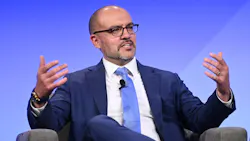
One word to describe yourself: Resilient
Alma Mater: Boise State University
Fast fact: I visited all 50 states by age 15.
What’s your best experience on transit and what made it memorable? I vividly remember as a child around first grade taking the Washington Metropolitan Area Transit Authority to visit the Smithsonian Museums with my parents and how that trip was as much of the adventure as touring the museums.
Mark G. Bathrick has spent his career thus far working to simplify the complex world of transit funding in an effort to ensure agencies across the country can keep their communities moving. Beginning his career in state-level transit programs, Bathrick is currently serving as the director of the Office of Grants Management and Guidance at the Federal Transit Administration (FTA).
In this role, Bathrick has worked to redefine how the transit industry interacts with federal funding systems. He led one of the most significant optimizations of the national Transit Award Management System (TrAMS) since 2021. Bathrick also spearheaded improvements that streamlined the user experience, improved record clarity and ensured the system keeps pace with modern technology. His ability to bridge the gap between technical system requirements and the practical needs of transit operators has established him as a department-wide expert in grants management.
Upon taking his leadership role, he prioritized realigning the team’s strengths to the mission of public service. He’s been described as someone who fosters an environment of accountability and open communication, ensuring that his staff understand the why behind their work. Under Bathrick’s direction, his office updated and combined six complex federal circulars into four streamlined requirement documents in one year—something that historically takes two or more years.
Further, he led the implementation of the American Rescue Plan (ARP). For his work designing and implementing the ARP Additional Assistance Funding process, Bathrick was awarded the Meritorious Achievement Silver Medal by the U.S. Department of Transportation secretary in 2023. Bathrick also managed the calculation of federal funding, adapting for post-pandemic changes and shifts from the 2020 census. His leadership assisted in the obligation of over $21 billion in funding in fiscal year 2024, impacting 900 recipients and 9,000 active awards totaling over $155 billion. He also recently served as the FTA’s acting associate administrator for program management.
Bathrick frequently shares his industry knowledge and experience as a speaker at transit industry conferences, where he translates federal policy into actionable advice for local transit agencies. He is committed to making the grant process as painless as possible for the end-user. To that end, he oversaw the creation of a library of training videos and numerousin-person sessions designed to show grant recipients and FTA employees exactly how to navigate their responsibilities. He’s described as someone who does not just manage grants;but as someone who empowers transit agencies to succeed by providing the structure, guidance and vision necessary to sustain the nation’s infrastructure.
What do you enjoy most about your job?
At FTA and in the transit community as a whole, it has to be the people. Transit is a unique industry where I have the opportunity to work with folks from a variety of technical backgrounds; from engineering, to planning, finance, real estate, legal and politics. Each program and project requires a deep talent bench and allows me to collaborate across a wide group of professionals to bring innovation and multifaceted solutions, improving America’s communities through public transportation.
What is the accomplishment you’re most proud of and why?
While serving as division chief for FTA’s Urban Programs, I led the team responsible for the creation and implementation of many of the new funding programs created in response to the pandemic (CARES, CRRSAA and ARP) and also the implementation of the Infrastructure Investments and Jobs Act (IIJA), including the development of the Rail Vehicle Replacement Program, the All Stations Accessibility Program and new initiatives in FTA’s Ferry Program portfolio. In each of these opportunities, I crafted the implementation plans and materials that were focused on how the transit industry could best interface with FTA and make optimal use of these funds to keep transit going throughout COVID-19 and then launch a new era of investment through the IIJA.
What is your best advice you can share from your area of expertise?
Leaders should always remain focused on the customer, no matter what the line of business is. As a federal agency, the FTA customer base is wide-ranging, and as such, I always encourage my team to ask ourselves, “How will each decision, allocation of resources, new initiative or process improvement not only improve life for our team, but also for our customers?”
About the Author
 Noah Kolenda
Noah Kolenda
Associate Editor
Noah Kolenda is a recent graduate from the Craig Newmark Graduate School of Journalism with a master’s degree in health and science reporting. Kolenda also specialized in data journalism, harnessing the power of Open Data projects to cover green transportation in major U.S. cities. Currently, he is an associate editor for Mass Transit magazine, where he aims to fuse his skills in data reporting with his experience covering national policymaking and political money to deliver engaging, future-focused transit content.
Prior to his position with Mass Transit, Kolenda interned with multiple Washington, D.C.-based publications, where he delivered data-driven reporting on once-in-a-generation political moments, runaway corporate lobbying spending and unnoticed election records.