2026 40 Under 40: Taylor Eidt
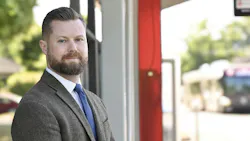
One word that describes you: Catalyzing
Alma Mater: Undergraduate: University of Mary Washington; Graduate: University of Oregon
Fast fact: I have a travel tradition of experiencing each new place through its pickles and public transit. So far, I've kept it going across 23 countries.
What’s your best experience on transit and what made it memorable? My best experience on transit was riding the train home from the airport with my 7-year-old niece, when she was visiting Portland, Ore. She didn't know how to get around, pay, or generally what to do, but she was determined because she knows I love transit. She followed the signs, helped me pay, told me when the train was departing, put me on the right train, picked out the best seat, and told me when to get off. I couldn't have been more impressed by her or all of the folks that put in the hard work that made using the system and wayfinding so clear that a 7-year-old could do it!
Tayor Eidt is described as someone that lives out the mantra that you can’t plan from behind a desk. As a daily rider on TriMet, and his system, C-TRAN, this mantra serves him well in his role as the director of planning and service delivery. He began at C-TRAN in 2020 as a senior planner before being promoted to planning project manager in 2022, then to deputy director of capital projects and planning in 2023 before director of planning and service delivery in 2025. Prior to his time at C-TRAN, Eidt earned his master’s degree from the University of Oregon in 2015, then working as a geographic information science (GIS) specialist for a private transportation consultant, then a GIS planner for the city of Hillsboro, Ore.
Since joining C-TRAN, Eidt has spearheaded or played a role in some of the agency’s transformative projects. He managed the development and implementation of service design and system restructuring for the Mill Plain Bus Rapid Transit (BRT) Project, leading to a 13% growth in ridership. Further, Eidt has supervised corridor planning and design of the Highway 99 BRT project, now in construction and set to open in 2027. He also oversaw the C-TRAN 2045 long-range planning process, assisting in the process of setting a new vision for C-TRAN’s future and engaging every jurisdiction in the service area in the process. Additionally, Eidt assisted in the improvement of bus stop accessibility, increasing C-TRAN’s systemwide ADA compliance by 33% in three years—covering physical improvements to more than 150 bus stops in the system.
Eidt also managed the joint implementation of C-TRAN’s microtransit project, the Current, helping guide it from the initial planning and development all the way to roll-out in January 2022. Since launch, the Current carried more than 15,000 rides in its first year of operation, and by 2025, the service expanded to a new city as total ridership surpassed 50,000 rides. Also in 2022, he helped facilitate C-TRAN’s partnership with Transit app to provide real-time arrival information and trip planning from every stop in the C-TRAN system.
Eidt works to engage his community and sees his actions through, staffing nearly every open house and outreach event related to service changes or capital projects. He’s been known in the agency to install bus stop postings himself if no one else is available. Even in his personal travels to other parts of the world, Eidt strives to observe and bring back ideas from international transit systems in order to apply new best practices to C-TRAN.
Further, Eidt is a regular presenter to the C-TRAN Board of Directors, C-TRAN’s Community Advisory Committee and numerous local organizations and city councils. Internally, he has fostered an environment of collaboration within a growing C-TRAN Capital Projects and System Planning Department, where Eidt now manages two teams within that group.
Eidt is a member of the American Public Transportation Association (APTA) Emerging Leaders Program Class of 2026. He also participates in the Washington State Transit Association’s Planning Committee and he has attended numerous APTA conferences and events on behalf of C-TRAN. In 2026, Eidt has also worked to share his knowledge with the next generation of transit professionals, coordinating C-TRAN’s partnership with a group of Portland State University students to create a bus stop accessibility action plan. The effort provided those students valuable experiences in a real-world setting and provided C-TRAN an important road map to continue its own accessibility improvements.
Is there a specific experience that led you to where you are today?
I grew up in a sprawling suburb that didn’t have transit service, relying on a car to get virtually anywhere. I first experienced the freedom of transit moving to college in Fredericksburg, Va., where I spent hours riding tiny, crowded buses on circuitous routes. Even with limited means, the system's community-focused mission was inspiring. I found that again in Eugene, Ore., while interning with Tom Schwetz at Lane Transit District. There, I was able to experience new types of integrated urban mobility, which further reinforced my appreciation for supporting fundamental community mobility.
What do you enjoy most about your job?
I truly love the tangible impact of our work. Having the opportunity to be out in the field, working with an incredible team to design accessible infrastructure and service. There is nothing more rewarding than seeing those improvements in use, when someone may be able to take a seat, have shelter or make a trip they wouldn’t have been able to in the past. Seeing and hearing those experiences from our community helps us make every improvement better than the last.
What’s the most challenging part of your job?
The most challenging experiences are the times we see the system fail a rider. When information about a service change may not have made it to a rider, so they miss the bus or that change has had a negative impact on them because their stop is closed. We implement changes to improve the system, but almost every change has a comprise for someone. Helping riders understand why the schedule changed or a stop closed can be a difficult conversation, but taking the time to connect and have those conversations can be mutually beneficial and impact decision making and shape service into the future.
What is the accomplishment you’re most proud of and why?
I am proud of every successful rollout of our service changes. Every change we put on the street represents months of intense, coordinated effort from every corner of our agency. It starts with data analysis and community engagement, which then translates into planning, collaboration and design. Then to construction, scheduling, operator training, technology updates and clear public communication. Seeing that massive, cross-departmental collaboration come to life is incredibly rewarding. I’m proud of these milestones because they prove what our agency can achieve together to keep connecting our community to life.
What is an accomplishment you would like to work towards in your career?
I want to advance transit accessibility and intuitive wayfinding, moving our system beyond baseline ADA compliance toward universal design. Our transit systems serve most of our community, yet those who find them hardest to navigate are often the ones who rely on them the most.
This will require close work with local jurisdictions to integrate infrastructure seamlessly with the surrounding public right-of-way. This also means advocating for more funding to expand transit service; more frequent buses and broader coverage are fundamental to making a system truly accessible. Ultimately, developing a more integrated regional network where any rider can travel safely, seamlessly and independently.
A system that is accessible for anyone, can be accessible for everyone.
What is your best advice you can share from your area of expertise?
My best advice is to live and experience your system firsthand, from the seamless transfers and real-time information to the 90-minute, three transfer trip to work and bus stop signs on a dirt shoulder. True expertise isn't found in an office; it lives on the street with riders, community members, operators and maintenance teams. They interact with the infrastructure every day and know the ins and outs of how our systems are used beyond the intention. By actively listening to their experiences and frustrations, you can ensure they have a voice in planning decisions, design improvements and system investment.
About the Author
 Noah Kolenda
Noah Kolenda
Associate Editor
Noah Kolenda is a recent graduate from the Craig Newmark Graduate School of Journalism with a master’s degree in health and science reporting. Kolenda also specialized in data journalism, harnessing the power of Open Data projects to cover green transportation in major U.S. cities. Currently, he is an associate editor for Mass Transit magazine, where he aims to fuse his skills in data reporting with his experience covering national policymaking and political money to deliver engaging, future-focused transit content.
Prior to his position with Mass Transit, Kolenda interned with multiple Washington, D.C.-based publications, where he delivered data-driven reporting on once-in-a-generation political moments, runaway corporate lobbying spending and unnoticed election records.