2026 40 Under 40: Matthew Trecha
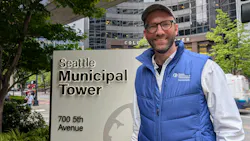
One word to describe yourself: Resourceful
Alma Mater: Undergraduate: University of Michigan; Graduate: McGill University
Fast fact: I started learning French in seventh grade and can now speak it fluently.
What’s your best experience on transit and what made it memorable? When I moved home from abroad once, a Chicago Transit Authority employee at an ‘L’ station asked about my trip when she saw my large pieces of luggage. I said, “I’m moving home to the U.S.” She gave me a big hug and said, “Welcome home!” That was still the best welcome from a trip or move I’ve had.
After moving where he could rely on public transportation and live car-free, Matthew Trecha began his transportation career in Seattle in 2014. His experience spans positions across regional transportation organizations including Commute Seattle and Community Transit, experiences that led him to his current role serving as the Seattle Department of Transportation (SDOT) strategic advisor and transportation demand management lead. Along with Trecha’s transportation background, he also earned his master’s in Montreal, spent a year of intensive Czech language study in Brno and worked in the private sector logistics space.
During his time in transportation, Trecha has led the development of new partnerships, new programs and leveraged the city’s multi-agency service area to improve movement in his communities through transportation demand management (TDM) programming and projects. Trecha has led programs to encourage the use of the region’s transit, vanpool and active transportation options in lieu of single occupancy trips. As part of this work, Trecha co-authored the city’s first TDM programs five-year strategic plan, moving the city’s TDM programs beyond large business and building compliance programs to encapsulate all trips.
In his role, Trecha project manages the city’s federally-funded Center City TDM project that includes SDOT’s Flip Your Trip—a multimedia outreach, communications and programming campaign to support shared trips to and within greater downtown Seattle. Under his project leadership, Flip Your Trip won an American Public Transportation Association (APTA) AdWheels Award for its 2025 summer campaign. This campaign worked to help Seattleites and regional commuters navigate Revive I-5, a local interstate preservation project. To support the Flip Your Trip and TDM programs five-year strategic plan portfolios, Trecha identified and won new funding for his team and department, including winning a Washington State Ecology grant to reduce single occupancy trips in and through overburdened communities adversely impacted by regional roadway construction and air pollution.
Further, Trecha and his team are piloting a new roadshow program that advertises their TDM work to internal and external teams to the city of Seattle and regional transit agencies with whom SDOT partners. By identifying pain points and solutions offered by TDM for other teams within the city, Trecha’s roadshow work has led to the development of new partnerships with SDOT’s curbspace management team and with SDOT’s public engagement team during and through capital construction projects. This work led to the first integration of TDM into the delivery of a transit capital project delivery, giving SDOT a new opportunity to educate residents and businesses on how to take advantage of new transit infrastructure from day one.
Within the state regulatory space, Trecha’s management of the city’s Commute Trip Reduction ordinance has resulted in greater employer support and transportation flexibility, including local ordinance updates. Trecha has also authored and advocated for Seattle Municipal Code updates, including those recognizing telework/hybrid setups and scooter/bikeshare memberships as compliant trip reduction strategies—ordinance updates that were adopted unanimously by the Seattle City Council and signed into law in 2025.
Across his work, Trecha’s experience in multiple agencies and organizations is described as one that has given him a unique understanding of how Puget Sound’s multiple transportation systems work in tandem. With this knowledge, Trecha created the first equity analysis of Seattle’s Commute Trip Reduction program and has informed proposed Washington State legislation related to the transportation demand management space. For these efforts, Trecha was awarded the Association of Commuter Transportation’s Cascades Chapter TDM Policy Champion Award.
In addition to his role with SDOT, Trecha recently completed a three-year elected board position, finishing as chair in 2025 of the Washington State Ridesharing Organization (WSRO)—a TDM professionals organization offering educational opportunities, including the state’s only TDM-specific annual conference. During Trecha’s board tenure, he led both a revision of WSRO’s bylaws to allow for greater flexibility in the organization’s operations and the establishment of WSRO’s first rainy-day savings fund in the organization’s 38 years—assisting the organization’s fiscal stability.
Is there a specific experience that led you to where you are today?
Taking the chance to move to Seattle in 2014 without a job lined up is what allowed me to get into transportation. I wasn’t having luck finding work in the Midwest but was able to find a contract job on the Line 6B oil spill cleanup in Marshall, Mich. Saving up enough money, I headed out west to get into public transit work. I knew Seattle was heavily invested in its public transit systems and within three months of moving, I had found my first role at Commute Seattle.
What do you enjoy most about your job?
I love that my job combines creativity (shoutout to Sal the Salmon), an opportunity to collaborate with so many people, and that when I travel, I can bring back new ideas for us to try.
What’s the most challenging part of your job?
Seattle has multiple transit agencies operating within its jurisdiction. The number of agencies who run trains, buses, streetcars, ferries and more can be confusing for the public and even for non-transit government stakeholders. Our partnerships are strong and well-coordinated, but I still sometimes need to clarify who operates which transportation options or who has which information.
What is the accomplishment you’re most proud of and why?
Before grad school, I took a year off and lived in Brno, Czech Republic, to learn Czech well enough to speak with my grandparents in their first language. By the end of the year, I could close my internet and bank account during separate 30-minute appointments—all in Czech and one over the phone! When I got back, I was able to speak with my grandparents in Czech as well. I still meet with a tutor once a week, but I may never get back to the level of fluency I once had.
What is an accomplishment you would like to work towards in your career?
One day, I’d love to be a leader at a small or medium-sized transit agency. I really valued my time working at Community Transit, where I got a glimpse at both the nimbleness that comes with a smaller agency but also the extremely close connections you develop with co-workers. Having grown up in a college town, I also really appreciate the impact transit has in connecting smaller communities to big opportunities.
What is your best advice you can share from your area of expertise?
Connect, connect, connect! Whenever I’ve started new roles or new projects, I do my best to grab coffee with people at all levels who will touch the work or who work on tangential projects. Hearing about other colleagues’ roadblocks or needs has allowed me to connect projects, programs and colleagues in new ways that lead to better products for the public.
About the Author
 Noah Kolenda
Noah Kolenda
Associate Editor
Noah Kolenda is a recent graduate from the Craig Newmark Graduate School of Journalism with a master’s degree in health and science reporting. Kolenda also specialized in data journalism, harnessing the power of Open Data projects to cover green transportation in major U.S. cities. Currently, he is an associate editor for Mass Transit magazine, where he aims to fuse his skills in data reporting with his experience covering national policymaking and political money to deliver engaging, future-focused transit content.
Prior to his position with Mass Transit, Kolenda interned with multiple Washington, D.C.-based publications, where he delivered data-driven reporting on once-in-a-generation political moments, runaway corporate lobbying spending and unnoticed election records.