Infrastructure Technology Podcast: Celebrating 70 years of the U.S. interstate
Key takeaways
- The Interstate remains a critical national asset: Roads and Bridges Head of Content Gavin Jenkins hosts a roundtable with Tracy Larkin Thomason, director of the Nevada Department of Transportation, Jonathan Gifford, director of the Center for Infrastructure Public-Private Partnership Policy at George Mason University, and Tony Kratofill, HNTB's national DOT market sector leader. They discuss how the system continues to serve as the backbone of the nation's freight network, connecting major cities, ports and economic centers while supporting national defense.
- Redundancy is a growing concern in rapidly expanding states: Larkin Thomason highlighted the limited number of alternative routes in many western states, making additional connections and network resilience important priorities.
- Technology is changing how the Interstate should operate: The discussion surrounds how connected vehicles, intelligent transportation systems and real-time information create opportunities to manage the highway system as a coordinated national network rather than 50 separate state systems.
- Digital tools can improve project delivery and lifecycle management: The panel notes how building information modeling, digital twins and stronger integration between design, construction, operations and maintenance could help agencies reduce costs and use available funding more effectively.




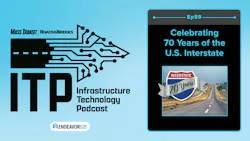 Episode 59 graphics.
Episode 59 of the Infrastructure Technology Podcast celebrates the 70th anniversary of the U.S. Interstate Highway System with a roundtable discussion about the network’s current challenges and what lies ahead. Hosted by Gavin Jenkins, head of content for Roads and Bridges, the conversation features Tracy Larkin Thomason, director of the Nevada Department of Transportation; Jonathan Gifford, director of the Center for infrastructure public-private partnership policy at George Mason University; and Tony Kratofill, HNTB’s national DOT market sector leader. The panel examines how the Interstate has evolved since President Dwight D. Eisenhower signed the Federal Aid Highway Act of 1956, including the demands of aging infrastructure, growing freight volumes, congestion, extreme weather and limited transportation funding.
The discussion explores how agencies can balance preservation, capacity improvements and modernization while making better use of existing infrastructure through technology and operational strategies. The panelists also consider the potential of connected vehicles, intelligent transportation systems, interstate corridor coordination, alternative project delivery, public-private partnerships and innovative financing. As the Interstate enters its next 70 years, the conversation looks at how states, the federal government and private-sector partners can work together to build a more connected, reliable and resilient national transportation network.
Episode length
1:14:46
Here is a transcript from the episode:
JP: Hello and welcome to the Infrastructure Technology Podcast. As I'm sure you could tell, I am not Gavin Jenkins, nor am I Brandon Lewis, but I'm Jessica Parks, staff writer for Roads and Bridges, and I'm here today to share with you a very special episode of the Infrastructure Technology Podcast. Over at Roads and Bridges, we've been hard at work putting together a suite of content celebrating the interstate at 70 years old. And today we'll be sharing our interstate round table where Gavin Jenkins discusses with three experts the future of the interstate. In addition to the round table, we are also sharing a media slideshow on our website compiling then and now photos of interstates across the country, as well as a reader submission series where we ask readers to submit photos and/or memories of their time traveling the highway or working on the highways that we see around the country today. Our last piece of content is a discussion with highway historian Bruce Sealy, where we discuss the history of the interstate and how it shaped America today. You can find all this content on our website at roadsbridges.com, and there'll be a link included in the episode description. I hope you enjoyed today's round table, and I look forward to hearing all your thoughts. Thank you.
GJ: On June 29th, 1956, President Dwight D. Eisenhower signed the Federal Aid Highway Act of 1956, launching what would become one of the largest public works projects in American history. The U.S. interstate highway system transformed how Americans travel, how goods move across the country and where communities and businesses develop. But the interstate we have today is very different from the highway system Eisenhower envisioned. Much of the network is decades old. Traffic volumes and freight demands have changed. Extreme weather events are placing new debands on infrastructure. States are confronting the enormous challenge of maintaining aging pavement and bridges while also addressing congestion and safety. At the same time, transportation technology is changing rapidly. Connected vehicles, intelligent transportation systems, digital project delivery, automated work zones, advanced materials, artificial intelligence and increasingly sophisticated asset management tools could change how the interstate is designed, built, operated and maintained. The picture for funding and delivery has also changed, with greater reliance on innovative finance and alternative delivery using public private partnerships and other approaches. I'm Gavin Jenkins, head of content for Roads and Bridges. In today's round table discussion, we will be examining where the U.S. interstate stands at 70 years old and what challenges it faces and how we should think about its future. Now let's mute our panel. First up, we have Tracy Larkin Thomason. She is the director of the Nevada Department of Transportation, and she is responsible for operating, maintaining and improving a major interstate network in a rapidly growing western state. Jonathan Gifford is director of the Center for Infrastructure Public-Private Partnership Policy at George Mason University. He is an expert on the policy, financing and systems that support the U.S. interstate as a national infrastructure network. And finally, we have Tony Kratofill. He is HNTB's national DOT market sector leader. He brings an engineering and consulting perspective on how state transportation agencies are approaching the challenges of aging infrastructure, mobility, construction and technology. Panelists, welcome to today's round table. Let's dive in. So first question, what is the actual state of the interstate system today, and what should concern us most about a network that is now 70 years old? Are we primarily dealing with a system of aging infrastructure or a system that is being asked to do things its original designers never anticipated? And what about tolling, public private partnerships or traditional delivery? It's a loaded multi-part question. Tracy, since you are the one responsible for the highway system in Nevada at the Nevada DOT, I'm going to let you start.
TRT: All right. Well, I think the network of the interstate system is fulfilling what it was originally intended for. I just think now that we are starting to grow out of, it is becoming more than what was envisioned at the beginning. As a part of a western state, there are many western states out here that are still growing, the fastest growing states in the nation, and when you look out at the system here, there's very little redundancy in the system. So there has to be some, as I'm looking forward thinking, there needs to be some alternate routes or some other redundancy built into the system to allow for it. So you have major freight. I still believe that the interstate is the major supply chain management. It is the major freight system in the nation, major northwest. And when it comes to national defense, which again, one of the things that President Eisenhower put together as he envisioned this, it is still a major part of that. And when you're looking across the area on there, we still need to maintain that and perhaps now move to how do we enhance it. A lot of it is, you say about aging infrastructure, certainly there are parts of it. I would say that in most states, the interstate systems are probably, they're our number one priority, so as you get progressively down to your arterials and so on, more emphasis is placed on keeping the major routes in good shape, so I don't know if you want to expand more on that.
GJ: No, no, that's perfect. I think that we should jump off from there, and I'm going to go to Dr. Gifford, Jonathan. Jonathan, what do you think of what Tracy said, and what are your thoughts on where it stands at 70?
JG: Well, Tracy used the word network, I think. And when you look at the interstate as a system, the comprehensiveness of the network is an enormous asset. The fact that it ties together almost all the major ports of entry, major cities, economic hubs. There are certainly places where it could be expanded in terms of connecting new centers of activity, and there've been small additions to the system since it was originally conceived in the 1940s and then put into legislation in the 1950s, so I think that network as an asset is a huge plus for the country in terms of having that as a backbone to build and expand on, so I think we're very fortunate to have that as a legacy of the vision of the people in the 1940s and the 1950s who passed the legislation that made it happen. The challenge is the federal government paid for 90% of it, at least. I think in Nevada it paid for 95% of it. I think because there's so much public land in Nevada that is owned by the federal government that the formulas for reimbursement to the states for their construction expenses was higher in states that had large fractions of their land that weren't available for economic development by the states themselves. And so how do we meet the expenses of operating and maintaining the system that we have, major maintenance, as well as routine maintenance day-to-day, that's a burden that's on the states with some federal assistance. And how we do that I think is a big challenge. I think the state of good repair of the system varies from segment to segment and from state to state, but overall, I think I agree 100% with Tracy's point that this is the priority system for every state, and that is an emphasis for trying to keep that in a good state of repair because not only are they citizens, but businesses rely on it so heavily for supply chain and logistics. The big challenge I think is tackling that financial, I don't want to use the word burden. I think the financial responsibility to enhance and maintain the system going forward for the next 25, 50, 75 years, the system will be with us in perpetuity essentially. And how do we meet the challenge of doing that at a time when the strains on the federal budget are very high, and there's a lot of competition for the resources at the federal level, and that's where alternative finance, tolls, public-private partnerships have come in, and I think there's a lot of potential there, although tolls are, I will say an understatement, not universally popular, so we have to figure out how to do that in a way that is going to meet the test of public acceptability as well.
GJ: Tony, let's get to you. They're both going in the same direction. Now it's your turn to zag and say they're both wrong and that the interstate is crumbling, and we need to do something drastic to improve it so it lasts another 70 years, right?
TK: Well, I hate to disappoint you, Gavin. I'm going to agree with both Tracy and Jonathan in their assessments, and I would think if you asked any of Tracy's peers, they'd answer in a similar way that she did, but I wanted to build on something Jonathan was saying about the idea of a network and how the modern world compared to the 1950s when the interstate system started is much more connected in real time, and I think the expectations of users of our infrastructure systems expect that type of connectivity. Yes, the system was always physically connected or when it was built out was physically connected, but the idea that it is being operated as a network and not operated as 50 different states systems is something that is emerging as a challenge. And so yes, state of good repair is an important responsibility that has to be addressed because people do rely on the system and the resources are limited, but at the same time, I think Tracy and her peers, the other DOTs and the federal government, are also challenged with how do you modernize the system at the same time, not just rebuild it the way it is, but rebuild it to what the expectations and needs are of modern society in America.
GJ: All right, so we're all in agreement, and I think the key word so far has been network, and that's really what it is, and what's really unique about it is how it connects us. So moving on, if transportation agencies have limited resources, like we've already mentioned, should the priority for the interstate be maintaining what we have, rebuilding aging infrastructure or expanding capacity? How do agencies decide? And are we still thinking about the interstate capacity the way we did 30 or 40 years ago or has the definition of capacity changed? With this one, let's stick with you, Tony.
TK: Yeah, first of all, I don't think it's this kind of either or decision between any of those things. You have to try to address all of them. But to your point, there are limited resources, and so it's not just fixing it first, even though that sounds good. It's good rhetoric, but it can't mean that you're fixing it only. You're also needing to address what are the modern needs for the system. Your question about the way we view capacity or view how the system function is different. In the past, we maybe thought about it in terms of, well, if it's not meeting the need in our peak hours, then we add additional physical lanes to it, and I think the industry as a whole, particularly the DOTs, are recognizing they need to try to squeeze as much capacity out of what they already have and are turning to technology and operational strategies and ways to either level those peaks in demand for the system or help address situations when there are disruptions to the system, whether it's crashes or weather events or things of that nature and really try to get as much out of the physical infrastructure that you have by using digital or technology types of infrastructure to balance that out over the course of the day. One of the things that I think most people value, certainly freight haulers value, is reliability. And so it's about knowing that that travel time is going to be something they can count on, they can plan around that. And so trying to find ways to improve reliability, I think when the interstate was first built, it was largely about how do we speed the time of travel from one point to the other across the country? Now that that's largely achieved, it's how do you do that in a reliable way?
GJ: Excellent, excellent points. And yeah, I mean, Tracy, you're sitting right here, you are a top of an agency, so was I wrong in making it an either or? So how do you make those decisions when it's preservation versus expansion?
TLT: Basically, it is a balance. There is always a level of preservation, particularly on the interstate with the major truck traffic, the commerce that it serves, like in Nevada, I-80, I-15 don't just serve Nevadans. It's a major lifeline for us, but it serves the interior of the U.S., particularly I-80. So when you look at preservation, yes, that's part, but I'm also looking at bottlenecks, areas where I need to do capacity. As we're in the major urban areas for us, Las Vegas and the Reno areas, we have areas that are eight, 10 lane highways, but we're not going to do that all the way when we get to the rural areas where basically it's two lanes or four-lane highways, two lanes each direction, so we have bottlenecks though, we have capacity, we have a major project that we're in the middle of now to increase lanes and capacities as we're moving farther east. But I'm following up on Tony's point though, we're also looking at the operations. Again, how much can we squeeze out of what we have? And it's not just within internal regional things to each state. We are looking at corridors. We are literally looking at I-80 from California to New Jersey. We're looking at I-15 from California up through Idaho. We're really looking at these, how do we get messaging out ahead of time for the operations so that if we close down the border at I-80 at the California state border, Nevada, California border, but we go back literally to Nebraska. We let the truck traffic and the traffic know Nebraska, you want to turn off or get off the interstate before you get to Nevada or else you're going to be stuck on I-80, so I think taking that technology and advancing it really allows us, one, additional capacity, additional messaging and giving informed choices to all the travelers. I mean, we're really focusing on supply chain management, but it's benefit to everything else. And also adding on that, these are critical for emergency management, large regional events. We just had fires in the last few weeks, and we closed down a related interstate I-580 because the fire was going to jump the freeway, literally. There was no way to get around. I mean, how do you manage it, get the messaging out, keep people out, get them around? This is becoming super critical. And if there's a major event and there's more of those major events, they're more frequent, they're more intense, whether it's like insert whatever you want, tornado, fire, flood on there. If you get multiple, that backs up, and that network becomes even more critical because that's where the majority of the traffic will be evacuating to and from and so on. Particularly in the west, we have smaller roads, but it can't handle the type of traffic that's on the interstates. So that's when I say it's the backbone, but we're going to reiterate probably many times more, it's a network of how we actually get it connected.
GJ: You said an interesting point at the beginning there about the finance aspect of it and where do you want to stretch those dollars, and Jonathan, that falls right into your area of expertise. What are some of the consequences of postponing maintenance when you're going up against a really strict budget and how do agencies determine which projects get funded?
JG: Well, I think every state has its own process on how they identify and then prioritize and schedule and program projects, so I think it's hard to generalize. Maintaining the state of good repair is a priority, I think, particularly on the interstate for every state DOT. We could always use more money. There's never enough money, and you have uncertain events like weather response and so forth that can cut into the funds that are available without any ability really to anticipate those, so I think that is something that states have learned to do this over 70 years, and you ask them if they need more money, and they would all probably say absolutely, but I think they also make a very valiant and largely successful effort to try to keep the system operating. And both Tony and Tracy mentioned operations, and we've seen extraordinary advances in that in my career just in terms of the technology, the hard technology that is available, but I wasn't aware of the I-80 corridor effort, but I am very familiar with the Eastern Transportation Coalition, which used to be called the I-95 Corridor Coalition, which goes from Maine to Florida, and that is a coalition of state DOTs, toll agencies, emergency responders from local police and fire and EMT that are all networked together so that they are able to, one, respond to incidents when they do occur and also transmit information up and down the corridor to users to be able to give them just exactly the sort of information that Tracy was mentioning. But the big CapEx projects, what do you do when you have a real capacity problem, and you've got a very congested corridor, you've expanded the footprint of that corridor as far as you can expand it. Adding lanes isn't an option. Then how do we tackle those? I was at a conference last week on express lanes and the growth of express lanes in the U.S., I think we have some 83 projects at one state or another of express lanes across the U.S., and an express lane is a situation in most cases where you have existing non-tolled lanes, free lanes, which are not free. Somebody has to pay for them, but you have non-tolled lanes, but in order to manage the capacity more effectively, you insert two or four toll lanes and construct them and allow them to be used by users for a toll, often a toll that varies by the level of congestion, and that has been very successful way of managing congestion in very congested corridors. We've had a lot of examples around Washington, D.C., along I-66 outside the beltway, along the 495 Beltway around Washington D.C., I-77 around Charlotte, North Carolina. Tennessee has just gone to market with some, they call them choice lanes, which I think they've trademarked that, but it's a very apt name for it because the non-toll lanes remain available to those users who choose not to use the toll lanes and those who on a particular day or every day want to exercise the choice to use the choice lane or the express lane, they have the ability to do that, so that seems like it's been a pretty effective way, and it has benefits for transit and usually HOV, high occupancy vehicle cars, carpools of three or more are allowed to use the facility without paying the toll. So those are common in Texas, they're common in Virginia, they're coming in Georgia, in Tennessee, in other states. So I think it's a very interesting development that helps address that part of the problem. An interesting initiative from the Trump Administration right now is looking at multi-use corridors. What is it called? AGCC. I have to look up what it actually stands for, but America's Great Corridors of Commerce and looking there at ideas about taking this network, this physical network that we have and being able to expand its usability for say fiber networks or other use networks that would be complimentary and have economic value and which could generate some sources of revenue for the owners of that right of way, which in most cases is going to be the state who's delivering it. It's complicated. There's lots going on in that highway right of way, but there are, I think, opportunities there. And Japan for many decades has had an active program of under road space where they try to make the best use of this under road space, so I think that can be an advantage. And then back to the notion of a corridor, these corridor coalitions I think have tremendous potential in order to manage disruptions and also to coordinate response to major events because the roadways need to be cleared not only for the users, but also for the emergency responders who are trying to move into the area and provide relief to whatever it may be, a fire, a snow event, whatever it may be.
GJ: Now part of your answer, Jonathan, really touched upon our next question, which deals with the future. So let's gaze forward a little bit and think about and talk about what does the modern interstate need to do? The interstate, as we've already talked about, was designed for mobility, commerce and national defense, but what should the interstate be designed to accomplish in the 21st century? Are we still designing roads primarily for cars and trucks or should the interstate become part of a broader transportation ecosystem with broadband and the electrical grid? And also with what the Trump Administration is doing and make it great by having a lot of technology involved, should we be looking at places like Japan for inspiration? Tracy, we're going to start again with you. What do you think about the future of the interstate?
TLT: Well, I think a lot about that. So actually, we've talked about the network a couple of times, and there is, when we talk about the I-80 coalition, there is an I-15 alliance, there is an I-70 coalition, there's an I-10 coalition. These are all building up at a national level. We have about 11 or 12 interstates now who are actively working together looking at how we communicate in each area. Is there an alignment of our messaging? Do we have gaps in the infrastructure? Do we have gaps in our connectivity? Do we have gaps in the interoperability of platforms used across there? That is very actively being done. There's regular meetings on it, looking at how we can better align the network in our operations. Do I think there's absolutely opportunities for telecommunications increasing in that there? I think energy, there's a number of states that are already looking at how they can put in energy fields within there to help enhance the system or provide even outside benefits to the system. I think utilizing the interstate, we have in some places, Florida, and we're looking at now in Nevada and California, we have railroads in some of the areas of the interstate that's picking up additional traffic, so I think looking at all those opportunities, definitely looking at it. I do think the interstate itself, if you're talking about the physical part, is still primarily geared and needs to be prioritizing supply chain and the really heavy east-west, north-south movement across there, and we've touched upon emergency management a few times. There's also that part, if any major event, and like I said, we've seen it in the west, and I always use this as an example of if you're in Nevada, but you cut a line from Canada down to Mexico, I have really four major interstates that you're going to cross, and it's I-90, I-80, I-15 and I-10, and there's a few other in there. That's not a lot when you consider that distance, so I think that we maintain and enhance what we have is absolutely critical as a backbone. But again, are there opportunities for telecommunication to go in? We're looking at that in Nevada now, and I know other states already have Nevada fiber sharing within there. Are there ways that we can get some benefit to the public, benefit to the agency and also a little bit of revenue coming back in to feed into the upkeep of the system. We're just beginning to explore energy, and like I said, I think Georgia is a prime example of a state that has brought in other energy on there and looking to see how they have done it and is the way we can incorporate it.
GJ: I want to jump in for one second and ask you a follow-up question if I could. We're on the topic of energy there. What about EVs and EV infrastructure? How is Nevada approaching that?
TLT: It's challenging, and if you look at it, we are twice the national average at adoption of EV vehicles, primarily in the urbanized areas. When you get out of the urbanized areas, we have long stretches, I mean like 450 miles where you're going to find a gas station or even a community every 100 miles, so you're not putting an EV station in the middle of nowhere at 50 miles, and majority of the state does not have the grid to actually support infrastructure. So we are looking alternatives on how we can expand our energy footprint to accommodate some of that and then be very strategic about where we can work with partners to provide the infrastructure necessary to support that, so it's kind of a mix. We love it, but if you're in the urbanized area, it's really great. You'll find that the majority, like I mentioned, of the adoption is in the urbanized areas and then along the major interstates, but when you get in the middle of a state and you're looking at our north-south routes, you're not going to find a lot of infrastructure, and we're still struggling with when we put it in the maintenance of it, the upkeep, and if something goes down, can we get someone there to fix it in a reasonable time?
GJ: Yeah, that's what I thought that you would say, especially in regards to the urban areas, because every time I go to Las Vegas for World of Concrete or CONEXPO, I see lots of EVs, and it's a struggle for building out that infrastructure. Tony, let's go to you. When you look at the future of the interstate with your experience working with DOTs, what do you think we need to be designing the interstate for in the 21st century?
TK: I think that the comments from Jonathan and Tracy kind of alluded to it, is that it's more than just the concrete and steel that is out there that supports vehicular transportation. It is how can these public rights of way, which by the way, state DOTs tend to be the largest landowners in their states in many states because they have so many rights of way, and that public asset has value both in the space that it provides to put other things, but there's commercial value there too. I mean, Jonathan's reference to the choice lanes and things, those are being delivered through public-private partnerships because the financial markets see value in extracting the use of that space to address the congestion issues. They see value in the development potential that's going to happen because of how the interstate is being rebuilt or modernized in certain areas. And so there's tremendous opportunity to be thinking about it because it’s bigger than just the pavement, bigger than just the bridges, but what is that role of the infrastructure in the overall economy of a region, of a state and really of the nation?
GJ: Yeah. Jonathan, there's definitely a policy angle to this question, and I was wondering if you could approach the future of the interstate from a policy perspective.
JG: Well, if you go back and look at the history, the first proposals for a national road network, depending on where you want to start, but 1890s, 1900s, there was talk about a national network. Franklin Delaware Roosevelt famously drew three lines north-south and three lines east-west on a map and the Bureau of Public Roads. Now the Federal Highway Administration went out and developed some plans around that that ultimately evolved into the interstate system that we have today. I think the question of tolls is a huge one. I think we made a choice in the 1950s as a country to deliver the bulk, whatever, probably the 45,000 miles of the interstate system, 35,000 miles of it, 30 to 35, I don't have a precise number, has developed without tolls, and we have developed an economy around the utilization of those facilities that don't involve tolls, and there's nothing more difficult than convincing a road user that a road they've used without paying tolls for their entire lifetime, it now makes public policy sense to start charging a toll for it. That's a tough, tough, tough sell, and I think you can count on one hand probably the number of successful attempts to do that. Even roads that started out with toll, had the tolls removed and then bring it back, even that, very, very tough, so I think that's one of the really challenging policy issues because we have a federal budget that's got a lot of demands on it from social security to Medicare to defense to increasing interest costs. There's just lots of pressure. And so I saw a number the other day that the interstate system was a $702 billion infrastructure investment in 2026 dollars and the likelihood of getting an investment on that order of magnitude out of the Congress and the executive branch, I don't think there's money there to pay for it, so we have to look at alternatives, and I think that's where some difficult conversations about how do we deal with how users pay for it. We had sort of a magical formula in the 1950s of this highway trust fund that was fed by a gas tax, went in on a pay as you go basis, the revenues to the gas tax into the highway trust fund then paid to build out the system but the appetite in Congress and to raise the gas tax, to keep pace with the requirements of building out the system, it's just not there. We haven't raised the gas tax in 30-plus years. And so because it's a sense per gallon tax, and we've had a lot of inflation over those 30-plus years, the purchasing power of that federal gas tax has gone down quite a bit. And then we have electric vehicles and hybrids and so forth and much more efficient internal combustion cars, so that fiscal policy challenge I think is one that we need to grapple with and try to come to terms with. In congested corridors, the express lane does provide an option. The Tennessee Express Choice Lane procurement that just was announced the preferred bidder there, an upfront concession. Well, I don't know the details of it, but the overall concession fee paid by the preferred developer is announced by the Tennessee Department of Transportation is $24 billion, $24.8 billion. That's an enormous, enormous number. Not all of it's going to be paid on day one, but that is a source of revenue to Tennessee to be able to provide services that go to not only highways, but to transit and other modes of support, very, very significant, so I think we'll have to see how that plays out. In Virginia, we had a much smaller one for the I-66 quarter. It was $589 million, I think, payment to VDOT for the right to develop that 19-mile corridor. Georgia had a 3.7 or $3.8 billion concession fee from the developers on their Georgia 400 project, so that's an option. Those are large enough numbers that I'm sure the governors of every state are saying how much of that or where would that possibly work in my state to deal with some of our infrastructure shortfalls? But the other thing that has a policy dimension to it that we haven't talked about very much so far is the whole notion of automated vehicles, and that is not only for personal cars, but also I think critically for freight vehicles and the potential for that is enormous and we don't have the results yet, but the promises in terms of improving highway safety seem to be very, very favorable in terms of particularly dealing with impaired drivers and things like that, which is a challenge across the country, so I think we have some opportunities there, and I don't think we've figured out how to do that yet, and I think each state is sort of grappling with that with some cooperation from the federal government and how to deal with those types of vehicles, what permissions to grant them for use of the system, and I think that's going to be a very interesting thing to watch develop over the next decade or two. In my career, we joke about a long history of a bright future, but I think we're seeing things that are really happening in the AV space that I think maybe the time is now.
GJ: All right. So automation leads us to AI. And for our next question, I want to talk about the ways technology can change not just the ways we design and build, but also how we operate and maintain the interstate for the next 20, 25 years. Jonathan, let's stick with you. And from your perspective, I'm interested in how different owners of the interstate can afford this technology because what I've gathered from traveling across the country and talking to people in the industry, there are some haves and have-nots when it comes to technology. And how can we get the same technology that's working on the interstate, say in California to poorer states or just states that need more funding like, I don't know, Arkansas or Alabama, where the interstate there really does need the help?
JG: Well, I think at some level, some of these applications pay for themselves. I mean, if you can improve or lower the cost of bridge inspections or pavement inspections by an order of magnitude, by the use of AI-assisted pavement condition detectors and inspection technologies, use of drones for looking at the underside of bridges and doing AI processing of the images that come forth, that can just give the state much better information about the state of their assets at a much lower cost and in a much more real-time setting that just allows them to use whatever limited resources they may have in a much more efficient way. And so I think there are a class of applications that will pay for themselves. If you look at applications of AI in design and construction, the design applications are sort of, I was going to say self-evident, but I'm sure we haven't even scratched the surface in terms of what we're able to do on the design side with AI yet. But still we're seeing things, just the ability to rapidly visualize different design alternatives and to turn AI loose to come up with better solutions to highly constrained problems, and I think those, again, sort of come through in the capital expenditures budget and how much it costs to design and then construct. Are you able to devise better materials because of the ability to use AI for material exploration? So in that sense, I think, I don't know that it's a rich state, poor state contrast because I think the design and construction industry, as Tony knows very well, is that national is a global business and the techniques that are able to be used for one client can be used just as well for another client and can give a contractor a competitive edge when they're competing for the business of state A or B or C or D or E. So there may be other areas in terms of say an operation center and being able to outfit an operation center for a state's major corridors or major facilities where the CapEx required to outfit that center coming out of the DOT's pocket and a rich state might be able to afford to do things that a poor state could not, that probably is some technical assistance that could come from the federal government. So that's not a very organized answer to your question, but it's an attempt at an initial response anyway.
GJ: It makes perfect sense. And poor choice of words with poor state, rich state, but there are states with more flexibility in their budget. And Tony, let's jump to you, the design aspect and also the maintenance aspect. I imagine that, from what I know about HNTB, one of the best engineering firms in the country, that when it comes to AI, digital twins, BIM and digital project delivery, you are ahead of the curve, you're leading the charge. And so please tell us how those tools can really help improve the interstate.
TK: First of all, thank you for that recognition, and we certainly work hard to support our clients moving into this digital age. And clients are at different places, but everybody is using technology to some degree. And it's just about, I would argue the pace of change is not limited necessarily by budget, but by the ability to really think beyond just that individual application of perhaps a digital model for design or construction or a digital application for inspection and maintenance. It's really about how do you start doing those things at scale, how does that change your business process? Do you have the right governance structure? Do you have the right ways of assuring data quality? Do you have the right protections against cyber attacks? Do you have interoperability across systems so that you're using one source of data for multiple applications, multiple uses? State DOTs are maturing in that, and some are definitely leaning in farther and are going a little bit faster than others, but they're all coming along, and to Jonathan's point, the industry, as big as it is, is a small community and folks on all sides of the fence are learning and growing in their capabilities, and I think you'll see within the next 10 to 15 years, tremendous change in the application because it's going from pilot and test to scalable application, and that's the exciting part is helping our clients, helping public agencies really think about how they do their business differently in a digital age and not just try to apply technology in the way they've always done business.
GJ: Well, Tracy, I'd love to hear what you guys are doing out there in Nevada when it comes to AI and the interstate. What has the process been like to implement it?
TLT: Actually, we've been using some form of AI, if you want to talk early on, like machine learning for about two decades or more. We have an operation center that covers not just the NDOT network in the Las Vegas, Southern Nevada area, but also all the cities and counties surrounding it. But one of the things putting on there is yes, there's more efficient ways that we can manage the traffic, get it through, but I think we're also learning how we actually measure the benefits of it are not always just in transportation. The fact is if we use AI to recognize patterns on our freeways, we can identify incidents much faster. We get whatever's necessary to go in there with a triage. So do you need an ambulance? Do you need a tow truck? Do you just need some there? By clearing things off faster, we're reducing the secondary crashes, we're reducing other related incidents, but now we're saving the insurance industry, we're saving in other industries besides just transportation, and I think as we start spreading out along the freeways, and we're looking at cameras trying to get it all the way up the I-15 along up to Salt Lake City and San Bernardo County, Phoenix, we identify things faster, we manage events faster, we can deal with the incidents faster. We are coordinating much better, but not only in the transportation sector, but the emergency management, connecting communities along the corridors, law enforcement, first responders, all those things are now part of that environment. And I think one of the things is as I'm managing or looking at our AI, our investment in technology is not only how does it support the system that we have, but how it is also a fundamental foundation for supporting all those other industry, those sectors I just mentioned. And particularly in the rural areas, that's becoming more and more critical. Are we connected? And Tony mentioned before, the interoperability of platforms. Are we communicating when we're talking, particularly in areas that have very little coverage, can we communicate to the law enforcement first responder there? Do we communicate right across the border? Are we communicating with our partners in other areas? I think just that relationship is also morphing as we talk about putting the AI, putting the technology within the transportation system. I think that's forming a foundation for a much bigger ecosystem on there, and I think particularly as we connect those interstates, as we talked about the network before, and I'm an operations person, so you'll see me go on this one for a while, but when we start to take that, you really start to look at it as a national investment. We really start seeing that as we connect this, what we can do to really connect the supply chain thing. You talked a little bit with Jonathan before about AVs. We've met with the fleet companies together like Zoox and Tesla and Waymo, along with the long haul like Aurora and so on, more about as we morph into this, what kind of technology is needed to support you as an ecosystem? And a lot of what they're asking for is some commonality as they move from place to place. What's the commonality of the parameters for operation within your state or along your corridor so that they could go along all the corridors state to state, replicate in different cities with the same kind of expectation of operations.
GJ: All right. Well, that leads us to our next question, and it's about, again, maintaining this network that we have. What needs to change or if something needs to change, I don't want to assume that we need to change anything, but what needs to change if we want to continue this network? Is there anything that we need to change in terms of construction models, accelerated construction, prefabrication, modular construction? Of course, accelerated bridge construction is huge right now. Is there anything we need to have more of to improve the interstate for the next 70 years? Tony, let's start with you.
TK: So all those things you mentioned, Gavin, are currently being used, and I think for very good reason. When you first built the interstate system, when we first built the interstate system, it was kind of in virgin territory, right? Nothing existed, there was no traffic on it when it was being built. It was not saying it was easy, but it was different. Now you're trying to maintain traffic while you're also rebuilding it, and economies and businesses and citizens rely on that system. And when it's being rebuilt, it's somewhat taken partially out of service. And so it certainly requires a different level of creativity and innovation. And so whether it's accelerated methods of project delivery, accelerated bridge construction techniques, or simply different models of delivery other than the traditional, you design it, you bid it out, and you build it, things where there's more collaboration and interaction with the contracting community in the design, in the plan for how it's going to be delivered, really will allow public agencies to get more out of the investment that they're making and serve their customers better. So we are seeing that across the country. More and more agencies are using various forms of alternate delivery, various forms of ways of accelerating construction, and I think that's only going to continue, and I think it should continue. There's a lot of opportunity to continue to tap in. I've always said, I was in the public sector for 30 years, and I always said contractors are a creative class. You give them a problem to solve and give them a little time to think about it, they will come up with stuff that you never would've come up with on your own, and I think the more the public sector engages their private sector partners, the better solutions we're going to get in the end.
GJ: Tracy, I want to ask you a question that is attached to this question just to extend it a little bit further. When we're improving the interstate, how crucial is the coordination between designers, contractors and DOTs? And please talk to us a little bit about how the Nevada DOT has fostered those relationships and improved communication and coordination when working on a project.
TLT: Oh, I actually, I'm going to echo what Tony was saying. I think the coordination, I know, surprise, the coordination I think between the owner, the designer and the contractor, I think is becoming even more critical. And when you're looking at a place on the interstate where you have to also maintain a level of traffic during any construction, how can you best maintain the level of traffic and then also build? So early on, looking at creative ways, whether it's design build, getting in early, that coordination, we're doing our first progressive design build, and as we're going through that, we're in the middle of that now, and it's constantly evolving how we can better develop those relationships. And on there, we were talking last week with a group on modified progressive design build. How can we keep modifying that relationship? But it has to do on materials, it has to do on methods of constructability. How much can we prefab? I mean, particularly in the urbanized areas where you need to be in and out, is everything preformed? What kind of materials are you using? Concrete may have a longer life cycle, but it has a much longer curing time, which means you can't use that piece of pavement while you're building it. So like I said, we were just in the middle of a couple last week of talking to the contractor basically on this one out there as he's talking about different methods and bringing up things like we stand back like, well, that's kind of cool. Literally, it's a different method of construction or a potential of thinking outside the box where many times as an agency we've grown, we know what we know, but there's a lot we still need to learn too on what can be available as the industry. And you also mentioned, or it's been mentioned, the variability of materials, things that we can use, different construction materials that can be applied, and we're just beginning to get into that. So the short answer to you, it's critical that relationship be enhanced and grown.
GJ: Okay. Jonathan, I want to just fast-forward now to our next question because I feel like your answer to the previous one would touch upon this one. So the interstate was built around a very different funding model in transportation economy. How should we pay for the interstate over the next 70 years? Is the traditional federal state funding model capable of supporting the interstate we need by 2050?
JG: Well, I was going to say that's the $64,000 question, but if only it were only $64,000, it's a much bigger question than that, and I think it's about innovative approaches to financing, to building, to contracting, to procurement, to the way we do business, and I think one thing that the feds could do that would help relax the constraints that are associated with federal projects and federal money could help. We have very strict federal restrictions on rest areas and how states can use rest areas. I think vending machines are about the most advanced service in most states that can be used on interstate rest areas that were paid for from the highway trust fund, and there's been a strong industry response by the off interstate businesses that support traffic that they don't want to be competing against the state providing services in rest areas. I though maybe the desire for electric vehicle charging might change that, but it doesn't seem to have precipitated a big change there, but that's just one example of the restrictions that the feds impose on projects that receive or received federal funding where there might be opportunities for revenue, which doesn't mean that the incumbent suppliers would be fenced out. I mean, the states are not going to get into the gas station business themselves. Somebody's going to be operating those properties, and it's going to be the private sector, whether it's EV charging or other types of services, so that's one type of constraint. We've talked for decades about permitting reform and trying to improve the permitting process, and I think with all of the public attention on the grid and trying to respond to the data center pressures and the fact that building new transmission lines are running into the same types of permitting barriers that roads and bridges have been running into for many decades, a lot of the protections that are built into those procedures were put there for a very good reason, but have they been implemented in the right way? And have we constrained our ability to respond to emerging challenges and opportunities with a set of permitting procedures that make it very hard for us to respond? So how can we maintain the integrity, the environmental and community integrity of our infrastructure development processes while at the same time relaxing some of those constraints, which gets to funding because part of the cost of America's very, very, very high infrastructure development costs are the soft costs of permitting and public engagement and litigation and so forth. So we have a serious cost problem and it's much of it, I think, not so much the cost of our materials and our construction, but a lot of it Is the procedures. I think there's also the states have the capacity to change their own procurement processes, and many states have begun to do so, and I think looking at how that can facilitate design build, progressive design build, public-private partnerships, other forms of alternative delivery, as Tony mentioned, I think you can not only get more creative solutions potentially through doing that, but also find innovative financial solutions to approaching it. I'll mention, again, Georgia 400. In the procurement there, the state accepted more than 140 alternative technical concepts that were proposed by their contractors. And the state typically or traditionally, I think the state said, ‘Okay, we will accept this alternative technical concept, but the permitting risk is on you, so if we have to reopen NEPA in order to evaluate this and proceed, that's all on you, contractor’. The state's not going to take that risk, but in Georgia's case, I think they accepted one third of the cost of reopening NEPA if necessary, two thirds to the contractor, one third to the state. Very innovative, I think unprecedented and opens the potential for much more creative solutions. And so I think getting more money is going to be a challenge, and I'll be willing to go out on a limb and say that's going to continue to be a problem. That is never, never going to be easy, but I think spending the money that we have more effectively is an area where there is a great deal of promise from the technologies that we've talked about, from procurement reform, from alternative delivery, and I think there's great promise there in looking at, you mentioned digital twins and BIM systems, these things can make a difference. And finally, I'll say reorganizing the way the state DOT does its business. Traditionally we've had a capital projects division, and they throw the project over the transom to the operations and maintenance division. If we have things like digital twins and BIM and so forth, a tighter integration between operations and maintenance and design and construction I think can help reduce the lifecycle costs of projects and allow us to use the funds that we have more effectively.
GJ: Tracy, I bet you're dying to talk about your budget, but please tell us a little bit about how the budget process is. What's your approach to it? I mean, it's so complicated with the federal funding, state funding, the highway trust fund declining. We've already talked about the declining gas tax revenues. I mean, what is your approach when you're running the Nevada DOT?
TLT: There's a lot of prayer involved. Seriously, it was mentioned before that primarily our funding base in Nevada is primarily on fuel tax revenue at the state level and the federal level. It has not changed since 1993, so it's over 30 years, so in many ways it's pretty much flatlined, and when that federal gas tax, it’s a per dollar gas tax. It's not like it's not indexed, it doesn't raise to inflation, which inflation just in the last three years has been close to 70% but well high into the 60s. That has hit us hard. The availability ever since COVID of just getting the supply, getting the supplies here, there's a long lead for certain things like steel, ITS features, just bringing them in, getting them delivered. So when you bring all that into the budget and then you're trying to balance each part, but now it's becoming in, can I preserve what I actually have, maintain the system I have while meeting some of the needs in a state that's rapidly growing? We're one, I think we're the fifth fastest growing state in the nation, along with many other western states, but looking at that capacity, which we mentioned before, so it's tight. We've reduced our program considerably. We are moving more towards a preservation only. We're delivering what we have, but as we look at the matching parts on federal funds, there's some grants we do not go after because of matching the part of it, so we're looking at how we maximize what we have, pull it back in, so I really wasn't far off when I said I do a lot of praying.
GJ: All right. Well, thank you for that. What we're going to do now is we're going to get to the closing thoughts section. And so we'll go around and I just want to hear your closing thoughts, panelists, about the state of the interstate, and its future. And Tony, we're going to start with you.
TK: Look, the interstate has been one of the most consequential public investments that our country's ever made. We've seen it play out over the last 70 years, and I think it will remain to be one of the most consequential parts of our nation's infrastructure systems, but it is going to require some rethinking and seizing the opportunities of a digital world and how that can change the way infrastructure is delivered and operated and maintained and how things that people are looking for in terms of reliability are provided, and I think it's also, to that last question, I think is self-evident. The systems for funding this are changing and the states are finding new creative approaches. Our business is changing as an engineering firm. We're not just providing engineering services, we're providing advisory services to help our clients figure out some of those challenging funding and financing solutions. And so it's really, in some ways, an exciting time to be thinking about the future because there's so many interesting and innovative ways to approach it, so I'm actually very optimistic about the future and how the interstate system will make us more connected and more competitive as a country as long as we're up to the challenge of embracing technology and embracing innovation.
GJ: All right. Tracy, let's go to you.
TLT: All right. I will also agree that the interstate system is still the backbone, and I believe there's probably there does need to be a federal interest in it looking at the network because I believe the network still has to be operable for the nation itself. When you get down into there, I agree with Tony, it's an extraordinarily exciting time to be in transportation. The technology is changing the way we do business, it's changing the way we operate the system, and it's providing opportunities we never even considered before. But with that, as we look along the corridors, and as we're talking about the interstates, that technology is we're looking to see on these alliances that I've been talking about is really looking at providing a basic level of connectivity and interoperability along the system so that we actually grow the network, it's benefit for the state, but it also allows, we have memorandums of understanding between states along these corridors that are basically saying when we get to the borders, when we get... And whether you're at the state border internally, the level of service to expect eventually, but it allows each area, we've talked about rich and poor states, it allows each state to move at the pace that they can with the budget they have, with the priorities of their state at that time, but to create a basic level of understanding. Like I said, I still believe that the federal government has a strong vested interest in it, but then each of the states need to step up and see how we can actually take care of ours, but also work with our neighbors and make sure that we are a solid piece of that growth.
GJ: Excellent. Jonathan, closing thoughts.
JG: I think the federal interest in the interstate system is changing. Again, I'm history buff, and you go back to the 19th century, there was a whole question about whether the federal government even had authority to support internal improvements and things like the National Road were shut down over concerns about that, that advantaged one state over another, and we didn't really have a big federal presence in the road system until the early 20th century and that evolved in fits and starts originally like, well, the constitution mentions post roads, so we'll focus on a postal road network. And only later through partnership with the states did the federal role really become a partnership with the states and a funding partner, as well as a partner in technical expertise in the best methods to develop the system. What's the federal role in the future? I think Tracy has mentioned it, Tony has mentioned that the critical value of that network, not only of the physical assets themselves, but of the operations on the system and the institutional linkages that allow us to exchange information and provide a reliable service to freight, to individual travelers who are using that system, and I think the promise, I think one thing the feds can do is deliver money to the extent they're able to do that, but they also, I think there's tremendous prospect for cutting some of the red tape and the procedural things that constrain states from trying new things, trying new technologies, trying new applications to solve problems because we do have 50 states, three territories, a federal district and what works in Nevada is not going to work necessarily in Washington DC or Massachusetts or Rhode Island. I mean, there's enormous diversity out there and not only diversity of situations, but a diversity of talent. And so allowing different states to try to solve problems in ways that make most sense to them. But having that reliability I think has tremendous economic value for the country and trying to unlock and enhance that reliability, not only of the physical network and the bridge clearances that allow a truck to go from coast to coast without bumping into overpasses and things like that, but the service quality of the system that the system can deliver, the business transactions that take place for commercial vehicles at vehicle borders, all of that, trying to strengthen that network I think has tremendous potential. And then we're on a dawn of so many technological frontiers with AI, with automated vehicles, with new construction materials, with new construction techniques, with innovative financing. I think it is an exciting time, and I think having the flexibility to pursue that while keeping paramount the importance of the safety of the traveling public and the individual initiatives of the state, I think is tremendously important.
GJ: All right. Thank you so much, panel. So once again, I'd like to thank Jonathan Gifford, Tracy Larkin Thomason and Tony Kratafill. Thank you so much all of you for joining us today. The interstate was one of the defining infrastructure achievements of the 20th century. The challenge now isn't simply preserving what Eisenhower's generation built. It's deciding what an interstate system should look like for the next generation. For Roads and Bridges and our parent company, EndeavorB2B, I'm Gavin Jenkins. Thank you for joining us.
About the Author
 Brandon Lewis
Associate Editor
Brandon Lewis is a recent graduate of Kent State University with a bachelor’s degree in journalism. Lewis is a former freelance editorial assistant at Vehicle Service Pros in Endeavor Business Media’s Vehicle Repair Group. Lewis brings his knowledge of web managing, copyediting and SEO practices to Mass Transit magazine as an associate editor. He is also a co-host of the Infrastructure Technology Podcast.