Infrastructure Technology Podcast: How data is changing transit signal priority
Key takeaways
- LYT is making transit signal priority (TSP) performance easier to understand: Mass Transit Associate Editor Brandon Lewis interviews LYT Founder and CEO Tim Menard, a former Mass Transit 40 Under 40 winner. Menard explains how LYT’s cloud-based platform connects existing transit vehicle data with traffic management systems, helping agencies and cities coordinate traffic signals to move people more efficiently.
- TSP needs measurable results: Menard notes that transit agencies need to demonstrate that their investments in signal priority are improving performance, but limited staffing and difficulty interpreting raw GPS and automatic vehicle location data can make that challenging.
- New dashboards turn complex data into accessible reports: LYT’s updated reporting tools use color-coded intersection scorecards to show whether buses encountered green or red lights and whether TSP was requested. Users can investigate individual intersections to understand performance and identify opportunities for improvement.
- Agencies can evaluate performance across an entire trip: Rather than looking only at bus-stop arrival and departure times, the platform helps planners examine what happens between stops, including signal interactions, schedule adherence and other factors affecting travel time.




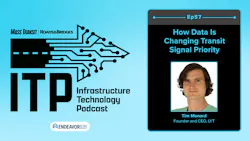 Episode 57 graphics.
In Episode 57 of the Infrastructure Technology Podcast, Brandon Lewis speaks with Tim Menard, founder and CEO of LYT, about the evolution of transit signal priority (TSP) and how new performance dashboards are helping agencies better understand what happens on the road.
Menard explains how LYT’s cloud-based platform connects transit vehicle data with traffic management systems to help buses move more efficiently through intersections. The conversation explores new color-coded dashboards that allow agencies to track signal priority requests, examine trip-level performance and identify factors affecting on-time service. They also discuss the technology’s potential applications for paratransit and shared mobility, the importance of accessible reporting tools and the growing need for agencies to demonstrate measurable results to funders and the public.
Episode length
37:57.
About the guest
Tim Menard is the founder and CEO of LYT.

Here is a transcript from the episode:
GJ: Welcome to the Infrastructure Technology Podcast. I'm Gavin Jenkins, head of content for Roads and Bridges, and I have with me two of the finest in the business. We have Brandon Lewis, podcaster extraordinaire from Cleveland, Ohio. He is an associate editor at Mass Transit, and we have Jessica Parks, staff writer at Roads and Bridges. Brandon, what day is it?
BL: Today is Tuesday. It is a podcast day, and I'm glad to be saying it after you've done the intro. So welcome back, Gavin.
GJ: Oh yeah. Well, see, I was in Singapore and then I had to have a root canal. I was at the Bentley Year in Infrastructure and Going Digital Awards, where I'm a juror. I'm honored to be a juror on one of their awards. And so I was in Singapore and on the last day that I was there, my face just swelled up. I had a lump in my jaw, and I didn't know what was going on, and I flew across the Pacific Ocean with ice packed against my face. I have Invisalign in and so I thought, ‘Oh, maybe the Invisalign, the new brackets that I put in were too tight and now I'm having a reaction’. But no, root canal, needed a root canal. And so I was not on the podcast recently because of Singapore. And then when I got back, I had to get a root canal, and on our last recording day, I was full of Novocain, so I couldn't exactly talk. So yeah, that's my story. How have you guys been or have you been taking care of the podcast?
BL: We have. We've been good. As a matter of fact, Gavin, you'll hear it back. But last week I told a story on the ITP of how I got my first gig in radio, and they asked me about having a co-host, and I said, ‘Co-host, are you kidding me? I have way too many thoughts if I had to share the spotlight.’ And so it's been an adjustment sharing it with two wonderful co-hosts that you guys are. And last week me and Jess did a phenomenal two-person interview with Sam Richardson from Volley, and I'm excited for you guys to hear this interview that I have coming up today because it's another great one.
GJ: Is your arm okay
BL: Yeah.
GJ: Is it? Because you were really patting yourself on the back there. We did a phenomenal job in your absence. I will be the jump judge of whether it's phenomenal or not. And we're recording this a couple weeks ahead of time. Brandon, the guardians, the guards, they're gone. They got eliminated last night.
BL: For the second time in my life, a rain delay might've caused the Guardians a World Series.
GJ: Oh my goodness. Heartbreak in Cleveland. Up is down, left and right. I feel bad, man. I would love to see Cleveland win a sports title again. That'd be great.
BL: First time since 1948. It'll happen one day. Maybe not in my lifetime, but someday.
GJ: It will. The Cleveland baseball team has a great organization. They'll get it done. They'll get it done. Well, speaking of great organizations, we are here to talk about an interview and we'll talk about transit signal priority, and you have an interview that we're going to hear from, is it Tim Maynard?
BL: It is. So Gavin, I don't know if you remember this. Way back in season one with ITP, I had to look it up. It was episode seven.
GJ: Season one. Episode seven. I remember it clear as day.
BL: And at that time, the company that he founded, he's the founder and CEO of LYT, and it was just getting off the ground. It's been about two years now, and this technology has developed so fast in the last two years. And what our listeners and now watchers on our YouTube channel may notice here is how transit signal priority has changed, and what it's really doing to help agencies get more real time information for routes and really seeing what these buses are doing, not only on the road, but what's specifically going on at bus stops and stops to get that more real time information.
GJ: Okay. Sounds cool. We love Tim. We're glad to have him back on the podcast here. How many people have been on twice more than once? This is episode 57, and he's already been on twice. We must really like him.
BL: Tim is amazing. We've had Tim on a couple times. We've had our friends on from WSP a couple times.
GJ: And we're going to get them on again. They'll be three-timers. I want this podcast to be like Saturday Night Live where we get sports jackets made for the five-timer club when we get there. All right. Well, we now go to Brandon Lewis's interview with Tim Menard. Take us away, Maz.
BL: And Tim, welcome back to the Infrastructure Technology podcast for the second time.
TM: It's great to be back. Thanks for having me, Brandon.
BL: Yeah, we had you on in the very early stage. I had to remember what episode. It was very early in season one. It was episode seven. Of course, you are the founder and CEO of LYT, and when I first had you on, if I recall, it was sort of the beginning of the company stages. And today we're going to talk a lot about traffic signal priority and where everything is headed there with LYT. We're going to start out by talking about you guys that you are reporting dashboards further. What gaps or unmet needs among trans agencies that help shape the direction that you're currently taking?
TM: We kept hearing the same thing from agencies. They're being asked to prove that their signal priority investment is working, and they're doing it with limited staff. I mean, everybody right now has got a staffing shortage in some place or some way. And what we're seeing is that raw GPS and AVL data exists, but turning it into a number they can defend to a board or a funder is hard. On top of that, agencies often don't know what good trip level analytics look like until it's already under contract and the gaps show up. So we built toward closing both gaps, defensible answers and a clear picture of what to expect before you sign.
BL: And I should have did this a little bit before. I want you to sort of do this now. For maybe newer listeners of the podcast or for maybe our Roads and Bridges industry listeners or viewers that are not familiar with LYT, can you talk a little bit about the company and how you guys work with transit agencies?
TM: Absolutely. So as we're talking about today, transit signal priority, it's the transit agency's only tool to having some level of control over the roads. As our buses, our light-rail vehicles travel with traffic, they too are affected by the same challenges that we face driving or biking or walking, and it's the traffic light and no one likes a red light, especially one that is sitting too long. So what LYT does is we are a cloud-based platform. We connect with the infrastructure you already have. We have already GPS, cell connections, lots of dispatch information at transit agencies, excellent understanding of what buses are doing, where they are and why they're doing it. Wouldn't that just make sense to connect it with our traffic management systems? And that's what we've done and that's what we've been the leader of, is helping transit and helping cities come together to move more people more effectively without degrading how bicyclists and pedestrians and other modes of traffic all compete for the same level of green time at traffic lights.
BL: And I also do want to note that Tim was an award recipient of our 2025 Mass Transit 40 Under 40 Awards, where we honor 40 young individuals that are under the age of 40 for their impact in the public transit agency. So Tim has done a lot of great work in short periods of time. Let's talk about these dashboards now with light a little further. Walk us through a little bit what's changing in this next iteration and what agencies will be able to do that they couldn't do as easily before.
TM: So the headline is that agencies can now go from raw data to a report they can defend much faster. One of the reports I like most that we're bringing out is everybody loves a good scorecard. There's nothing better than something that anybody from any background can just understand. And so with transit signal priority being you purchased a green light for a vehicle, one of our most intuitive dashboards we're bringing forward, I like to call the scorecard or the bingo card because it's showing every intersection on a route laid out like a battlefield scorecard or tic-tac-toe, and it just clearly shows at each intersection, did that bus get a green or a red? And from there you can click to investigate further why the outcome is what it is, if you find it acceptable and if not, how to improve it more. And so that's what I'm most excited about is the frameworks behind it, is that it gives agencies a clear set of questions and benchmarks for judging any TSP provider. So the proof is simple enough for a planner without a data scientist background to produce these reports in minutes, not weeks.
BL: Now, is it green and red dots or is it a green check or a red X? How does it look visually?
TM: So visually it is green and red circles. And then what's really cool is that all the circles have gotten additional illumination ring around it for where transit signal priority was requested so that it's very clear as to what signals got a priority request, how did that interact? And where is it coming from is because we get asked a lot and a lot of agencies and cities wind up compromising with each other on putting in priority request policies. So a common one you'll hear about is schedule adherence. If the bus is three minutes late, should we prioritize and give it more green time? And so this is one of the ways we've also put behind. So when it flips up, this will be easier to see, but you get to see a trip from end to end, you get to see its schedule adherence, you get to see it in simple colors from where it was late on time or early so that in one pictorial view you get the full picture of does providing greenways really immediately affect on time performance? And what's great about this and the samples that will flash up will demonstrate how late buses go on time, how on time buses can wind up early if there's no policy whatsoever. And from a planner's point of view, what's so powerful now about tools like this is that the name of the game was always just bus stop to bus stop data, and you never knew what happened in between, and they tried to extract.
BL: Which a lot happens in between way more than just bus stop to bus stop.
TM: Exactly. Or even just at the bus stop. What's been phenomenal too in the last five years is just how much more sensor fusion is coming to the buses, which is great for our bus manufacturers out there. It's awesome that we now know when the bus is kneeling or deploying the handicap ramp or that we can be told when a stop's requested and a door open event because it's twofold. What's happening at the bus route that's affecting the arrival and departure time and then the traffic that's around it. And you can also appreciate that a 40-foot bus is going to have a different traffic wake than a 60-foot articulate. And a system like this now is able to demonstrate those differences.
BL: So in terms of reporting, are you guys releasing this data set on a set time? Do agencies request the data? How does that work?
TM: So as part of our online web portal, agencies are able to log in and see all their data. Everything is processed nightly. So if you go in, you can see yesterday's data. We are working towards more live reporting in the future, so we'll be seeing a bit more of that where that makes sense, where you might need to see some operator calls in, they report something, something that you might want to go back within the last hour to see what's going on.
BL: And you could see that immediately then just from logging into the web portal?
TM: Yeah. So what's really neat about our portal and what really caught the attention of the industry immediately was that when we first launched the transit signal priority, we brought forward what we call the live operations map. And so for anybody who used Google Maps or Apple Maps, and you've put your own route in, and you could see your own car drive around, this didn't really exist for transit where you could see the vehicles and the traffic lights and how they were interacting with each other. So standardization has been really powerful and the transit industry has been one of the leading transportation spaces for ground transport on standardizing across the board. So with the GTSF feed, with those shape files being made, now you could immediately see where the routes are, where the bus stops are and then working with cities, which have invested a lot into their traffic management and having connectivity to there. That was the biggest exciting point that our planners and data scientists, but you can appreciate our GIS folks and everybody at the industry. We’re like, ‘Look, we've never been able to actually get what traffic lights are doing and how they affect everything’. And now it's all in one window. You're seeing this picture and it's phenomenal and so that's always been kind of live and so people could go in real time and so we got really far on, ‘Oh great, we can go and see what's happening there’. But now, as much as people would like to be in there every day, we all got to do 100 other things. So now we've been bringing back out a lot of the important historical playbacks. So we've had for a long time the daily averages, weekly averages, but as you and I both know, things change drastically throughout the day, by the hour, by the 15 minutes. So we gave immediately what's happening, then we gave what happened throughout the day, and now we're coming back and we're finishing out the rest of the layers of the cake so that if you want to look at your a.m., your p.m. peak, any other time in between or actually just do a full trip analysis directly, however you want to slice and dice, you're going to have the opportunity now to investigate it thoroughly to understand where you can make your improvements.
BL: Well, and the thing with this, it's not just for fixed bus routes. It can be used for shared mobility rides and shuttles, paratransit as well. Those individual rides where I feel like a lot more happens to your point in between the bus stops, whether it's someone needs medical attention or whether it's deploying ramps and trying to figure out one of that on time. Because from personal experience and being one of those riders, they give you a half an hour schedule window, and it's usually either so early or so late, the window most of the time doesn't even matter.
TM: You're absolutely seeing the vision right there. That fixed route was a great spot because all the environmentals were pretty concrete. And so in any good solution step, you want to start with, can we get this right? What do we learn? Paratransit, lots of agency interests now, and we're very excited about paratransit because they're one of the most costly operations per hour. And like you were mentioning there, these are for generally a population that that's all they have access to and being given these large gaps, how are they going to continue to turn to paratransit when we have competing micromobility now like Lyft and Uber or Waymo and Zoox? So this is definitely becoming a larger tool in the toolbox for our paratransit friends who are trying to help some of those individuals that absolutely need.
BL: And the other thing with this technology that I want to get into a little bit is obviously there's going to be some agencies and some workers who may not have much of a technical or data and analytics background. So again, part of that could be the color coding, making it very easy to analyze, but how are you approaching that challenge of making these reports accessible to maybe somebody who just came into the agency, for example, and doesn't really know maybe what they're looking at?
TM: So we do a couple of different things here. So first of all, we always try to incorporate tool tips and intuitive design because that's the first step. If you have to go into a user's manual or dive deeper, then hopefully it's for something actually complex for a frequently asked or a troubleshooting or what kind of problem do you have that you're trying to solve for? Here's kind of step by step. Then on top of it, we do have a lot of ADA compliance controls in our portal so that if you're dyslexic, if you're colorblind, if you need larger texts, we have the little ADA that you'll be able to click immediately for whatever else you can do. In fact, I love using it because I love the extremely high contrast feature of it. And so yeah, something for everyone.
BL: What do you mean by the extremely high contrast feature? I'm not familiar with that.
TM: So there's a feature in there where, for instance, like gray scale, that there's lower saturation, there's higher saturation, there's invert so that depending on how your color vision is. So for me, ultra high saturation really makes really bright greens and bright blues. So for me, who likes to be in... For an example, if you've been in a car that has an entire black interior, and you've been in a car that's an entire white interior, they have two very contrary different experiences, and I prefer the very white, to me it's very alive, very open, greenhouse feel.
BL: No, I never even thought about that, but you are completely right. In terms of the industry at large, Tim, do you think the industry is moving towards these standard performance benchmarks for technologies like a TSP? Are they going to continue, you think, to evaluate success differently from one another, maybe using TSP or maybe different metrics?
TM: No, I think that agencies will continue setting their own targets because corridors and local goals differ, but I do expect the standard of proof to coverage. As funders tighten scrutiny, agencies need to answer the same basic questions. Can you isolate the effect of signal priority? Can you isolate the environmental variables? Not everything can be solved with software. Sometimes you have to go back out and physically make a change, but that's okay. We should be making data-driven decisions, not emotional or gut. And so the numbers hold up to, but people are going to be asked, whatever data comes up is going to be scrutinized by the funders, the public, and that's another big thing as well is the thing that we see here is how does transit reengage their public relations team? Because it's one thing to apply new technology, but it's another thing to go out and inform the public that the investments are being made on their behalf. And so these are things that can get really hard is we can standardize reporting all we want, but really at the end of the day is everything comes down to ridership. We want what I like to call the quality of ridership index, and what does that include? Security, timeliness, cleanliness. And so transitional priority falls in reliability, timeliness. And so when this gets put in place, unless it's extremely aggressive, like on a light-rail line that goes from stopping at every red light to now every vehicle has to stop for that, well, that's pretty apparent to the public. But for buses where our system was developed to be not as obvious, which means that it's making the adjustments with the natural tone, so buses just go through and no one realize it, but you see it in the performance reporting, but you have to go back now as an agency and do your justice to the public of ‘We made these investments, go ride it, tell us what you think because our commitment to you being to work on time or being where you need to be.’ Because if you're taking the bus, your boss isn't mad at you if you're late. They're not going to go outside and get the bus driver.
BL: That's what's unique I think about public transit, and it relates to TSP a little bit, is people that use public transit that don't work in the industry just assume that public transit is either going to always be on time, or this design didn't work out properly, or why is the bus late? Where it's like the people that are solving the issues within the industry are also riders, so they know from within what the real issues are, and I think that's where this technology really pops in because you can identify the issues quickly.
TM: You are absolutely right. And where we look towards globally of what people really gravitate to, you look at Japan, what do people always say? They're completely punctual. They're on time. They have a frequency. Europe also as well, ubiquitous to you that you don't need to rent a car, you can get from city to city. And the challenges of North America, we're a very large continent. We're just the U.S.; we're 50 divided states, and the pros and cons, you can live where you want with the ideas of what you want, and that's why we see that some cities have got more or less, but at the end of the day, all of our voices matter, and we vote with the dollar, and if you get on the bus, you're making a vote that we want more transit, and we need it and the best part is too, is the more that we focus on our transit, it's really the first thing anybody sees when they go to a new city, whether you're an American or not.
BL: That's true. Bus. rail. And by the way, most people, when they go travel somewhere, it's mostly planning around, ‘Well, how am I going to get somewhere?’ And Ubers and Lyfts and all of that are becoming more expensive by the day, so you lean towards public transit.
TM: Exactly. And then what's the common gift that you get from cities like Chicago and New York? It's the L, it's the subway, right? Those cities are iconic for you want to be stuck in traffic, rent a car. You want to have a good time, take the train.
BL: I mean, they're so iconic there in most movies.
TM: Exactly. I mean, even Lego's got a new streetcar that they brought out that looks like the San Francisco trolleys, and it's another one, right? You got the cable car and the historics. People enjoy the service when they are able to show up and depend on it, and that's the social compact, right?
BL: Agreed.
TM: That's for everything in society.
BL: So last question for you is looking at the future of the technology as these dashboards come out as LYT becomes more integrated with increasing technology, as more transit agencies get involved with the technology, what does the future of transit without this technology look like?
TM: So the future of transit without this technology is that there's going to be more and more ridership loss to all the other competing modes. And so look, we're seeing a lot more ridership back on transit just because gas prices have gone up, so that's always been an indicator. If you make personal driving more expensive, people will find other alternatives, but the real big competitor right now that transit will also tell you is going to be the ride sharing. It's going to be the Lyft and Ubers that were first, but now that we're seeing more autonomous, and I'm really bullish and optimistic here. I think that the transit agencies are in an actual pretty unrecognized powerful position that with autonomously coming forward and having multi-decade experience serving their regions and having all this traffic info, that I think they're in the best possible position for setting excellent autonomous transportation.
BL: And to your point, the agencies also have experience. I mean, looking over them like the Jacksonville Transportation Authority just launched their Navi service last year. Yeah, in a way that is part of the Waymo side of the industry, but it's within the JTA, and they developed the whole transit system and they are embracing the autonomous technology, so it's not like they're going away from it. It's just a different form of transportation.
TM: Exactly. And then on top of it, when everybody's on... As we get more and more transit out there, that means we get more and more usage data on what's happening on the roads. If you have that information, then this is like the tide that lifts all boats. Then the traffic management system gets better because it knows where people are trying to go. So the old way of traffic management was just, ‘Here's a street. It goes north, it goes south, it goes through downtown’. Well, people must obviously want to go all the way north and all the way south, not recognizing that, well, maybe a stadium is right there or a massive place of employment, so they go up, left, right and that's how we move from a world that had to be reactive because all we had was just cars driving around with no knowledge of each other. But now we live in a world where everything can be connected and we not only know it, but now we can predict and prescribe alleviation treatments ahead of time.
BL: Tim Menard, he is the founder and CEO of LYT. Tim, once again, thank you for joining me on another episode of the Infrastructure Technology Podcast
TM: It was a pleasure. Thanks again for having me.
GJ: All right. And we are back. That was Brandon's interview with Tim Menard. Brandon, listening back on it, what are some of your takeaways from it?
BL: Yeah, and me and Tim talked about this too. The ability for him to develop this technology alongside LYT in such a short period of time is very fascinating, and I know our listeners and watchers are going to see it on the screen because I had Tim give me a screenshot during the interview that Maz is going to shoot up for you guys, but you can really see the dashboard and what those green and red colors on the maps mean and really how it could impact transit frequency moving forward. Also, the fact that Tim already at such a young age, the way we connected, he was a Mass Transit 40 under 40 winner last year and having an impact already at this point in the industry. I mean, it's really clear what he's doing, and this technology is going to impact transit agencies for years to come.
GJ: Excellent. Jess, what did you think?
JP: I thought it was really interesting how not only did he recognize a problem, but he gave the data to back it up. I mean, apparently with signal priorities, and it's hard to prove how effective it is to see how a green light makes a bus go faster if it's delayed already and how it can end up being on time. And so it really just, it's an easy system that just has the data to back up using this technology. And I think, yeah, I thought that was a smart idea, just have it all in one place, make it easy for agencies who already have so much on their plate. And yeah, I liked it.
GJ: It’s incredible how this innovation can make jobs easier, and it really improves transit and infrastructure. All right, so one of the things here is, so Tim is an entrepreneur and our industry, and one of the reasons why we started this podcast is because there's so much innovation, and there's just this wave of entrepreneurs starting tech companies throughout the industry that are helping improve America's infrastructure and its transportation systems. And one of the most infamous entrepreneurs coming out of Silicon Valley in the 21st century is Elizabeth Holmes, and there is a documentary that's coming out. Now, granted, it's not infrastructure, it's healthcare and blood work. Theranos was her company, and it was a sham, and it was because she said it was doing things that it was not capable of doing. Now, that's the really brief version of what Theranos and Elizabeth Holmes is about. She went to jail for lying to investors. Brandon, everything I just said, do you have any idea what I'm talking about?
BL: I have heard about this story on the news because I do recognize the name now that you've said it, but I had no idea there was a documentary coming out about it.
GJ: Brandon, let me tell you something. There have been numerous documentaries about this woman, and there have been a couple TV shows about this woman. Do you know who Nathan Fielder is?
BL: No.
GJ: There's this man out there named Nathan Fielder. He's an absolute genius, and you have no idea who he is.
BL: Nope.
GJ: So you've never heard of the TV show Nathan for You?
BL: No.
GJ: And you've never heard of the TV show The Rehearsal?
BL: I've heard of that, yeah.
GJ: You've heard of The Rehearsal? Okay. All right.
JP: My friend's uncle was on The Rehearsal.
GJ: Really?
JP: He was Goglia. John Goglia is my friend's uncle.
GJ: Wait, he wasn't the pilot, was he?
JP: No, wait, the one from the safety board.
GJ: Oh, that guy. That guy was fat. Okay. I was really concerned that it was going to be that pilot that sat there and talked about all the dating apps he'd been kicked off of.
JP: Oh no. That was the most cringe thing I've ever seen in my life.
GJ: No, that guy, the guy that was from the safety board, he was adorable and so informed and so smart. So the reason why we bring this up is because Elizabeth Holmes is the extreme worst version of entrepreneurship, and our industry is filled with really quality, hardworking entrepreneurs who want to help infrastructure and want to help transportation improve with the technology that we have at our fingertips. And the documentary that is out that Nathan Fielder made about Elizabeth Holmes is called You Can See Everything. Is that the name of it? I think so, and you're going to see it tonight?
JP: Yeah, tonight. I'm seeing it tonight at 7:45.
GJ: I'm going to see it in the next couple of days. Brandon, I don't think you are allowed to watch it because you need to watch some episodes of Nathan for You and The Rehearsal before you even come near this movie because it'll be so cringe and so awkward that you won't be able to bear it.
BL: Well, now that the Guards are officially eliminated, I will have time, and I will watch Speed for you instead, so I will finally be able to see it.
GJ: Please watch Speed. If you can watch Speed and not have fun, I'd be shocked. It's a thrill ride.
BL: Fair enough.
GJ: It's Die Hard on a bus.
JP: Yeah, I think it's a movie Brandon can get behind.
GJ: Yeah, you'll love it. It's Keanu Reeves with a buzz cut and a white t-shirt. Sandy Bullock ripping darts, running for the bus. It's great.
BL: It's been on cable a lot here lately.
GJ: Keith and I, our supervisor, Keith, Keith and I like to joke that we should watch Speed 2. Speed 2 Cruise Control where it's on a cruise ship. Die Hard on a cruise ship. All right. Well, I think that's enough for Maz to listen to. She's probably rolling her eyes, which means it's time for us to get going. Who do we need to thank, Brandon?
BL: Well, we got to thank Tim Menard, first of all. Again, thank you, Tim, for coming on and being another great guest that you are. We got to thank our lovely listeners, our lovely watchers, and we have to thank EndeavorB2B, our parent company, for giving us this platform and let us talk about movies and infrastructure and transportation.
GJ: I love how you mention movies before infrastructure. And we also want to thank Karina Mazhukina, who is our lovely producer and talented, who makes us look and sound so good. Okay. All right. For Roads and Bridges, I'm Gavin Jenkins.
BL: I'm Brandon Lewis.
JP: And I'm Jessica Parks.
GJ: All Right. Until next time, goodbye.
About the Author
 Brandon Lewis
Associate Editor
Brandon Lewis is a recent graduate of Kent State University with a bachelor’s degree in journalism. Lewis is a former freelance editorial assistant at Vehicle Service Pros in Endeavor Business Media’s Vehicle Repair Group. Lewis brings his knowledge of web managing, copyediting and SEO practices to Mass Transit magazine as an associate editor. He is also a co-host of the Infrastructure Technology Podcast.