Infrastructure Technology Podcast: How APTA is introducing the next generation to public transit
Key takeaways
- Importance of National Work Zone Awareness Week: The podcast kicks off with Roads and Bridges Head of Content Gavin Jenkins explaining how important National Work Zone Awareness Week is to Roads and Bridges coverage and the importance of keeping workers safe.
- Safety in the roads and bridges construction industry: Throughout the episode, Jenkins lists his personal top 10 innovations that are transforming safety in the roads and bridges construction industry.
- Helping the next generation work in public transit: Mass Transit Associate Editor Brandon Lewis interviews American Public Transportation Association’s (APTA) Vice President of Workforce Development and Educational Services Carita Ducre about different programs APTA has for the younger generation.
- There’s different types of jobs throughout public transit: In the interview, Ducre explains how careers in public transit can cover many different types of industries.
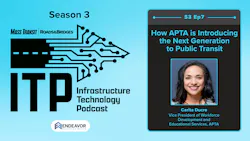




This episode of the Infrastructure Technology Podcast focuses on National Work Zone Awareness Week and the programs the American Public Transportation Association (APTA) is offering to help introduce the next generation to a career in public transit. Throughout the episode, Roads and Bridges Head of Content Gavin Jenkins lists his personal top 10 innovations that are transforming safety in the roads and bridges construction industry.
Mass Transit Associate Editor Brandon Lewis interviews APTA’s Vice President of Workforce Development and Educational Services Carita Ducre. Their conversation focuses in on how there’s a career for almost every industry inside public transit and how artificial intelligence is affecting the public transit industry.
Episode length
51:19
About the guest
Carita Ducre is the vice president of workforce development and educational services at the American Public Transportation Association. She is also on the board of advisors for the National Transit Institute and Young Professionals In Transportation.

Here is a transcript from the episode:
GJ: And welcome to the Infrastructure Technology Podcast. I'm Gavin Jenkins, head of content for Roads and Bridges, and with me, as always, we have Jessica Parks, staff writer at Roads and Bridges, and Brandon Lewis, who is an associate editor at Mass Transit magazine. How are you two doing today?
BL: It's Tuesday, it's a podcast day. We're seven episodes into season three, and let me just say this season so far has been a lot of fun.
GJ: Yeah, we're not stopping. No one can stop us. Jess, what do you think? How are you doing?
JP: I'm doing great. I'm loving this season. We have a lot in store for everybody. I'm excited to see it all come together.
GJ: Alright, and later on, we have Brandon's interview with Carita Ducre from APTA and up first, we want to talk about safety. Last week was the National Work Zone Awareness week, and I want to just talk to you guys a little bit about some safety technology. So what I did is I've created the top 10 innovations, transforming safety in the roads and bridges construction industry. This is technology that is in most work zones today. So if you've driven through a work zone recently, you may have noticed this. It's not just cones and signs anymore. These sites are becoming smart, connected environments designed to actively prevent accidents. So what I'll do is I'll give you guys 10 through six here, then we'll go to the interview and then I'll give you five through one at the end. How about that? Coming in at number 10, we got smart cones and connected barrels, so we're starting simple on this list, but this is very powerful stuff, so these are your everyday cones and barrels upgraded with GPS sensors and sometimes even lighting. They can detect if they've been hit, moved or knocked over and send that information back in real time so instead of passive plastic, you've got connected safety devices feeding live data into a system. Any thoughts on that? What do you think of a smart barrel?
BL: See, even as someone who is way younger than you, Gavin.
GJ: Wow.
BL: It is hard for me to wrap my head around a cone having some sort of smart capability.
GJ: Well, shots fired, but yeah, noted. I too think it's pretty wild that we have cones that can collect data. Alright, number nine. Number nine, I have some opinions on for sure. Automated, automated flagger assistance devices or AADs, this is a big one for worker safety. Instead of a person standing in traffic holding a stop slow sign, operators control the flow remotely using cameras and automated gates of signals. It's a straightforward concept with a huge impact removing workers from one of the most dangerous jobs on the site, so I personally am not sure that I like this. I understand that that's one of the most dangerous parts on the site, but the people who are on the walkie-talkie hold, twisting the stop sign is there to help motorists navigate the work zone. I feel like they're essential workers. I feel like they're usually either, often they're women and also they're often older people who need a job or their younger people are trying to break into the industry, and I think that, I don't know how I feel about it being driven by tech. What say you, Jessica?
JP: I just haven't really seen that implemented either yet. I wonder how, is it timing traffic signals or it's literally opening, how is it?
GJ: Well, it’s not happening up in Boston. The people in Massachusetts refused the technology. They want to stay in the 1900s. It's happening in real cities like Pittsburgh.
BL: No, we're not going there again, Gavin.
GJ: Are we? I'm just kidding.
JP: Our roads are made from the 17, 1800s, so it makes sense that we want to keep some antiquated.
GJ: Yeah, you guys still have a town crier yelling out the news.
JP: Yeah, exactly.
GJ: No, honestly, I haven't seen this either, but I've been in this job for five years and the AFAs have been talked about since I started in this job, and the main thing is that if you get someone who's not paying attention or someone who's just being reckless, and they're trying to zip around a work zone, those people, those workers are in a lot of danger and so it's something that is talked about. I don't think it's that common. All of the items on this list, you're going to see them in many, but not all work zones, and I think that this item here is not ubiquitous yet obviously, but I think it is definitely being used and tested. Brandon, what do you think about this?
BL: I agree with almost everything you said about I understand the why behind it.
GJ: I think you should just remember that in the future that you agree with everything that I say.
BL: Well, I just think that it is hard to wrap your brain around, ‘Yeah, automation is getting rid of jobs’. We all know AI's here, but it just sucks to hear it's reality that jobs are taken away, taking paychecks off of someone's table that may absolutely need that paycheck.
GJ: Yeah.
JP: But at the same time, we are dealing with a workforce shortage, so it's like how do we optimize employees.
GJ: That’s another thing, too. In an ideal world, it would just be like everyone in the community helps out with the work zone, and it's just like, hey, we need someone standing here like, ‘Hey Bob, get down there and help’.
JP: I don't think I'd volunteer. I'm sorry, I don't think I'd volunteer for the flag.
GJ: You know what? And the thing about that job is you would be standing there, and eight hours would go by, and you'd look at your watch, and it would only been like 30 minutes.
JP: Exactly.
GJ: It's probably a brutal job, but again, I think that a lot of younger people are doing it to earn their stripes and get into the industry, but it does not look fun. Okay. Alright, next one, number eight, end of Q warning systems. So rear end collisions are one of the most common crashes in work zones. These systems use radar Bluetooth tracking and GPS data to detect when traffic is slowing or stopping ahead. Then they trigger digital signs warning drivers in advance. It's all about eliminating the moment of surprise giving drivers time to react before it's too late. Now with this, I think it's really good. I like it. People should be paying attention to signs on the word on the road that say, ‘hey, work zone ahead, congestion ahead’. Also, you could just be a normal driver and not speed and look at brake lights, but that's just me. I am constantly paying attention to other drivers. Brandon, what do you think?
BL: So this is totally my fault. For some reason when you said digital signs, I had it in my head not as a sign that's physically there. I had it in my head as something that just somehow pops up on the road, and it just flashes like a green screen.
GJ: Yeah, well this isn't Blade Runner, so we're not there yet. Brandon, have you seen Blade Runner?
BL: I have not.
GJ: Okay, then that reference once again went right over your head. Blade Runner is a futuristic movie starring Harrison Ford about a cyberpunk future anyway that we are currently living in. Yeah, no, it's a sign on the road. I see them all the time. They're around here in Pittsburgh. They're definitely near the airport to say, hey, congestion ahead, time to get to the airport, like 10, 16 minutes from here, that sort of thing. Have you seen these in Boston, Jess?
JP: Yeah, I've seen that for sure. Definitely by the airport. I mean, I was saying the other day, our traffic hours here in Massachusetts are really from 2 to 7:00 p.m. It's literally pretty much most of the traveling day, so I see a lot of those. I think that they're helpful to know, but I don't think once, I think it gives people an idea of how long they're going to be in traffic, what's ahead, everything like that. They can play alternate routes, but I just don't see it as being super effective once people are pulling up to traffic and everything like that. It’s still just you. I mean you don't know exactly when you're hit it, so I think you still just got to pay attention to the road, and I think we do so much to just try to get people to pay attention to the road when that's what you should be doing when you drive, so it's like how much are we spending on stuff like that and stuff like that.
GJ: There's pros and cons for sure.
JP: Exactly.
BL: I was going to ask quickly. So that time and congestion, that's all being constantly updated like real time, correct?
GJ: That's the idea. Through Bluetooth tracking or radar. Yeah, that's the hope. Okay, let's move on. We've got two more to do: intrusion detection and worker alert systems. Now we're getting into some real-time hazard prevention with this. So these systems monitor for vehicles that enter the work zone where they shouldn't using radar, LIDAR or infrared sensors. If something goes wrong, workers get instant alerts, alarms, flashing lights, wearable vibrations. That early warning can mean the difference between a close call and a serious incident. This is just awesome. If it can save a life of a worker in our industry, I'm all for it. Let me get to the next one. Portable smart work zone platforms. Think of this as a mobile traffic control center. These systems combine cameras, sensors and software into a portable setup that monitors traffic conditions in real time, speed congestion incidents and all of that data feeds into dashboards and sometimes directly to drivers. It's like bringing big city traffic management tech into a temporary construction zone. So what do you think about those two?
JP: I think the sensor, the alerting the workers in the work zone that there was an intrusion. I mean that is priceless. I think that has to have such an effect just because you don't even see it. You're in the middle of a work, it is zoned in unless something just really gets your attention. I don't think that people will always notice right away when those incidents are happening, so that I think is just a given should be at every work site. I fully support that. Yeah, that's what I think about that one. What do you think, Brandon?
BL: So I think a lot of this technology is obviously helping work zone construction, but I think too a lot of it is helping out the drivers on the road, making sure that everybody is safe, and I think that while all of this technology can help everything, the biggest aspect of safety is just paying attention, being aware, and I think that that is one of the things that as we've gotten into this digital age, everybody's got one of these right next to them, and we see so many people just on their phones or even playing with a GPS or something like that, but they're just not paying attention to their surroundings, and I think that really this technology is being developed to help that side as well.
GJ: Yeah, the overarching theme to all of these are we have some bad drivers on the road who are distracted and not paying attention and putting other drivers and people in work zones at risk, and that's why National Awareness Week is such an important week. It's why Roads and Bridges covers it and really puts out a lot of great content to help our readers stay aware of new technology, new innovation in the space. Alright, so that was 10 through six, and we will come back and we will talk about five through one, but first we are going to go to Brandon's interview with Carita Ducre from APTA. Brandon, do you want to set us up?
BL: So she is the vice president of workforce development and educational services at the American Public Transportation Association. She's also on the board of advisors for the National Transit Institute and Young Professionals in Transportation. And what we talked about is all these different programs and all these different avenues that APTA has to get the young people that we've talked about all season long within the transit industry, no matter what field you are in, and I'll explain more about that on the other side.
GJ: Alright, here's the interview. Take it away.
BL: Carlita, welcome to the Infrastructure Technology Podcast. How are you doing today?
CD: Thank you. I'm doing well. Happy to be here.
BL: Well, thank you for joining us, and today, as I already mentioned at the top of today's Infrastructure Technology Podcast, we're going to be talking about all the different programs that the American Public Transportation Association, aka APTA, has to get young people involved in the transit industry. So let's start off by telling me a little bit about yourself. Tell me why you are working with APTA, sort of what your interest is in the transportation industry, because really, I don't think people realize how much is involved and how much really you can get into in the transportation industry.
CD: Yeah, no, you're absolutely right. So many people that I'm sure you've spoken with, I fell into transit by accident. If you would've told me as a young kid or a college student that this was going to be my career, I don't think I would've believed you. But before coming to APTA, I worked for a little boutique management consulting firm that was headquartered in Southern California and most of our clients when I worked there for nine years were public transit clients and what I started noticing was anytime I had an engagement with a client that wasn't public transit, I would find myself feeling antsy. I can't wait to get back to a public transit engagement after this one is over, and that's when I sort of realized that I think I might be in love with the public transit industry, so I was a public transit rider going to school in elementary and junior high and high school. My uncle was a bus operator in Culver City, California, so I have been a rider for the majority of my life. I'm a rider now of the metro system here in the D.C. area, and I think I just fell in love with the community. I always tell people that public transit is a nationwide industry, but it's a small community. I think it's the community aspect of it that I just really enjoy so much.
BL: Yeah. I was going to ask you, and you sort of answered it, but growing up, obviously I know you mentioned you took the bus a lot. I know what I got into this industry, one of the things that I did not realize, I think maybe part of the stigma, and again, it's because maybe I live in Cleveland, Ohio, and we do have a rail line, but it's like one rail line. We're mostly a bus city and so I didn't realize how much is involved with bus and all of this are rail. And then the mobility, the shared mobility shuttles and the ferry, I think that there's this like, ‘Oh, public transit just means, oh, you're taking the bus’, and that's not the case.
CD: Yeah, fortunately, I grew up in New Orleans and so in New Orleans, as you know, we have the historic streetcar. So we've got those beautiful streetcar that were so much fun to ride when I was growing up. And there's also ferry service in New Orleans because we're right along the Mississippi River, so I grew up knowing that there were different modes of public transit, but to your point, I didn't realize the variety of professional careers there were, and I'm still kind of blown away today when I learn about a new career in public transit because pretty much anything that you're interested in, I tell young people this all the time, if you're interested in real estate, if you're interested in human resources, if you're interested in finance, law policy, health and wellness, communication, social media, we have jobs for you in public transit, all of it.
BL: Yeah, no, it is totally true. And speaking of young people, let's dive into it a little bit because one of the things that I noticed at least, and again, I've been at Mass Transit now, Halloween was my three-year anniversary, and I had ridden public transit a little bit, but again, I did not know everything involved in the trans industry, and I'm still learning about the transit industry. I feel like everything changes almost on a daily basis but one of the things I noticed early on is there's a lot of movement in the industry. There's a lot of opportunities, and there are more young people getting into the industry now than at least when I started a couple years ago and so let's talk about a little bit about what APTA does to get those young people involved in the industry.
CD: So happy that you're noticing an increase in young people being interested. That's the goal. That's what my whole job is here at APTA is to help our members to attract and retain new talent to the industry and then to help them upskill or reskill the employees that are currently working. APTA has a number of programs. I feel like I can spend our entire podcast talking about the different programs, and you're probably going to have to cut me off, but one of the programs that we have for existing transit employees is our Emerging Leaders Program. And so that is for folks who've been in the industry, like you, for anywhere from two to six years, and they are future leaders in the industry, but maybe they're not exposed to all that. The industry has to offer all the different sides. Maybe it's someone who's a transportation planner or someone who's an accountant and basically all they know is their job function and their role, so when they come to our Emerging Leaders Program, they get this wide exposure to all of the different jobs that are available in public transit, and they get this one-on-one opportunity to talk to public transit leaders from all over the country, so it's just a really great way to expose them to everything that the industry has to offer. So that's one program. We recently just had our very first National Transit Career Day, which was so exciting. We had over 100 APTA member organizations and some organizations that were not APTA members. Some schools, some academic institutions who participated in National Transit Career Day, and that was so fun.
BL: Yeah, that's a lot.
CD: Oh my gosh, it was so great, Brandon. They did career fairs. They did social media posts. They did videos highlighting different jobs. I even learned last week about a job that I didn't know existed in public transit. I met a lady who works here in the D.C. area for WMATA, right. Washington Metro, and she's a crime analyst.
BL: Yeah, that job has recently came up.
CD: Yeah, how cool is that though, right? I was immediately thinking like CSI, but you told me, but it's more like analyzing data. One of her jobs is to kind of look at the data and try to predict where crime on the system might happen and what can be things that they do to mitigate that.
BL: Yeah, obviously safety's been a big focus for transit. I know we had just wrapped up at the time you guys are listening to this podcast. We may be closer to our January/February issue than our November/December issue for Mass Transit, but we have, at the time of this recording, wrapped up our November/December issue. I was fortunate enough to do the written portion for the Safety and Security Report, and I think that that's one of the bigger changes in the transit industry overall, and I also think that it's had a big impact on the stigma from younger people. I can take public transit now because I feel safer on it.
CD: Exactly. The public perception of safety on the system has a direct impact and correlation on the ridership. Absolutely. And so yeah, knowing that law enforcement and different types of, like I said, crime analysts, those types of jobs are available in public transit, I think are really great for young people to know about. So anybody going into criminal justice in college right now, we've got jobs for you in public transit. Anybody who's thinking of being a uniformed officer, we have jobs for you in public transit. So yeah, so I mentioned our Emerging Leaders Program, and I mentioned National Transit Career Day. We also are sponsors of Young Professionals in Transportation, which is one of the organizations you mentioned in my intro and also iyai+, which is Introducing Youth to American Infrastructure, and they do a national innovation challenge for young people, ages 18 to 25, and we also sponsor that program as well, so it's really fun.
BL: Okay. So two follow up questions to your answers there. Number one, let's put it out there. For the people that are listening to this podcast, when we mention young people, what are we specifically defining them as? I sort of just take it as, it could be 18, but I know that there are some programs out there that some people could get in for internships at high school. I'd say 16 or 17. And really wherever you want to start in the industry, I feel like you may have an opportunity to do so. I don't feel like there's a hard fast age on it, but am I wrong on that?
CD: No, you're right. I think wherever you want to start, we welcome you. There's no hard age on what is considered young. You might be familiar with APTAs Transit Workforce Shortage Report. That came out a couple years ago, so if you're familiar with that, then that report said that 43% of public transit workers are aged 55 and older, so when you ask me what is young, I would say anything under 54.
BL: But it's funny because it doesn't feel that way. Mass Transit, I don't know if you know this, every year we do our 40 under 40 program, and that has become such a huge program. Every year I get so many compliments from the nominees about how well we do the program and everything that goes into it. And you just see, it warms my heart when I see someone from that program put in their LinkedIn bio that I was a Mass Transit 40 under 40 nominee for a certain class. Again, it just shows the people that are involved in this industry and the connections that you can make from a young age, and again, I know some people that have been at agencies or in the same role for 30 years. I know other people that have switched jobs and change roles every couple years, and they've been at five different places and a lot of it isn't just based off work performance or whatever. Some of it's just, I want to try a different opportunity because your experience working in D.C. would be a different experience than me working in Cleveland, per se, or whatever. Every city has their own unique transit challenges, which is what I think makes transit very unique.
CD: I agree with you. Yeah, I have to tell you, 40 under 40 is so prestigious. I mean, it's an award. It's an honor that means so much to those recipients. A lot of the times, the 40 under 40 recipients are members of one of our programs, our Emerging Leaders Program or our Leadership APTA Program, which is more for people who are on the more seasoned side of their careers who are about to step into a C-Suite role. But when we get the 40 under 40, we immediately start scanning it.
BL: That's awesome to hear. It's so great. So what is actually entailed for some of these programs? What are they doing within the program? What's the length of the program, the time commitment, what are they get out of it? Let’s go more in-depth on that.
CD: So our two programs, emerging Leaders and Leadership APTA, they're for two different audiences. So emerging Leaders is for folks who are two to six years of industry experience and leadership. APTA, as I said, is literally for people who are ready to step into a C-Suite role, but they're both year-long programs, and APTA members apply to be a part of the program. Only one participant from each APTA member agency is able to apply, so think about that one person from all of…
BL: Thousands.
CD: From thousands, right, so it can be very competitive to get that one person, but once they're in the program, both of the programs, I think what makes them so great is the ability to be in the room with professionals in public transit that they would not normally get exposed to, so we do a lot of panels. The participants in our programs get to come to three different APTA conferences as a part of their program. And so first of all, just coming to an APTA conference, especially for someone who's new to the industry, is not something that a lot of people have the opportunity to do just for networking opportunities.
BL: I don't travel a ton. There's other people on the Mass Transit team that travel more than I do, and again, I've only been to one conference. I was at the APTA Rail Conference in 2024 in Cleveland, and again, just being at that one, just seeing people and how many people were there and interacting with clients and just, it's amazing that you gather all these people from most of the us, but sometimes even it could be international as well, especially for companies and things of that nature, to come to one location for most of these starting on a Sunday, and they go to either Wednesday afternoon or Thursday, so it's three to four days. And yes, there's sessions and all this, and we're learning about stuff, but the majority of it is just how you do it and connecting with clients and getting story ideas.
CD: Well, to your point, those attendees go back to their home agencies or organizations, and the question that they're asked is what is happening at other agencies around the country. And so just as you said, I think they picked that up in the sessions in the Emergent Leaders Program or in the Leadership Baptist sessions, but they also pick it up just being at the conference. They pick it up in the committee meetings and in the different conference sessions and having coffee and all of those different things. So yeah, so imagine you get accepted into one of our programs. You're guaranteed to attend three after conferences right off the bat, and you get to sit in a room and pick the brains in a confidential environment. You get to pick the brains and hear the real behind the scenes stories of what it's like to work in public transit leadership roles.
BL: Now for this application process, you mentioned only one member from each of the participating APTA agencies can apply for that application process. What is it like? Obviously, I would imagine there's a written component, but is there also an interview either virtual or in-person component to make sure that they would fit or maybe talk about their goals for being in the program? Or how do these people get selected then?
CD: Yeah, really great question. They fill out an application, and as a part of that application, they have to submit a statement of interest. They also have to submit a resume and two letters of recommendation and one of those letters of recommendation has to come from the CEO or general manager or executive director of their agency. So what the committee, who is looking at all the applicants, what they want to see is what is this person's future trajectory in the industry? What do they really want to do? What do they want to take away from the program? But also what are they going to give back to the program? And then, where do their leaders see them in terms of succession planning and future growth, not just within that organization, but within the industry? So it's competitive. We usually get about double the amount of applications that we can actually accept, and so that's challenging. You make half the people really happy, and you make half the people disappointed, but it's great, both of them are great programs.
BL: So once they're done with the program after one year, what happens next?
CD: So it depends. Usually they are now in a position where they're given extra responsibility or some sort of promotion in their role because of this experience. Because of having the Emerging Leaders or Leadership APTA credentials under their belt. We do a pretty good job with Leadership APTA of tracking. I want to say that last year's Leadership APTA class, 50% of the folks who were in the class were promoted while that year was going on.
BL: And I don't think that we talked about it. So real quick, could you just specify how many exact people are in each per year?
CD: Yeah, thank you for that. Yeah, it's 35. We accept 35 into Emerging Leaders and 35 into Leadership APTA.
BL: Every year. So if you're saying that, then it's what, 17 or 16, give or take somewhere around there that were promoted. Think about that promoted during, while you're in the program.
CD: We've even had a couple of Leadership APTA participants become CEO or GM of their agency while they were in the program.
BL: Think about that. Young people, think about the opportunity.
CD: That's right, and I haven't even told you about the foundation and the scholarships that we offer through our foundation either. Like I told you, Brandon, we could talk the entire podcast about all the different things that APTA does.
BL: Well, go ahead. Let's quickly give me a quick overview of some of the scholarships.
CD: So APTA also manages the American Public Transportation Foundation, which gives scholarships to college students and postgraduate students who are studying fields of study and pursuing careers in public transit, so if you are a college undergrad, junior or senior, or if you are postgraduate right master's or PhD, you can apply for one of our APTF scholarships. Last year, we gave out $342,000 to, gosh, what was it? About 33 scholars I believe. Since our inception in 1988, we've given $2.3 million out to about 450 students.
BL: And think about that ratio. I mean, that is a lot of money, and we know obviously how much expensive higher education could be, and it's getting more and more expensive every year as the country and time goes on. Obviously, we know the price of everything goes up, and I think you guys are doing a tremendous job with that. I wanted to ask you, I know we're recording in 2025, but this is going to air in 2026, and one of the things that we have spent almost the entire second season, our last season of the ITP on was talking about AI and artificial intelligence, and it's role in transportation. We're seeing even in our sister publication, Roads and Bridges and our co-host with this podcast, and the digital twins and the technology that they have in that space, and in the transit industry, we've had a lot of safety and security, even some bus camera stuff. How much of that stuff is brought up at APTA and where do you think that maybe, could there be down the road, like an AI training program?
CD Yeah, there could be. It's exciting and kind of scary at the same time because we just don't know. I always tell people, this emergence of AI kind of feels, to me, I feel like that same level of uncertainty at the very beginning of the pandemic when we were just like, ‘Oh my God, is this a worldwide thing that's happening, and I don't know what's going to happen’.
BL: I never thought about that, but you're right, and it's funny because again, as we're sitting here today, I think this week Google Chrome just wrote out a JEI update randomly on Chrome, and now you're sitting there watching TV, and you've got Microsoft Co-pilot and ChatGPT commercials,
CD: Claude, right?
BL: And six months ago, you're like, ‘Okay, where did this come from’? I knew it was here. It is kind of like the pandemic, you're right. We all heard about, ‘Oh, there's strains, and there's been COVID-19 and other places besides the U.S. way before 2020 and then all of a sudden, bam, it's here.
CD: And remember at the pandemic, we were looking at other people to say, ‘What should I be doing’? And remember, there were videos of people who went grocery shopping and then they would bring their groceries in one item at a time, and they would wash them, and we're doing the same thing with AI. We're looking at what are other people are doing, and we're looking for them to give us clues as to how to use this new technology, so I think the good news is that we can apply the things that we learned five years ago to what's happening now. But yeah, APTA is actually doing a study right now on AI in public transit. By the time this podcast airs, we may have a report published, so we're really looking forward to that coming out. But yeah, we're starting to incorporate it into our programs. Our next leadership after class is happening in two weeks, and one of the professors from Georgetown, we have a couple Georgetown professors that come and facilitate different topics. One of the professors is teaching on communications, and she's going to talk about AI. She's going to talk about AI as a part of strategic communications and message development for in-person and virtual and hybrid audiences and how can you use AI to be more effective in developing messages and engaging with your audiences.
BL: Yeah. I know obviously here at the company, some other editors outside of our brands have talked about using AI for social media posts. I've heard some press release items, maybe not even in the transit industry, but just general press release written items have been used by some companies using AI. It all feels weird to me, and I feel like we're all starting to take this and be like, ‘Okay, that sounds AIish’, but at the same time, it's like, ‘Okay, if I can use this technology to my benefit to work on other tasks or do something else in the community’, I do think that there is a place in the transit industry, specifically for communication, those quick communications. Even if, let's say a bus is not working or something like that, if you could use AI to push out alerts on apps or websites just to save people time, I think that's one of the biggest things where it's like, oh, I'll go on my train app, and I'll see, oh, this bus is supposed to come at this time. Well, it's not here yet. What's the issue? Especially for somebody who may not have good cell service, if you could get that pushed out as quickly as you can with AI instead of somebody checking social media or something like that, I think that's the benefit of it.
CD: Yeah, agreed. It's interesting you just talked about being able to read something or hear something and know that it was AI generated, so in the application process that we talked about just now for our programs, for the Emerging Leaders Program, for Leadership APTA and for the scholarships, the foundation scholarships, we have seen an increase in what appears to be AI generated paragraphs and sentences.
BL: Well, that's the other thing that I talked about. We were talking about it because there's a lot of editors on our team that just came from school, and these teachers and professors are telling, obviously, you can't use AI to write your paper and do all that, and I'm sitting there thinking, ‘Okay, for a college student who's got a master's degree and whatever, who's sitting there, who's so busy, who has so much time, how are they going to know specifically that they use AI to write everything’? I mean, there's ways to manipulate it, and I just don't know how everybody in the next two, three years is going to be able to tell the difference is my thing.
CD: Yeah, I don't think in three years we will be able to tell the difference. We can tell the difference now, right? Because those large language models are still being trained, and they're still learning, but three years from now, I bet you we won't be able to tell.
BL: Yeah, that's why I'm out of high school, and I'm glad I'm out of college. I don't know how you would teach it.
CD: Yeah, I don't either, and it’s changing so fast.
BL: It may not be transportation related, but I'm telling you, when it comes to these applications, we better be on the, I'm kidding here. We may need to be on the lookout for 40 under 40 applications generated by AI. But Carlita, you were great. Fantastic. I appreciate you so much today for spending some time with us with all the great things that APTA is doing to get young people involved in the transportation industry. And again, for those of you out there that are thinking or even are in the transportation industry and may want to join one of these APTA programs, we talked about all of the opportunities and the money that's potentially involved in these programs, so make sure to definitely look into that. Again, Carlita, thank you so much today for joining us on the Infrastructure Technology Podcast.
CD: You're welcome. Thank you so much for having me.
GJ: And we are back. That was Brandon's interview with Carita Ducre from APTA. Brandon, awesome job. That was a great interview. Tell us, you had a little bit more to say about it. What do you got?
BL: So my biggest takeaway from this, and we have done interviews with students so far during this season, and we have more to come, and I think the best part about this season so far for me has been talking to different people whether they've been in a transportation background or not. And one of the most striking things that Carita said was that whether you're in real estate, finance, policy, journalism, communication, social media, whatever, it's whatever field that law even she said, whatever field interests you, there is a role for that in public transportation somehow, and I think it goes back to just public transit is all about people and it's all about communication, and I've said this a lot on the podcast and I've said it, working here for Mass Transit now for 3.5 years, that public transit, in my opinion at least, just has the best overall collection of positive differential making people, and the people in this industry are incredible, and really, again, whatever platform you have, whatever interest you're in, I think that this interview is really a good showcase of, hey, if you want to be involved in some field, public transit probably has a role for you.
GJ: Alright. I couldn't agree more. Jess, what were your takeaways from the interview?
JP: I think that really transitioned to what I was going to say, Brandon, is my takeaway was when she mentioned the crime analyst position, she was like, I didn't even know that position existed in a transit system, And it really did have me thinking about how transit systems are like their own ecosystem. It's a whole world that they are facilitating in a way with all, you have just your own slate of issues when you're running a transit system And some of them are real world issues that you deal with just in regular life but then they're within a transit system, And I think that's so interesting is just how you have a full ecosystem of roles like you mentioned that lean into that for work under public transit as well.
BL: So to expand on that just a tiny bit on the podcast, we talk a lot about buses, and we talk a lot about rail lines, but there's other modes of transportation. There's obviously walking, there's biking, there's cycling, there's water fairies, and in all those divisions, there's operators, there's maintenance people, there's dispatchers, and then underneath that there's management positions underneath all that. And then she was talking about real estate in transit. Now a lot of these agencies are partnering with what we call transit-oriented development where they're partnering with communities, and they're building affordable apartment complexes that are right next to transit for easy access. So there's just a lot, if you never entered this industry before, I came in as a public transit rider, but I didn't know the ins and outs of the industry and how much safety matters and fair collection and housing and development and there's so much more that goes into this industry than meets the eye.
GJ: You didn't know about fare collection?
BL: I’m joking, but I didn't know to an extent because when I would ride public transits as a kid, I would never have to pay. I was under the low-income or whatever qualifications they had, so it never really occurred to me how important it was. I should rephrase here in the operations department and how I've talked about this before, fares are really important to maintain operations agencies.
GJ: Absolutely. I was just teasing, Brandon. Just teasing, sir. Okay, let's get back to the list. Great job, Brandon. Let's get back to the list of top 10 innovations making work zones safer. Alright, so we did 10 through six, now we're cracking to the top five. Number five, variable speed limits systems. So static speed limits don't always reflect what's actually happening on the road. These systems adjust speed limits dynamically based on traffic flow, congestion or weather conditions. Drivers see updated speeds on digital signs as they approach the work zone, the result smoother, traffic flow and fewer sudden stops. I think this is still very, this something that exists, but I don't think it's being implemented that much, so we can move on. Let's get to number four, and by the way, I rank these as a top 10. I put that at number five just because if it becomes popular, I think it could work. That's all.
BL: Okay, so this is your ranking. This is okay.
GJ: I rank them by If they became used, used all everywhere.
JP: Yeah, I like the variable speed limits. I read about those a little bit, and I think that those would be so effective and they would, yeah, but you have to remember, they only, I was reading about, too is that you can only go within a certain range. It's not like they're going to lower the speed limit on the highway to 20 miles. Typically the minimum 50 miles per hour or something like that is what I read, which I thought was interesting.
GJ: Yeah, absolutely. Okay, connected vehicle alerts or V2Eyes. This is number four. I love this one. This is where infrastructure starts talking directly to your car. What I love about it is because it makes me, it raises some red flags for me and my fear of technology and my fear of being monitored by big brother, but it also has a really good upside in safety. So work zone data, like lane closures or workers ahead, is transmitted to navigation apps or in-vehicle systems. Instead of just seeing a sign, you're getting alerts inside the vehicle itself. This is a big step forward for the future of fully connected and automated transportation. I think that it's also a big step forward for people being able to hack your car and just drive you off the road.
JP: What if you pull a Michael Scott and followl the GPS into the water?
GJ: Right into the water. The GPS told me to go into the lake. Brandon, Michael Scott was a character on video, film, a TV show called The Office.
BL: I've heard of The Office. I've been told that I will not like it, to not watch it, by people in my inner circle, if you will.
GJ: Well yeah, if you don't like cringe comedy or sometimes it can give you anxiety, happiness. Yeah. If you don't like happiness, you like joy. That's a good one, Jess.
BL: I mean, back to this connected vehicle conversation, I think the key part of that is the notifications within the car, within the app notification system itself. Just so again, as I talked about earlier, just so then it doesn't go to your phone and then you got to look at it and do whatever. If it's easily manageable and you can see it, and it's right there, it's not distracting your eyes from the road, that's obviously a good thing.
GJ: Yeah, absolutely. I think we touched upon this when we were talking last season about the app that can tell you if you just turned down the wrong way on a one way street, and it's the same thing to me. it's just a lot of private data being collected on that, and again, I mean people can track you and that makes me, I am always worried that I'm be wrongfully accused of murder and then I'm being tracked by a minority report through the situation. I live in fear of that.
JP: We're already being tracked. All these stats, like the traffic stats, all this stuff is coming from our Google maps on our phone or all Android phones are pretty much just being analyzed as they drive through traffic, and that's how they get traffic lines, all that stuff
GJ: They got you everywhere.
JP: I think we're already screwed.
GJ: Look, I was listening to a former CIA person on YouTube yesterday, so it's got to be true, and he was just like, they can turn your smart TV into a microphone and record everything that you're doing, so if they can do that, that's awesome. It's not awesome though. It's not. I'm kidding. I'm just sarcastic.
JP: That's horrifying.
GJ: It's horrifying. So now they're just going to be like, ‘Whoa. Well, so this guy, he's taking the drive to the grocery store’, and they just track it. But again, I automatically go pessimistic, worst case scenarios. I don't trust big government and big brother, but on the positive level, workers are safer in a construction work zone, I'll get my rights, so workers are safer. That is something we'll do. Well, I mean, we've got to get a place where we can keep workers safe or not give up our rights hopefully.
JP: Exactly.
GJ: Okay. Alright, number three. This one we can breeze through, but drones for work zone monitoring. Drones are becoming the eyes in the sky for construction safety. They provide live aerial views, track traffic patterns and help identify hazards in real time. It's faster, safer and more flexible than traditional monitoring, I think. I don't mind that. That's pretty cool. Number two, AI powered hazard detection systems. Now, we're stepping into predictive safety. These systems combine cameras and sensors with AI to analyze traffic behavior, spotting, speeding vehicles, erratic movement and potential collision paths. The key here is prediction instead of reacting after something happens. These systems can flag risks before an incident occurs. What I like about that one is that the data is there. We know where the most dangerous intersections are in a city. We know where the most accidents happen on a highway, and we can use AI. If traffic is congested in one place, we can kind of detect where an accident might happen and warn drivers ahead of time. I think it's pretty good. What do you guys think?
JP: Yeah, I think it shows when you're working on that job site, these are the potential risks that you should be looking out for as you're working because of these driving behaviors that are exhibited in this area, so I think it's on both sides, too. It can give a worker an idea of what they should be looking out for. Just be a little bit more prepared.
GJ: Brandon, what do you think?
BL: Yeah, I'm a big believer in life of just constant reminders. Even if you know something, just to have somebody tell you something again, just to be aware. Or maybe you're having a band day, maybe you're off on something, maybe you go to this construction site every day. I guess don't take for granted your safety, and I think anything that we can do to constantly have that and be better and faster and be more aware of a potential dangerous situation, the better.
GJ: What do you mean by having a bad day?
BL: I mean, if you're just having a bad day, something happened in the morning, you're frustrated, you're angry, I don't know.
GJ: But you can't predict that. You can't be like that guy from Toyota on a camera. He is having a bad day. He might crash into a telephone pole.
BL: You're on your way to work, maybe you're not as focused, you're thinking about something happening at home or something like that.
GJ: So it gives you a reminder that says, ‘Hey, you're on dangerous road. Why don't you stop being a depressed negative Nancy and get your head in the game.
BL: Yeah, no, but that’s my point.
GJ: Alright, well then, I agree with that. I'm sorry.
JP: I have something to ask you guys. So my car tells me to take a coffee break sometimes.
GJ: What kind of a car do you have?
JP: I have a 2021 Kia Selto and something will pop up on my car on the little thing behind my steering wheel and say, take a coffee break. I'm like, ‘Am I driving bad’?
BL: What?
GJ: In Massachusetts?
JP: Yeah, it's like dispatching.
GJ: Every car in the Boston area also just gives an alert when you're near a Dunkin’s. Take a right, Dunkin’s up ahead.
JP: I thought the first time it happened, I was like, okay, I have been driving a while, so maybe there's statistics that show driving this long, people start getting tired or something, but then just start the car, and it'll be like, take a coffee break, and I'm like, I don't get it. I don't understand it.
GJ: You know what? I want a car that tells me how handsome I am. I want to get into the car and be like, I checked the rear view mirror to make sure it's good and just the car goes ‘good looking’, and I'm just like, thank you car. Yes, that's what I want. Give me that kind of car.
JP: Yeah.
GJ: What I really want is Kit from Knight Rider. This is before both of your times, but there was a TV show in the 1980s called Knight Rider. You guys never seen, ever heard? You guys have never even heard of Knight Rider?
JP: I might've heard of it, but nothing substantial.
BL: I want to hear about the number one.
GJ: No, we're calling an audible. We're going to Knight Rider. I'm going to just read you the description of Knight Rider. Michael Knight is a man on a mission reborn, so to speak. After getting shot in the face, Knight decides to dedicate his life to fighting for justice. Self-made billionaire. Wilton Knight hires Michael to be the lead field agent in his Knight Foundation's public justice organization, part of which includes the development of Kit Knight. Industry's 2000, a superpowered intelligent souped up Pontiac Trans Am Kit can drive 300 miles an hour is bulletproof. Fireproof can talk and helps Michael fight injustices in the world. And it stars none other than David Hasselhoff, and it was awesome. And Kit would talk to him and be like, I'm not going to imitate Kit, but it was a very robotic voice, and be like, ‘Michael, Michael, there's trouble up ahead’.
JP: So did they say that Michael Knight partnered with Wilfred Knight? What was the other guy's last name?
GJ: Michael Knight and Wilton Knight.
JP: Are they brothers?
GJ: I'm not sure. I forget, I haven't watched Knight Rider since the 1980s. It was on TV. It was on TV from 1982 until 1986 and then it was in reruns forever after that. Do you know who David Hasselhoff is, Brandon?
BL: I do, only from the SpongeBob movie.
GJ: Okay, but he was also the star of Baywatch, but Knight Rider was a classic, and I just want Kit, I'm going to child out of the 1980s, who just wants Kit? Alright, number one, work zone data exchange or WZDX. This is number one because we've got the backbone of it all here. WZDX is a standardized way to share real-time work zone data, lane closures, timing, location with apps, GPS systems and even connected vehicles, like Kit. It's what enables those alerts you see in navigation apps and lays the groundwork for safer autonomous driving in the future. In a lot of ways this is the innovation that ties everything else together. What do you guys think?
BL: And I know we've talked about Waymo's and things like that before. Autonomous driving.
GJ: It's coming, whether you want it to or not.
BL: I know it's coming. I feel indifferent about it. It's weird because I see the value, and I see where it could go, but I don't know. I guess the danger of, it's like I can totally see someone just thinking that, ‘Oh, this computer's going to be so great. There's going to be no, everything's going to be fine’. And then you fall asleep and for some reason, whatever happens, the technology functions, and the car crashes, and I think that would be my biggest fear, especially if I was alone. As someone who doesn't drive regularly, I feel like, so I get the technology. I think it's great, and I think that it will help. I don't know about how our future is going to look when we have so many of them on the road together.
GJ: Okay. Alright, Jess.
JP: I saw this when I was at CONEXPO. I saw this automated welding system, so it was an auto boom and then there was a scissor lift bringing it up. It was all a demonstration, so there's a scissor lift in a boom that would weld this part, and it was all connected to each other working together, and it was all automated. There's nobody operating it, and I mean, it is just absolutely fascinating, and it's like anytime that somebody can not be elevated or anytime that we're doing something like that, we are really putting somebody out of harm's way, and I think that is so important. If we do have a future where, I mean, how many works on fatalities do we have? How much of this, I mean honestly, how often are these systems going to malfunction? The systems are already malfunctioning as it is. You know what I mean? We are already having horrible, there's already work zone fatalities are high, all this stuff is high. So it's like, I don't know, is it going to be worse having automated systems or is it the problem just already bad, and we can maybe fix it, but we're kind of scared. That's my thought.
GJ: Only time will tell, but more zone safety is evolving from passive like the cones, smart cones to active to predictive, and we're no longer just putting out signs and hoping drivers respond. We're building systems that monitor, communicate and anticipate risk in real time. It's a huge shift. Not just for construction, not just for safety, but for the future of transportation as a whole. And there's a lot to examine, a lot to dissect. And this podcast is going to continue to do it as we roll forward. And that is our episode for today. As always, email us at [email protected], and we'd like to thank EndeavorB2B for being a great parent company and providing us this space to talk about Knight Rider and infrastructure technology, and that's all the time we have. For Brandon Lewis, Jessica Parks, I'm Gavin Jenkins. We'll see you next week, but until then, goodbye.
About the Author
 Brandon Lewis
Brandon Lewis
Associate Editor
Brandon Lewis is a recent graduate of Kent State University with a bachelor’s degree in journalism. Lewis is a former freelance editorial assistant at Vehicle Service Pros in Endeavor Business Media’s Vehicle Repair Group. Lewis brings his knowledge of web managing, copyediting and SEO practices to Mass Transit magazine as an associate editor. He is also a co-host of the Infrastructure Technology Podcast.