Infrastructure Technology Podcast: Safety cameras on VIA Metropolitan Transit buses
Key takeaways
- Work zone cameras can be a more targeted form of surveillance: Gavin, Jessica and Brandon discuss the difference between temporary cameras that are being deployed specifically to protect construction workers from broader surveillance systems that monitor people or vehicles for multiple purposes versus the flock cameras from last episode.
- VIA Metropolitan Transit is modernizing its onboard camera system: Brandon speaks with Tremell Brown, deputy CEO of VIA Metropolitan Transit, about the agency's fleet-wide modernization of its mobile video surveillance system in partnership with Safety Vision.
- Higher-quality video can improve transit safety and investigations: The agency’s upgraded cameras capture activity inside, outside and around buses, with improved resolution particularly important for identifying details on moving vehicles and people under constantly changing lighting conditions.
- AI could expand what transit cameras are capable of doing: Brown sees potential for future systems to identify shapes, objects and other activity, potentially allowing transit agencies to provide useful information to law enforcement or respond to public-safety situations more quickly.




 Episode 54 graphics.
Episode 54 graphics.
In Episode 54 of the Infrastructure Technology Podcast, Gavin, Brandon and Jessica discuss the ethics of putting temporary cameras in work and construction zones. Then, Brandon interviews VIA Metropolitan Transit Deputy CEO Tremell Brown, who explains now new cameras on the agency’s buses is helping to improve safety and security across the system.
Episode length
37:22.
About the guest
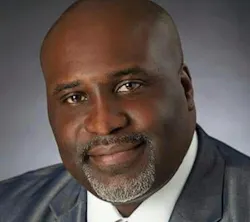
Tremell Brown oversees all VIA Metropolitan Transit staff functions and operations of the agency. Brown directly manages key operating divisions, including Fleet & Facilities, Safety, Transit Police and Training and System Security. He also serves as the agency’s chief safety officer and incident commander for Emergency Management/Response. He began his career at the agency as a bus operator in 1990 and during the ensuing three decades with the agency has advanced to serve in various leadership positions, including vice president of transportation and vice president of safety, training and system security.
Here is a transcript from the episode:
GJ: Welcome to the Infrastructure Technology Podcast. I'm Gavin Jenkins, head of content for Roads and Bridges. And with me, we have Brandon Lewis. He is the associate editor of Mass Transit magazine. And Jessica Parks, she is the staff writer for Roads and Bridges. Jessica, Brandon, how are you guys doing today?
BL: Well, whether you are listening to us on all podcasting platforms or whether you are watching us on the Infrastructure Technology Podcast or the Roads and Bridges YouTube channel, welcome to episode number 54. It is a Tuesday, which means it is a podcast day.
GJ: That is right. Jessica, how are you doing out there in Tulsa?
JP: I'm doing great. Hard to follow up with Brandon's always fantastic intro.
GJ: You can’t beat it. You can't beat his energy.
JP: Yeah, you cannot. On a Tuesday morning, he's unmatched.
GJ: You cannot out energy Brandon Lewis. That's why he's the man. Okay, so let's get into this. We're talking a little bit more, digging deeper, peeling back another layer on cameras. And so let's start here. Earlier this year, Minnesota's Department of Transportation announced that testing work zone speed safety cameras on I-35 West and Highway 65 would be done. They started it this summer. They announced it in June, July. So my question to you two, if a camera can change driver behavior and reduce the risk of a worker being struck, is that a fundamentally different and more acceptable use of surveillance technology than using cameras to monitor people for other purposes? So I think there's a huge distinction here between our Flock discussion where Flock is trying to catch people who are doing speeding violations at intersections, whereas cameras that could be posted around where a construction site are different because they're going up with the job site, aimed at the job site to try to keep people safe. But what say you? We'll start with you, Jess.
JP: I do think that it's different because it's serving a specific purpose. It is at a work zone. I'm sure that it is grabbing some people that maybe don't need to be on camera, but I think overall it's serving a specific purpose for a specific reason that if someone isn't about to intrude or intruding into a work zone, it will trigger. It's a delineated area that is being surveilled, and I don't think really many people have a problem with that if you are going into a parking garage, if you're going into certain spaces. Those are being used for surveillance, but people are going back and watching that. That's not AI necessarily triggering a search for someone, I guess in a way.
GJ: Yeah, understandable. Okay. Brandon, do you agree, disagree? And in your response, Brandon, I'm wondering, do you see any flaws where it could be used for bad?
BL: For sure. So unlike last week, where if you guys did not check out our flock camera discussion, I was very neutral. Jess and Noah were going back and forth having a wonderful discussion, and I was taking both sides of the issue like a politician. This week I'm going to dive in a little bit more, and I will say that for the most part, Jess, I do agree with you. I think one of the big differences here between this and the flock cameras was with the flock cameras, we were more talking about vehicles. Here with work zones, there are obviously a lot of people going around within construction. There's a lot of people out of their cars. And so with cameras being there, you're never going to stop the intention if someone really wants to try and get away with something, they're going to try their best to do so, but I think the awareness of cameras being there may deter them with more people being potentially in an area as opposed to just driving by it. I think one of the major flaws it could have though is still that identification purposes because you're only looking at someone maybe from one side, whether it's from the back maybe, or even the side of you, unless you see someone from the front and obviously people look differently, it would be hard, I would think, to personally identify them.
GJ: Yeah, I hear you there. I see the flaws in it because it could still be used by police officers who use it for bad stuff, like following a girlfriend or something like that, or it could be used for surveillance purposes and invasion of privacy, but I think where I see the distinction is that it's probably temporary because it's a work zone. And so whenever the work zone comes down, the cameras likely come down as well. And so it's really there to keep the construction workers safe. And so for that, I think that it doesn't cross a line. And look, we don't live in a black or white world. We live in a very gray world. And so I think that this, when it comes to safety versus surveillance, this falls into a very gray area where safety is paramount and the workers in our industry need to be safe, and there's been a lot of deaths in our industry that have been really tragic because of drivers speeding and being reckless, but it also makes me wonder how much more do we as a country need to do to keep work zone safer? Now we have cameras at work zones. We have signs, tons of signs, and barriers, and if you get a ticket in that, I mean, they've increased the penalty for a ticket in a work zone as well. And so it's like there's all these barriers and yet people are still disregarding work zone safety. I remember I was at a conference several years ago where someone predicted that eventually technology would be at a place where once you entered a work zone, they would be able to slow down your car.
BL: Oh, automatically?
GJ: Your car just automatically from a sensor and connected, immediately just you go down to 10 miles per hour, which I feel like that would probably solve it, but it would also drive people insane.
BL: I feel like that would cause a ton of accidents, too. If you're going at some certain speed, and you're not aware and you all of a sudden hit something, and you slow down, and you're not aware and people start freaking out.
GJ: Brandon, it would be gradual, sir. You wouldn't just go from 55 to 10.
JP: You fly out your window.
GJ: It'd be gradual, but that's the thing. What if it messes up, and it isn't gradual?
BL: That's what I'm saying.
GJ: You know what? Actually, it's a valid point.
JP: And then it's like, where do you draw the line on those capabilities to be able to do that to a vehicle? Are you going to get slowed down in school zones? Are you going to get slowed down here? If this agency can do it or this company can do it, who else can do it? So it's scary to have people have control of your vehicle a little bit.
GJ: Yeah, but we’re jumping the gun, so we're in agreement about cameras in the work zones then. All right. So before we start going into getting the machines being controlled, let's go to the next one that I want to talk about. So TrueLook, which is a provider of construction camera and job site visibility solutions, released its 2026 Estate of Construction Site Security Report in partnership with Noonlight. This report stated that 2,639 confirmed construction site break-ins occurred during 2025, which is a 50% increase over 2024. More than 40% occurred on the weekends. All right, it sounds like an SAT quiz there, but those are some statistics about theft on the job site, construction equipment getting stolen. So when contractors put cameras around a job site to prevent equipment theft, where do we draw the line between legitimate security and creating another environment where people are constantly being watched? Brandon, let's start with you this time.
BL: I'm just going to be honest that I don't think thieves care. I think thieves know that the cameras are going to be there and sometimes they just do what they're going to do, and I think part of it may be just because in general, construction equipment costs are up and people know if they can get access, they can sell it for a lot of money and bad people are going to do what they're going to do.
GJ: Yeah. Honestly, I'm surprised at this point people aren't going into construction sites and siphoning out diesel from the construction equipment. The price of diesel as a result of the war in the Middle East, the Iran war, diesel prices have skyrocketed. It's crushing our industry. And yeah, I'm surprised people aren't going in there with tubes and siphoning out diesel gasoline.
JP: It's funny because it's like creating a push to go electric with this diesel spike.
GJ: This - Right. Yeah. Yeah. We have a story in our September/October issue about how the EV market is having a moment, has a great opportunity because of the prices. But with equipment, Jess, what do you think? Do you agree with Brandon's take that stealers are going to steal, that they don't care?
JP: Yeah, I do agree with that. I mean, I have no problem with people securing a job site with cameras. That equipment is really expensive if you're breaking into a job site. I have no problem with it if you're in a kind of a... I know it's a private space in a public way in a way that's a little confusing, but you shouldn't really be going on a job site and trying to steal, so I have no problem with the surveillance camera on there.
GJ: I agree. I think that Brandon makes an excellent point about how the deterrents sometimes don't matter in our society, but like I said earlier, it's temporary. It's a temporary camera because the job site will be taken down, so therefore I'm okay with it, and if an owner of equipment... And a lot of the equipment's being rented, right? So if a contractor wants to protect that investment and protect that rental by putting up a camera, if that contractor feels safer having that camera up, and it's temporary, then I'm okay with that. I just don't know if it's a deterrent that works.
JP: I think for me with both these questions, I think it's a question of for a specific purpose, if you're breaking a law as opposed to just flock cameras being a catchall for anything. That's I think the big distinction for me.
GJ: Yeah, I think that's a huge distinction. Yeah. Okay. All right. So Brandon, I think that this discussion leads really well with your discussion that you have with Tremell Brown, who is the deputy CEO of VIA Metropolitan Transit in San Antonio, Texas. Do you have anything you want to say before we hear this interview?
BL: Correct. Yes, Gavin. So Tremell, he also directly manages key operating divisions, including fleet and facilities, safety, transit police and training and system security of VIA Metropolitan Transit. He also serves as the agency's chief safety officer and incident commander for emergency management response, and he began his career at the agency as a bus operator in 1990, so he has seen obviously various incidents throughout his career, and the agency just installed these new high-definition cameras on these buses, and we're very open with the public about how these cameras are going to be installed to help riders feel safer, and we dive more into that in the interview today.
GJ: Now, Brandon, have you seen the movie Speed yet? Because a camera on the bus plays a pivotal role in the movie Speed.
BL: No.
GJ: So do you know who's in Speed?
BL: I do not, no.
GJ: Okay. But you have heard of the movie Speed?
BL: Yes, from you.
GJ: From me. Okay. All right. Okay. All right. Just checking. All right, so up next, we have Brandon's interview with Tremell Brown, deputy CEO of VIA Metropolitan Transit. Take it away.
BL: And Tremel, welcome to the Infrastructure Technology Podcast.
TB: Thank you, Brandon. It's a pleasure to be here this afternoon. My name's Tremell Brown. I'm the deputy CEO for VIA Metropolitan Transit in San Antonio, Texas.
BL: So today we're going to be talking about this sort of fleet-wide modernization approach that you guys have had with your mobile video surveillance systems. And this is in partnership with Safety Vision LLC. Just to start us off here today, Tremell, can you tell us a little bit about what this technology exactly does and how it works?
TB: I sure can. You can kind of look at this as a refresh in technology. We've moved from kind of tongue in cheek from the video recorder situation all the way up to a streaming style level of play. We've got greater definition. We've got better low light technology to record in ambient situations. We just allow ourselves to maintain the fleet in a much better way in a video representation way. It's just a good opportunity to just refresh what we always do.
BL: So what is this technology actually recording?
TB: It's recording all the events that happen inside the vehicle, outside the vehicle and adjacent to the vehicle, and by adjacent, I mean what is behind the vehicle and what's in front of the vehicle. Our technology is used much like you've seen a lot of other transit properties just to make sure that the environment that our customers ride in is captured just for any type of safety reasons or training reasons that we can use.
BL: Is there audio with this video or is it just your typical, if you will, dash cam video?
TB: Yes, there is. There is audio. The audio is on the interior portion of what gets captured because we need that information just to help our customers have a better experience, and that's not unlike almost every transit system that you'll find in the United States.
BL: So how did this partnership then with SafetyVision come about?
TB: Well, we already had a relationship with Safety Vision and part of our fleet, but what this measure has now done is it kind of take us from a Frankenfleet, where we had multiple different types of video support contractors, and just bring it all under one, and it syncs our camera technology with our current Safety Vision NVRs, which just makes the whole system more unified and much more easier to manage, especially for maintenance and repairs and just fleet integrity.
BL: So the main purpose of this then is just to better provide safety for anybody, as you said, either onboard or outside of the vehicle. So let's say if a rider reports incidents, you guys could go back and maybe review that footage?
TB: Absolutely. We could actually do that before this stage of the partnership. This just allows us to do it easier, more efficiently and just a lot faster.
BL: Is there any AI or other artificial technology role that's making this more efficient?
TB: At this time, no. There's no particular AI branch of the way that data's captured, but what does happen is the quality of the footage that we capture. It allows us to spend less time reviewing and trying to zero in on key elements that we may find in some of the footage that's been captured but because of that clarity, it'd be much like looking at a brand new TV that you just bought this week versus one from 20 years ago. It just makes the experience easier for us to be more efficient and more effective to help keep our environment safe.
BL: Okay, so it's really about the resolution then of the cameras?
TB: Yeah. Resolution is very important when you have things that are moving around the vehicle and inside the vehicle and ambient light keeps changing with street lights and headlights and interior lights. And so you really want something that has great resolution that can deal with those settings.
BL: So these cameras right now are currently on fixed buses, excuse me. Are they on all of the fixed buses or is there a certain amount?
TB: Well, at this plan, they're going to be on all the fixed buses, but now moving forward, all new buses and vans will also be equipped, so we still have a unified system and so it's going to be something we're looking forward to.
BL: So is there a staged rollout? Obviously you said that the new buses and vans are going to be equipped but is there a timeline to get all of the buses equipped with this technology?
TB: Well, that is being determined right now what that looks like. It will be a short turnaround because we, again, already had Safety Vision kind of as a root base in that system. What we're now doing is connecting better eyes and ears and so there won't be much of a lag by the time that we get to the last vehicle, but we've got vehicle purchase coming up in the future and so we want everything to be under the same umbrella of operations, so we have the same performance expectation.
BL: I gotcha. Now in terms of cost, is this something that has been worked out with Safety Vision? As you said, you already had a partnership with them.
TB: We did have a partnership with them, and I'll have to get back to you on what those costs are, but we may have had some incentive, and I believe we may have even been a recipient of a potential rebate that allowed us to get them at a discount price. I'll have to check with the rest of the teams though for further details.
BL: Did you guys get any feedback from riders on this technology?
TB: We have indirectly. A lot of times the customers are happy at the outcome that comes from some of our safety measures that are out there. We rely a great deal on the video footage, and the indirect feedback that we get is the thank yous from customers. For example, if they have lost an item or misplaced something or they encounter a situation that was adjacent to the bus but not in the bus, a lot of times when these records requests come in, our ability to achieve that information and capture still photos and still shots to help law enforcement partners as well as our own trans police do their job, generally that's when we'll get the feedback that they're so thankful that we have the opportunity and the ability to use technology to help keep them safer, so that's the indirect feedback that we get from them.
BL: And I’m assuming that this is all part of a broader safety initiative from VIA Metropolitan Transit. I know you guys have issued a bunch of safety initiatives previously.
TB: Absolutely. I'm glad you brought that up.This is just kind of one finger on the larger hand of ensuring safe spaces and safe experiences for our employees as well as our customers. To be able to have this is again, like much work processes that take place when you have good data in, you get good data out. This is an opportunity for us to see better, hear better and report a lot more, see something, say some of the situations, add that to our strategy to make sure we're keeping our riders as safe as possible while they're making their way to their quality of life experiences of doctor's appointments, employment, education, things of that nature.
BL: In terms of maintenance, are you guys the ones sort of maintaining it once they're installed or is that more Safety Vision?
TB: It's a little bit of both. Part of our agreement that we have, we have a team that is trained by Safety Vision, but we also have a period of time where Safety Vision will be present, and they'll be here to help things go as we land the plane that they get the entire fleet converted.
BL: What, in your opinion, is the biggest difference between this technology, and I guess the resolution is part of it, but between this technology and the old security system that you guys had?
TB: That's a great question. The highest benefit that we're seeing from this move is in the back office. What does it take to identify a segment of footage, a segment of video and confirm what we're matching with police reports, complaints or comments or operator input? The ability to scan faster and go through larger amounts of content in a short amount of time just based on the way that back office works is a benefit. There are a lot of agencies right now that I'm sure can attest to the volume of time that is spent just efforting open records requests, accident claims, things of that nature and there is just volumes of footage. So the way the cataloging works in the back office and connects with MVR, it really just allows us to have a much more smarter, intuitive experience, and I'm sure the video teams that we have here appreciate that because it would probably be the equivalent of going from a file cabinet system and fingering through paper versus being able to queue through a table of contents and segments, so we're happy about the back office. It's very efficient.
BL: Gotcha. Now, do you know how it works? Obviously this is recording. Does it record 24/7 or is there a manual start and stop?
TB: So generally what you'll find, which is kind of an industry norm, is when the vehicle fires up, it's already recording. It's not necessarily triggered by a movement, triggered by a particular moment. So if that vehicle is servicing, so are the cameras, and what happens is just like everything else, there's a lifespan, if you will, of a time before that tape stops and then starts to record over itself, and those are some of the things that we're evaluating right now is what does that window of time look like? What we understand on the white paper reporting information that we have a capability of going much further and recording video longer before it actually records over itself, but we're still enjoying getting new and breaking into some of these things that we're finding out.
BL: Now, does this go back to one of the computers in the main office and then someone on the video team is able to, like you said, almost virtually go through a file cabinet, if you will, or a folder on their desktop and find video like that relatively quickly? Or does it take time to download and search and find and load up, for example?
TB: Pretty much the previous comment that you made. What you'll find, it's kind of an industry norm, which is great of how the migration of technology is working in our industry right now, is you'll find many of these systems, much like this one, they take in the data, and you're able to retrieve them and set up recording times and download times so you don't have to physically wait for the bus to get in and start to do your search and whatnot. So we're able to access some of the content and see what's going on and set up download time so that way it can already be ready and kind of be in the queue, if you will, so we don't have to wait for that bus to get all the way to the yard at the end of the night.
BL: Now, I know that with this partnership at launch about late June or early summer, do you have any data? Again, have you guys seen more incidents reported or anything like that?
TB: Well, I can tell you the technology definitely doesn't determine the rate or the frequency of the reporting that we get, but I can tell you in the society that we're dealing with today, there's so much recording going on with people's individual cell phone devices and others. It seems like anecdotally that there are more people who rely on their own technology, and they'll use fixed technology and vehicles and facilities and things like that as a backup just in case. And so there's no rarity and availability of video and content footage, but what we are proud to do is that if those do increase, we can effort those at a much better rate than we could previously before this level of a Safety Vision.
BL: It is wild. You'll see the videos all the time of somebody on a transit system and two people are getting into an argument and the people are not even trying to solve the argument. They're just recording it on their phones to potentially upload to social media to get quick views. I guess that's just society today.
TB: It is, and there's pluses and minuses to that, but for us, as long as it's in the effort of safety, we see a lot that's going on. We have people who show up to our trans police officers wanting to show video footage or content and they want to upload themselves. We've seen cases where they will share that information on their own social media channels and someone gets identified by it. So in the days that we live in right now, everyone wants to capture what they just saw, and we just hope that continues to go towards the reporting of potential capture and addressing the issues that someone may have performed, a criminal act or something that may have impacted someone negatively while using the service.
BL: Yeah, I think agencies really, I've been here since October of 2022 at Mass Transit, and during my time, I have seen a lot of agencies now, I think really over the last couple of years starting to push these safety efforts, whether it's more transit police on board or with technology and cameras like you have been saying. Is there anything about this technology that may be expanded upon in the future that it might not be doing right now?
TB: That's a phenomenal question. If you were to ask me that question even 10 years ago, there are things that today's technology can do that we probably weren't thinking about 10 years ago. What I would love to see if I had the crystal ball and could design the future is the availability of AI to do identification of shapes, figures, different types of things. It does exist in Lehring and different types of facility cameras and things you've seen at airports that can identify the shapes of packages and bags and suitcases. But to be able to use that technology regularly on all the cameras on a transit vehicle, there's a lot of use, even for public safety, for a situation we may just happen to be driving past and the local municipal law enforcement may need some assistance in just trying to address a crisis, and if we can help in that manner, that's a good thing. We see those requests coming in now, but we can't always provide them relevant content that they're needed, but I think in the future, we may actually see something like that where it's accessible faster by others. And so all reporting is good reporting if it keeps everybody safe.
BL: To your point, isn't it crazy? You'll watch a video of something from 2016, 2017 that looks so out of date? It wasn't that long ago.
TB: It really wasn't. And you'll see even some cell phone footage that people use, body cam footage that law enforcement use and things of that nature. We have gotten so used to a diet of sharp, clear images, so much so even TV prices have dropped because availability of clear quality images is so readily available. I think that's what we're seeing in the industry is almost a flattening of the expectation that if it doesn't do all of these things, why would you want to be a part of it? And I think that's the speed of technology and change, and we're just glad to bring that to our fleet and kind of unify that on everything that serves the public.
BL: Was there any concern from riders of like, ‘Oh, the agency is putting up these cameras inside and outside the vehicle. It is my right to personal privacy. Are they going to record things that I say?’
TB: That's a great question. We've not seen that here. We've had cameras on our vehicles. I've been here at VIA for 36 years now. We've had cameras on vehicles for decades, and we just don't run across someone who says that you don't have the right to record me. I mean, the city statutes and citations still identify it's a public space in a public area. You've seen that in social media where you'll hear the phrase, there's no expectation of privacy in a public setting. For us, we don't go that far, but we remind people that this allows us to make sure you have a safer experience, and sometimes that's a great deterrent for people who may be nefarious or have just some poor ideas about trying to carry out some effort in and around our system. We just want to be sure we can gather all that we can to help bring them to justice.
BL: Tremell, is there anything on these cameras or this partnership with Safety Vision that I did not address?
TB: No, not that I can think of. I can tell you what you did well. You asked a lot of great questions about the output of now that we have this technology, how does our landscape and our abilities change? And that's great because that's what I think you'll find is most people have found a better mousetrap and they just want to put that into play as fast as they can. And for us, that's what we have. We have something that gives us better back office, more prowess to get better, higher content video. And that helps us in the end because every system that you'll see out there as far as transit system is spending more and more time efforting open records requests. So much so they're creating entire departments and divisions just to deal with the volume of those requests and so we're just glad to be able to have more efficient measures to do so.
BL: Tremell Brown, he is the deputy CEO of VIA Metropolitan Transit. Tremell, thank you so much for joining me today on the Infrastructure Technology Podcast.
TB: Thank you so much, my friend. I wish you well, and please stay safe.
GJ: And welcome back. That was Brandon Lewis discussing safety cameras on buses with Tremell Brown, deputy CEO of VIA Metropolitan Transit in San Antonio, Texas. Jess, what did you think?
JP: I though it was a really interesting episode. I mean, I think the community is seeing a lot of benefits of this surveillance. I've left stuff on a bus or a train a million times, and I'd love to have a recourse of getting it back. And typically when I've left up on a subway or something like that, that's gone into the ether. I will never see that again, so I think that this program, while you are being watched on a bus by a camera, I think that it is overall very... There are benefits to the community that outweigh the negatives.
GP: Yeah, absolutely. I mean, look, a lot of weird things happen on buses. I've ridden a lot of city buses here in Pittsburgh. At an old job, I used to take the bus to work. I saw a lot of weird stuff and having the cameras on there, like we talked about at the beginning, it can keep people safe. It also, and the main thing is it can keep the bus driver safe, and it can keep the bus driver protected against accusations. It's really wise to have cameras on buses. What do you think, Brandon?
BL: Moving forward, all of their new buses that the agency will bring in will already have these cameras equipped on them, and one of the most fascinating things to me that Tremell pointed out was he said that resolution is very important when you have things that are moving around the vehicle, inside the vehicle. Ambient light keeps changing with street lights and headlights and interior lights, which I found fascinating to think about how the amber picture could change based off a light color, based off where you are inside the bus reflecting that. And to be able to get that very high quality resolution, even in today's environment, while it may be more work for the agency to install, it is worth it in their mind.
GJ: All right. Okay. Well, that was episode 54. We did it. All right. Don't be too excited. We did it.
BL: Fifty-four down, a zillion to go.
JP: Exactly.
GJ: Many more to go. All right. Well, we want to do our thank you’s now. We want to thank Tremell Brown, obviously, for joining us on today's show and talking to Brandon. We want to thank Endeavor B2B for giving us this wonderful podcast, this platform where we can talk about Speed and Speed to Cruise Control, which is Speed on a cruise ship. And we also want to thank you, the listener, for listening to us. Be sure to check us out on YouTube, check us out on Spotify, wherever else you get your podcasts, and be sure to give us a note. Drop us a line. Our email address is [email protected], and that about does it. I'm Gavin Jenkins, head of content for Roads and Bridges.
BL: I'm Brandon Lewis, associate editor for Mass Transit magazine.
JP: And I'm Jessica Parks, staff writer for Roads and Bridges.
GJ: All right. Well, until next time, goodbye.
About the Author
 Brandon Lewis
Brandon Lewis
Associate Editor
Brandon Lewis is a recent graduate of Kent State University with a bachelor’s degree in journalism. Lewis is a former freelance editorial assistant at Vehicle Service Pros in Endeavor Business Media’s Vehicle Repair Group. Lewis brings his knowledge of web managing, copyediting and SEO practices to Mass Transit magazine as an associate editor. He is also a co-host of the Infrastructure Technology Podcast.