Denver RTD expands Customer Experience Elevator Program to seven more locations
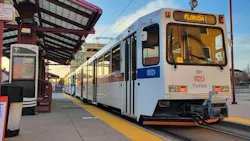
The Denver Regional Transportation District (RTD) has expanded its Customer Experience Elevator Program to seven more locations, building on a program the agency says is successful in reducing unwanted behavior and maintenance calls. Denver RTD says reprogramming public elevator doors to remain open when not in use significantly deters security-related calls and criminal activities at stations.
The program launched in March 2024 as a 90-day pilot at three high-usage light-rail stations—Colorado, Nine Mile and Southmoor—spearheaded by the RTD Transit Police Department (RTD-PD). The agency notes that after clear reductions in customer complaints, maintenance issues and overall calls for service, the program expanded throughout 2025, reaching 10 total stations by year’s end.
“[Denver] RTD is immensely pleased that the Customer Experience Elevator Program continues to deliver reduced overall incidents and calls for service at the locations,” said RTD-PD Chief of Police and Emergency Management Steve Martingano. “Our goal continues to be to employ tactics that will support a transit environment that is a welcoming, convenient and enjoyable experience for all customers. The program demonstrates the effectiveness of environmental design tactics that RTD-PD has implemented across the district and contributes to the overall efforts across the system to further enhance safety.”
As part of the expansion of the program, Sheridan Station experienced a 77% reduction in overall calls for service from June 2024 through September 2025. Prior to the elevator reprogramming, Denver RTD received 570 calls for service in 2024 compared to 127 calls in 2025.
Lakewood-Wadsworth Station experienced a 76% decrease in reports of illicit drug activity, decreasing from 414 reports in 2024 to 96 in 2025 to 18 through May 2026. Denver RTD says reprogramming the station also resulted in a 62% reduction in calls for service dropping from 852 in 2024 to 316 in 2025. The location also experienced a significant drop in maintenance calls–55%–decreasing in 2024 from 128) to 57 in 2025.
In the same time period, Colfax Station experienced an almost 45% reduction in calls for service, decreasing from 567 in 2024 to 312 in 2025. Reports of illicit drug activity dropped by 55%, comparing 2024’s 213 reported incidents with 2025’s 94.
With fewer than 10 calls prior to reprogramming, the Jefferson County Government Center-Golden Station continued to experience low service-related calls and no calls reporting illicit drug activity from 2024 to 2026.
Starting in October 2025, Florida Station experienced a 50% reduction in calls for service, dropping from 333 in 2024 to 166 2025. Reports of illicit drug activity also dropped 73% from 2024’s 84 reports to 2025’s 22. Maintenance calls decreased from 64 in 2024 to 21 in 2025 and through May 2026.
In the same period, US 36 and Broomfield Station elevator reprogramming led to a 25% reduction in calls for service, decreasing from 40 in 2024 to 30 in 2025 . RidgeGate Station experienced a 50% reduction in calls for service from 2024 to 2025 and a reduction from three to no reports of narcotics activity during that same period.
“By reprogramming the elevator doors to remain open when not in use, we’ve significantly improved security at our stations,” said Denver RTD Manager of Facilities Maintenance Sean Moran. “This simple operational change has created a cleaner and more secure environment for customers and maintenance staff alike. The [Denver] RTD Facilities team remains committed to partnering with transit police to implement improvements that keep the system accessible and a more welcoming transit environment for everyone.”
The agency says elevator reprogramming is based on security-related and maintenance data analyzed by the RTD-PD and the elevator model’s capability for reprogramming. The agency owns and operates 79 public-facing elevators and will continue to broaden the program beyond the 17 locations reprogrammed to date. By the end of summer, the agency anticipates extending the program to include University, Orchard and Belleview stations, with further reprogramming planned at Louisiana-Pearl and US 36 and McCaslin stations. The agency says more stations remain under consideration contingent upon the ability to reprogram other elevator models.
The program is part of Crime Prevention through Environmental Design (CPTED)–an initiative the agency has been undertaking since 2022 across its entire service area. Related efforts include upgrading lights, installing TV monitors that display security feeds, as well as smoke detectors in public restrooms. Denver RTD says CPTED is a multi-faceted approach to reducing crime and deterring offenders at stations, stops and facilities.
“The program demonstrates the environmental design tactics that RTD-PD is employing provide significant benefits and are replicable to other locations. We’re deploying these efforts across our transit environment to continue enhancing security for our customers and employees,” Martingano said.
Recently, Denver RTD became one of five transit agencies in the U.S., along with the Chicago Transit Authority, Los Angeles County Metropolitan Transportation Authority, Southeastern Pennsylvania Transportation Authority and TriMet, that was evaluated in a study of transit systems’ strategies used to deter illicit drug activity and the effects on post-pandemic transit ridership recovery. The study was conducted by the Transit Cooperative Research Program.
As part of its annual safety metrics report, in April 2025, Denver RTD reported in 2024 it met all of its established bus and light-rail targets related to minimizing fatalities across the system. In March 2025, the agency increased RTD-PD officers patrolling the system.
About the Author
 Brandon Lewis
Brandon Lewis
Associate Editor
Brandon Lewis is a recent graduate of Kent State University with a bachelor’s degree in journalism. Lewis is a former freelance editorial assistant at Vehicle Service Pros in Endeavor Business Media’s Vehicle Repair Group. Lewis brings his knowledge of web managing, copyediting and SEO practices to Mass Transit magazine as an associate editor. He is also a co-host of the Infrastructure Technology Podcast.