CA: Coastal Commission approves more sand and rock to protect San Diego’s coastal rail corridor
More sand replenishment, rock riprap, and the construction of a seawall were approved Thursday for eroding beaches in San Clemente to protect the only rail corridor connecting San Diego with Los Angeles and the rest of the United States.
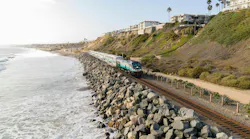
Most of the riprap has already been installed along the seaward side of the railroad tracks as part of emergency repairs made without permits after recent high tides and strong ocean swells, California Coastal Commission staffers said at the meeting in San Francisco. The approval will allow the boulders to be rearranged and extended.
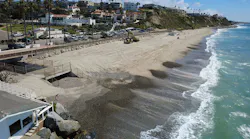
Also planned is the placement of up to 690,000 cubic yards of sand along the shoreline to further protect the corridor. That is about twice the amount of sediment usually removed and placed on nearby beaches by the annual dredging of the Oceanside harbor channel.
“We have to do something now,” said Commissioner Ray Jackson of Hermosa Beach. “It’s not perfect … (but) this is a plan to move forward and save what we have.”
Several commissioners said the proposal by the Orange County Transportation Authority (OCTA) and the Southern California Regional Rail Authority (SCRRA or Metrolink), should include more sand, enough to keep the beaches at least 50 feet wide for public access and recreation.
However, commission staffers said that would not be practical without doing extensive studies to determine how a specific width could be established and maintained.
Factors such as how much sand would be required, how frequently it would be replenished, what the operation would cost, and whether the width would be measured at high, low or median tide need to be determined, they said.
“We just don’t have enough information to say with any confidence what amount of sand would equal that beach width,” said Executive Director Kate Huckelbridge. “We could get there, but we don’t have it today.”
As a compromise, the commissioners agreed unanimously to include a requirement to report back in five years with information on the condition of the beaches and how a minimum width might be maintained.
The two areas to get additional rock and sand are separated by about two miles. One location is a short distance north of the San Clemente Pier, and the other is south of the pier near the Cyprus Shore community and San Clemente State Beach.
The sand is to be placed sometime within the next year. The project includes long-term monitoring of the sand’s movement, including its effects on nearby kelp and reef habitat, with a final report due to the commission in 10 years.
The 1,200-foot-long engineered seawall will replace a boulder revetment at the southern location near Cyprus Shore.
Also included is a requirement to study the possible eventual relocation of the rail line, with regular progress reports to the Coastal Commission starting in 2028 and every three years thereafter. Transit agencies have occasionally talked about moving the San Clemente segment east to the Interstate 5 corridor, but construction would cost many billions of dollars and little progress has been made on the idea.
About 40 members of the public addressed the commission about the shoreline protection measures. Many of the speakers opposed the use of rock revetments or seawalls, often called armoring, which can contribute to beach scouring and erosion.
“There is convincing evidence that coastal armoring has a harmful effect on beaches,” said San Clemente City Manager Andy Hall.
A wide beach with dry sand above the high tide line is the best way to protect the railroad tracks, Hall said. He urged the commission to focus on beach replenishment and ways to make it quicker and easier.
“Why are we making firm commitments to rock and steel,” asked Jeff Berg, of the local advocacy group Bring Back Our Beaches. “Losing the beach doesn’t just hurt the public, it makes the railroad harder to protect.”
The railroad is part of the 351-mile Los Angeles- San Diego- San Luis Obispo (LOSSAN) rail corridor, used by Amtrak, Metrolink and BNSF freight trains. North County Transit District operates its Coaster commuter trains on the portion of the corridor between Oceanside and downtown San Diego.
About seven miles of the rail corridor runs along the beach between Dana Point and San Clemente, just north of the San Diego County border.
Since 2021, the Coastal Commission has approved 15 track-stabilization projects to protect the existing railroad along the San Clemente segment, including 10 emergency coastal development permits, four regular coastal development permits, one waiver, and two amendments.
During that time, the tracks have either closed or had limited service on multiple occasions totaling about one year.
©2026 The San Diego Union-Tribune.
Visit sandiegouniontribune.com.
Distributed by Tribune Content Agency, LLC.