MTA breaks ground on Second Avenue Subway Phase 2 construction
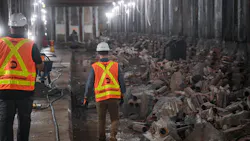
The Metropolitan Transportation Authority (MTA) broke ground on the next construction stage of the Second Avenue Subway Phase 2 project. The groundbreaking occurred at the location where, in early 2027, the tunnel-boring machine (TBM) will be lowered into the ground and begin mining the new subway tunnels from 120 Street and 2nd Avenue to 125 Street and Malcolm X Boulevard.
“The Second Avenue Subway will change everything for East Harlem, saving people precious time and making possible opportunities that have for too long been out of reach for too many,” said New York Gov. Kathy Hochul. “The last groundbreaking for a second avenue subway in East Harlem was 54 years ago, only for the project to be abandoned and this community left behind. When I became Governor, I promised that I would be the leader to finally get this done and by breaking ground on the major construction phase of this project, we are one giant step closer to realizing a dream nearly a century in the making.”
Gov. Hochul also announced that, following the resumption of federal funding to the project in April, the MTA has awarded the next major contract to construct the final tunnel section of this phase from 105 Street to 110 Street, including the future 106 Street Station, using a “cut and cover” approach. The authority notes it is applying lessons from Phase 1 of the project to deliver more than $1 billion in savings, also noting it is on track to complete advanced utility relocations early, allowing pending work on this project to start six months faster than originally scheduled.
"It was 80 years ago they started knocking down the Second Avenue El—an entire lifetime,” said MTA Chair and CEO Janno Lieber. “Today's groundbreaking is another major step toward transit justice for East Harlem, the City's most transit-dependent community."
The variable-density TBMs are set to be delivered early next year. Weighing more than one million and a half pounds, the machines are equipped with 23-foot, tungsten carbide cutter heads. The TBM can adjust its methods depending on what kind of material it encounters, toggling between one kind of drill for hard rock and another for soft soil or sand. The TBM also reinforces the tunnel lining it leaves behind as it travels beneath Harlem.
Concurrent to today's milestone on the Phase 2 project, the MTA notes it is already scoping and designing a potential next phase of the Q train westward across 125th Street to Broadway with three new stations and more than 160,000 daily riders. Following the completion of an MTA feasibility study announced by Gov. Hochul in 2024, this year’s fiscal year 2027 enacted state budget secured $25 million to conduct preliminary engineering and design of a tunnel extension and approval of an efficient environmental review process. If the project is advanced, work on the tunnel could continue using much of the same equipment from phase 2.
Second Avenue Subway Phase 2 is divided into four contracts—compared to 10 in Phase 1—to increase project efficiency and minimize complicated contractor coordination. The tunnel boring is part of Contract 2, valued at $1.97 billion, including shaft excavation for the TBM, controlled blasting for future stations and asbestos and lead abatement in the existing 1970s tunnels.
At the groundbreaking, the MTA and Gov. Hochul announced progress on another major component of Phase 2: the award of Contract 3. Contract 3 will construct the structural shells of the new 106 Street Station and associated tunneling, connecting the existing tunnels north and south of the station, which the contractor is expected to begin work in the coming months. The entire Second Avenue Subway Phase 2 project is budgeted at $6.97 billion and is on track for revenue service in 2032.
"The new MTA is delivering on the longstanding promise to bring subway service to the East Harlem community,” said MTA Construction and Development President Jamie Torres-Springer. “By applying lessons learned from Phase 1, we’re delivering this project better, faster and cheaper—with more than $1 billion in savings to date."
Using cost containment strategies learned during Phase 1
Addressing utility relocation requirements upfront reduces the risk of unexpected costs or delays later as construction progresses, according to the MTA—especially in New York City (NYC), which has one of the most complex underground utilities networks in the world, most of which is unmapped.
Additional cost containment initiatives in Phase 2 include:
- Reuse of a tunnel segment that was built in the 1970s from 110 Street to 120 Street along Second Avenue.
- Early real estate acquisition.
- Adoption of innovative contract structures such as best-value, performance-based contracts, design-build.
- Close coordination of contracts.
- The reduction in back-of-house, ancillary spaces and station sizes.
All told, the MTA says these initiatives have saved more than $1 billion.
“The next phase of the Second Avenue Subway reflects a multi-faceted approach to reinforcing the East Harlem and uptown Manhattan economies, not only in what the project aims to generate upon completion but in the construction itself,” said NYC Comptroller Mark Levine. “A new, accessible transit line, 70,000 union jobs and over $1 billion in savings is what adaptability and efficiency in government can look like. I look forward to Phase 2 beginning shortly and learning even more valuable lessons from its undertaking.”
Delivering better transit for East Harlem
According to the MTA, East Harlem is a historically underserved neighborhood which has one of the largest concentrations of affordable housing in the U.S. It’s also where 70% of residents rely on transit. Phase 2 will create three new accessible stations right in the heart of the community at 106 Street, 116 Street and 125 Street and offer one-seat rides from East Harlem to the Upper East Side, West Midtown and Coney Island, shortening travel times by up to 20 minutes.
The Second Avenue Subway Phase 2 project is also intended to create thousands of jobs, including union-wage construction jobs. A 20% local hiring goal for the project is designed to generate good-paying job opportunities for hundreds of East Harlem residents.
East Harlem has long been promised a new subway connection on Second Avenue. In the 1920s, the Second System proposal, which ultimately became the IND subway system, included service on Second Avenue. In 1948, NYC voters approved bonding intended to build the second avenue subway, which was ultimately left unbuilt after the start of the Korean War. In 1972, construction on the line finally commenced in East Harlem but was later abandoned in 1975 during the city’s fiscal crisis. Sections of the tunneling constructed in the 1970s will be adapted and utilized in Phase 2, including for the 116 St station.
The second phase of the project will extend Q train service from 96 Street north to 125 Street and then west on 125 Street to Park Avenue, approximately 1.5 miles in total. There will be a direct passenger connection with the existing 125 Street subway station on the Lexington Avenue subway line. Phase 2 will also feature an entrance at Park Avenue to allow convenient transfers to the Metro-North Railroad’s Harlem-125 Street Station.
Each station will have above-ground ancillary buildings that house ventilation, mechanical, and electrical equipment, as well as space for possible ground-floor retail and community uses. The expansion is set to serve 300,000 daily riders when combined with Phase 1—and provide three new ADA accessible stations. Increased multimodal transit connectivity at the 125 Street station at Park Avenue with connections to the 4/5/6 lines, Metro-North and the M60 Select Bus Service to LaGuardia Airport will allow for transfers to other subway and commuter rail lines, facilitating smoother, faster transportation across the city and metropolitan region.