The MDOT MTA Purple Line: Nearly Two Decades in the Making
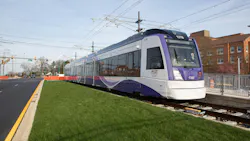
In winter 2027, the Maryland Department of Transportation Maryland Transit Administration (MDOT MTA) will launch service of the Purple Line, a 16-mile light-rail line that will provide service from New Carrollton to Bethesda, Md., including direct travel options to the following locations:
- Washington Metropolitan Area Transit Authority’s (WMATA) Metrorail: Red (Bethesda and Silver Springs), Green (College Park) and Orange (New Carrollton) lines
- MARC commuter rail (Silver Springs, College Park and New Carrollton)
- Amtrak (New Carrollton)
- Local and regional bus networks
When complete, the project timeline will have spanned over two decades, starting with a survey MDOT MTA issued to riders in 2002 that asked their thoughts on new potential transit modes that could be coming to the area. Light-rail transit (LRT) was selected as the mode of transportation for the project in 2009 after a draft environmental impact study was completed a year prior. Once service begins, Purple Line Transit Partners (PLTP) will operate and maintain the light-rail system for 30 years.
According to MTA Administrator Holly Arnold, a transportation project this massive in the state of Maryland has been dreamed of since the 1970s, noting that even though WMATA can get residents between Bethesda and Silver Springs, Md., “you gotta go all the way in and come all the way out or take a bus or a series of buses through pretty congested roadways.”
Construction challenges
Construction on the project began in 2016. In 2021, MDOT MTA brought in Maryland Transit Solutions (MTS), a team comprised of Dragados USA Inc. and OHL USA Inc., to be the design-build contractor on the project. MTA Senior Project Director for the Purple Line Ray Biggs II says this massively sped up the project's construction.
“Thanks to MTS, we were able to begin full-scale construction in the summer of 2022 after dealing with challenges from the pandemic,” Biggs said.
Those challenges included supply chain issues, as well as what Biggs and Arnold both describe as natural problems that pop up when dealing with a project in an urban area. When construction began, it was anticipated to be finished by winter 2026. But with all the construction challenges, in 2023, MDOT MTA agreed to provide an additional $148 million to PLTP to allow the project completion date to be pushed back a year to winter 2027.
Biggs explains the location of the project is unique, as the project is just outside the Washington, D.C., area and covers Interstate 495, also known as the Capital Beltway, in Maryland. Because of the area, MDOT MTA had to coordinate with multiple agencies and counties, including WMATA, Prince George's County and Montgomery County, to complete underground and overhead utility location work before rail could be installed across the alignment.
“I like to say the project has two parts: part one being the roadway and utility project and part two being the light-rail project,” Biggs said.
He notes the project is a public-private partnership (P3) and that there are over 30 third parties working on the construction side of the project.
“That P3 partnership is the only way we could complete this project because there’s too many different parts when you’re dealing with a project this big,” Biggs noted. “It took that project-first approach to identify and communicate and resolve issues as quickly as possible, as there’s a lot of moving parts with a multi-billion-dollar project.”
In an emailed statement to Mass Transit magazine, PLTP CEO Doran Bosso says the project’s location is “woven into the fabric of densely populated, existing urban and suburban areas.”
Arnold notes it’s not just light rail that makes a project of this size so complicated to complete.
“We connect to multiple [operators],” Arnold said. “We go over CSX tracks. We go over Amtrak tracks. We connect with Amtrak, and we make connections with Prince George's County, the bus with Montgomery County Ride On and with multiple WMATA buses.”
She notes those connections are what make it difficult to coordinate the normal day-to-day roadway closures with state highway officials and local counties. In addition to coordinating with local entities, MDOT MTA also had to work with residents due to the line impeding on their property.
“We're on people's doorsteps, we're going through their neighborhoods, we're in their front yards,” Arnold said. “And so it has been a lot of coordination, and Ray’s team does a fantastic job of knowing who the communities are and that different communities have different needs.”
Arnold adds the University of Maryland even moved the iconic ‘M’ on its main campus to make room for rail lines for the project.
In his statement to Mass Transit magazine, Bosso adds that there are over 1,200 people on site on a given day.
“PLTP has worked hard to establish processes and communication channels to keep everyone on the same page, and that extends to our teams’ outreach efforts informing the community about what they can expect throughout the various phases of construction and testing as this transformational infrastructure takes shape,” Bosso said.
Railcars
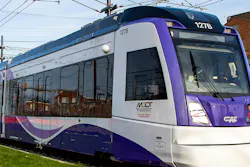
The 28 light-rail vehicles (LRVs) for the Purple Line were assembled by CAF in Elmira, N.Y. Arnold notes that when putting out a request for proposals for the railcars, there wasn’t anything specific the agency was looking for.
“We were pretty open to the type of car, other than it needed to be a light-rail vehicle, and it needed to be accessible for everyone,” Arnold said.
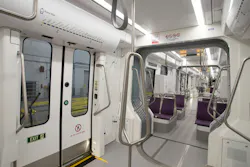
The cars are 142 feet long and are more than 8.5 feet wide, with a total passenger capacity of 400. They are low-floor vehicles, making it easy for those with mobility challenges to ride.
Features include seating for 80 people, bicycle storage and a fully open gangway, so riders can have clear visibility throughout the entire length of the train, as well as noise reduction measures such as dampening wheel skirts. The vehicles are electric, which make them less noisy compared to a typical railcar.
The first LRV for the Purple Line was delivered in 2024. Testing began on the cars in 2025, with the final car arriving in November. Cars will be tested through the end of 2026.
Transit-oriented development (TOD)
While the Purple Line will be connecting parts of Maryland that are currently difficult to reach, the state will also be using the Purple Line to integrate transit with housing with the help of TOD.
According to Arnold, the TOD focus speaks to the growth in both Prince George's and Montgomery County, who noted that apartments around the Purple Line location have already begun opening up.
“Not having to go into D.C. to make direct connections is going to be critical, but it is amazing to see the TOD that is popping up already around the Purple Line stations in anticipation… it’s like high rise after high rise,” Arnold said.
Along with the TOD development, Biggs notes the project has led to the creation of 19 miles of sidewalks, helping those with mobility challenges reach stations more safely. Biggs says all the locations for the new sidewalks, as well as new bike trails, were strategically chosen so residents wouldn’t have to use a car to get to one of the 21 Purple Line stations, including 11 stations in Prince George’s County and 10 in Montgomery County.
“These were sidewalks we had to build from scratch; this area simply didn’t exist before,” Biggs said. “We’ve taken an area where you couldn't go with a stroller or using a wheelchair and now you can easily access and be able to get to any one of our new stations with ease.”
Finishing construction
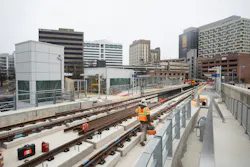
The project is currently 90% done with construction. In May, MDOT MTA celebrated the installation of the final piece of rail connecting Prince George's and Montgomery counties. According to Arnold, the latest the line would open would be early 2028, but the end of 2027 is still the goal.
“The reason why we can’t say for sure when the line will open is because of all the testing that still needs to be done,” Arnold said, while noting that around April 2027 pre-revenue service testing will begin.
The agency is planning a full alignment approach for the launch of the line, but it is too early to know exactly the frequency of service. According to Arnold, the target is a train coming every seven minutes during peak hours and every 10 to 15 minutes off peak, depending on the time of day. The frequency goal is to align train times so that they are not operating during class changeover at the University of Maryland due to the potential of high-volume pedestrian activity near the tracks. Arnold notes the timing “will have to be worked out as we get through the trial running period.”
Community involvement
MDOT MTA is working with Arts in Transit, a $6 million public art program designed to make art an integral element of the project and to further enhance the stations, aesthetic treatments and landscape designs. Art is incorporated into stations, as well as other project structures, including bridges, fencing and lighting.
The Purple Line Art-in-Transit Committee selected 22 artists from more than 700 submissions for the Purple Line stations. Currently, 10 out of the 21 Purple Line stations have Art in Transit installations complete. The agency has also received over $500 million in funding for small minority and disadvantaged businesses to work on the project.
“It was really important to us to have the community involved in this whole process,” Arnold said. “Transit is an economic driver, and this project is a great example of that.”
Project timeline
- 2002-2008: The MTA studied a range of alignments and transit modes for more transit options throughout the Baltimore region.
- 2008: A draft of the environmental impact study was completed on the project.
- 2009: Light-rail transit was selected as the mode of transportation for the project.
- 2013: MTA selected private-public partnerships as the project delivery method, and the final environmental impacts study was accepted by the Federal Transit Administration (FTA).
- 2014: FTA issued a record of decision on the project, and MTA issued a request for proposals.
- 2016: Purple Line Transit Partners was selected as concessionaire on the project, and construction began on the project.
- 2021: Maryland Transit Solutions was selected to be the design-build contractor for the project, accelerating construction.
- 2027: The project is scheduled to conclude.
About the Author
 Brandon Lewis
Brandon Lewis
Associate Editor
Brandon Lewis is a recent graduate of Kent State University with a bachelor’s degree in journalism. Lewis is a former freelance editorial assistant at Vehicle Service Pros in Endeavor Business Media’s Vehicle Repair Group. Lewis brings his knowledge of web managing, copyediting and SEO practices to Mass Transit magazine as an associate editor. He is also a co-host of the Infrastructure Technology Podcast.