Caltrain rider satisfaction remains at high of 4.4 for second consecutive year
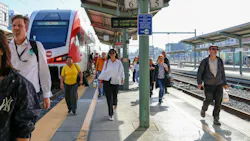
Caltrain has released results from its 2026 Customer Satisfaction Survey, reporting that riders are as satisfied as they have ever been, with 92% of riders saying they are satisfied with the service. The agency notes that overall satisfaction held at 4.40 out of five, up from 4.02 in 2024, the final survey taken before Caltrain launched electrified service.
Caltrain says that riders report broad satisfaction across multiple survey categories. The onboard experience scored 4.45, stations scored 4.32, and riders' sense of safety on Caltrain climbed to 4.44, up from 4.23 in 2024. On-time arrival at riders' destinations scored 4.40, holding from the triennial survey results released earlier this year, and the accuracy of arrival times on platform signs scored 4.38.
Caltrain says that its conductors stood out in particular, with conductors' politeness and helpfulness rated at 4.63—the highest score conductors have received in the survey's history—and gave conductors' professional appearance a 4.70 in the first year that question was asked.
"Our riders noticed the difference electrification made on day one, and two years later they're telling us those improvements have reinvented their experience for the better," said Caltrain Executive Director Michelle Bouchard. "Those ratings belong to the conductors, the maintenance crews and the operations staff who show up every day to run a safe railroad people want to ride and that the whole Bay Area can be proud of. We will continue to strive to provide the reliable, frequent service that our riders rate so highly while we engage in contingency planning to address our impending fiscal cliff, which may require a reduction in service."
The agency says that the survey shows how much Caltrain's rider base has changed and how the agency continues to adapt to shifting ridership patterns. Caltrain now serves an estimated 49,000 unique riders each month, roughly 37,000 more than in 2021 and close to its 2019 total, even though fewer riders now commute five days a week. The average rider takes the train two to three times a week—and special events have become a major ridership source that the agency notes it is targeting with outreach and marketing efforts. The increase in special event ridership has been supplemented by Caltrain’s half-hourly service-with even more service at peak hours. One in five riders said they took their first Caltrain trip to attend a game, concert or festival. Riders who travel to events reported the same 4.4 satisfaction as riders overall.
Riders are also coming back in growing numbers. Caltrain carried 12.6 million riders in fiscal year 2026, up 37.6% from the year before, building on being named the fastest-growing transit agency in the country in 2025 by the American Public Transportation Association. Since electrification, Caltrain’s improved service, average weekend ridership climbed 40.1% in fiscal year 2026 to 21,210. Weekday ridership rose 37.5%, and July set a new high of 1.32 million riders in a single month.
Those gains come as Caltrain, like transit agencies across the Bay Area, says it faces a structural operating deficit as remote and hybrid work continue to reshape commuting. Caltrain notes that it has responded on three fronts: cutting costs, generating new revenue from advertising, property and other assets and adapting its service to attract new riders.
The survey drew responses from 2,631 riders on randomly selected weekday and weekend trains and carries a margin of error of +/-1.78%.
About the Author
 Noah Kolenda
Noah Kolenda
Associate Editor
Noah Kolenda is a recent graduate from the Craig Newmark Graduate School of Journalism with a master’s degree in health and science reporting. Kolenda also specialized in data journalism, harnessing the power of Open Data projects to cover green transportation in major U.S. cities. Currently, he is an associate editor for Mass Transit magazine, where he aims to fuse his skills in data reporting with his experience covering national policymaking and political money to deliver engaging, future-focused transit content.
Prior to his position with Mass Transit, Kolenda interned with multiple Washington, D.C.-based publications, where he delivered data-driven reporting on once-in-a-generation political moments, runaway corporate lobbying spending and unnoticed election records.