Ten years of Stadler solidifying its footprint in the U.S.
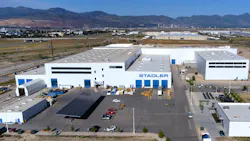
Over the past decade, Stadler has been steadily growing its footprint in Salt Lake City, solidifying its role as a local economic driver and an original equipment manufacturer for the U.S. rail market. What started as the Swiss-based company expanding into the U.S. after winning a $100 million contract with Trinity Metro has led to establishing a separate North America division, Stadler US Inc., taking on contracts from rail operators throughout the country.
To accommodate the increase in contract awards, the original equipment manufacturer (OEM) has continued to expand its facility, invest in workforce development and bolster the activities completed in-house. The Mass Transit magazine editorial team had the opportunity to see these expansions and activities firsthand on a tour during a visit to Salt Lake City.
Breaking into the U.S. market
In 2015, Trinity Metro ordered eight of Stadler’s diesel-electric FLIRT trains for its TEX Rail service. The company needed a facility right away to establish its U.S. presence and begin manufacturing the rolling stock. With little time to spare, the company searched for facilities it could lease for the immediate future.
“As you can imagine [with] building trains, you can’t just do it in every other warehouse, so the specification was relatively demanding,” Martin Ritter, CEO of Stadler US Inc., told the Mass Transit team during an exclusive interview.
Enter the state of Utah and the Utah Transit Authority (UTA). At the time, UTA put out a request for proposals looking for a sub-tenant to occupy its Warm Springs maintenance facility—previously an old Union Pacific shop that was purchased by UTA in 2003.
“Infrastructure wise, it was a perfect setting,” Ritter said.
Not only did the area have the necessary facility, but the state also offered a competitive package with ample opportunity for workforce development. Ritter explains the potential for local hiring, as well as from the surrounding states, would support the growth for future transit projects. In addition to the existing workforce, the region itself was also growing. With that settled, Stadler entered a two and a half-year lease and set up shop in 2016. By January 2017, the workforce was assembling the first TEX Rail vehicles.
Building a skilled workforce
Beyond the initial staff assembled for the TEX Rail project, Stadler US Inc. has been investing in workforce development programs throughout the region to fortify its workforce over the past eight years. Ritter notes that the manufacturer is doing the development of its workforce internally both to remain at the echelon of quality it’s known for, and because it’s part of the company’s Swiss DNA.
“At the end of the day, we're looking for high quality as a product, reliability when it comes to delivering on time and we're trying to stay state of the art, and those three areas will require a high quality and skilled workforce throughout the company,” Ritter said. “Workforce development is actually a foundation in order to meet the values and the mission and vision we have as a company. It just doesn't work otherwise.”
Enter the Talent Ready Apprenticeship Connection (TRAC), the company’s three-year youth apprenticeship program that the company launched in 2019 in partnership with the Salt Lake City School District, Salt Lake Community College, the Governor’s Office of Economic Development and Salt Lake Education Foundation. It’s now overseen by Talent Ready Utah, a department within Utah’s system of higher education. The program, modeled directly on the Swiss dual education system Stadler's leadership came up through, offers students another path besides a traditional four-year degree program or if they are exiting high school directly into the workforce.
“The youth apprenticeship program or dual education system is a public-private partnership between the education industry or the state, the county school district—in our case, with K-12 and with higher ed—both involved, and then, there is a substantial amount of education happening at the company,” Ritter said. “So, it's really hand-in-hand."
Students at Salt Lake City High School can apply to join the TRAC program in their senior year of high school, where they cycle between theoretical lectures in school and hands-on training at Stadler or another participating company until graduation. Once graduating high school, students then take courses at the Salt Lake Community College while still getting on-the-job training at Stadler US Inc.’s local facility for two additional years. Apprentices can choose from two tracks for the program: electrical technician or mechanical technician. Starting this school year, a third option will be available for welding.
At the facility, apprentices start with three months of training in dedicated on-site classrooms before getting onto the floor and doing the work with their own hands. Training is guided throughout the entire process as well, with apprentices getting paired with mentors throughout their entire experience.
Upon completion of the apprenticeship program and the successful passage of final exams where skills are tested and certified, students come away with an associate degree of applied science in advanced manufacturing and eligibility for full-time positions.
While the manufacturer still does other workforce development outside of its in-house training program, Ritter notes that about 80-85% of that development is done internally.
Beyond the TRAC program, Stadler US Inc. also works to train its employees further as they gain knowledge and skills in entry level positions.
“It's very forgiving, because it's a big product,” Ritter said. “It takes really from relatively standardized, more entry level jobs all the way to the high technician-capable jobs. Historically, you need that [training] on the timeline to build a train. So, we have the opportunity to basically train people on a job and then grow them into the next challenge, which is a very fortunate situation to be at.”
Facility expansions grow workforce capabilities, boost capacity
After settling into the leased facility in 2016, Ritter shares “we always knew when we were going to be more successful, we're going to invest eventually in our own facility.”
And invest they have. While leasing UTA’s facility from 2016-2018, they concurrently broke ground in October 2017 on the original footprint of their current facility. By May of 2019, they hosted the grand opening.
“Since then, I’d say on average, every other year we expanded the facility,” Ritter said.
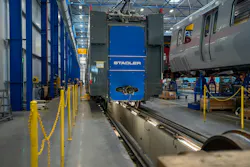
Some of the expansions were on a smaller scale, “30,000 square feet here and there,” as Ritter described. As the company grew, it needed a bigger space to boost capacity, so in 2024 Stadler US Inc. broke ground on an over 200,000-square-foot expansion. It includes doubling final assembly capacity and adding warehouse and preassembly space.
However, this expansion centers workforce capabilities. For one thing, the company is remodeling, building about 200 more workspaces in their back-office area to support an increased headcount.
But potentially the most exciting part of the expansion for the company is that employees are now doing aluminum welding on site. Instead of previously shipping the car bodies from Europe, they’re now able to weld their own floors and ceilings on site—creating one entity instead of separate parts to put together. According to Charlotte Thalhammer, marketing and communications manager for Stadler US Inc., these welding positions are one of the jobs the community is most excited about.
This marks the first time the company is welding car bodies in the U.S., and according to Alan Westenskow, deputy head of sales and business development for North America, this is the first aluminum car body welding site in the country. For the company, this means reducing costs, increasing domestic content to 80% and solidifying a more stable U.S. supply chain.
Managing an international supply chain
Supply chain management is a key focus point, especially as the North America division continues to take on more orders. Balancing the company’s needs within their supplier’s constraints requires a delicate approach.
“I think it became the more we grow, the more the supply chain becomes a challenge because the demand is higher, right?” Ritter explained. “The workload for our supply chain is higher, and I'd say the supply chain is most likely one of the most critical factors in our business because we're depending a lot on our suppliers. We're depending a lot on the local suppliers to meet Buy America, Build America requirements.”
Ritter shares that communication between their team and their suppliers—many of which are based in Europe—is necessary, so Stadler US Inc., is working within the capacity of their suppliers "in order to get the quality and the on-time performance.”
“I think communication in the rail transit industry, when it comes to [the] supply chain with the OEM, is a very important key point,” Ritter said. “We're trying to have, at least on the executive level, to have very good relationships as well to make sure we can learn from potential improvements we can make on both sides and both ends.”
One of the ways Stadler US Inc. is hoping to build on these international relationships is by hosting a supplier’s day every other year. Not only will suppliers visit the facility to see firsthand how their parts are incorporated into the finished product, but they will also have outlook discussions with Ritter and his team on project expectations, anticipated volumes and project timelines. Ritter says meeting in person at their facility allows them to show their own commitment to the market and how they’re investing in their own growth.
“So, we want that event to happen here so they see what happened with Stadler the last couple of years, right, to convince them specifically not just on their sales side, but also on their management side, that we need a strong supply chain and that the U.S. is a good place to invest—especially when they're from Europe—that they invest in their U.S. operations. And then also giving confidence in what we see and what we believe the market is going to bring,” Ritter said.
Orders on deck
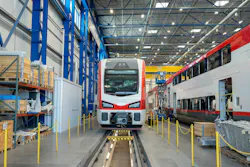
The expansions and workforce development, recruitment and training efforts have allowed the facility to manufacture numerous orders over the past several years. One of the larger wins, the company notes, was the Caltrain contract to convert diesel locomotives to electric and catenary propulsion. These four-wheel drive trains include two doors on different levels—to someday link up with high-speed rail in downtown San Francisco—a mechanism on the front cab for collision impact to absorb crash energy and operate as one as one trainset with seven cars once it’s fully assembled.
Caltrain’s carry-on order of these trainsets is one of the four orders currently in assembly at the facility. Other projects include manufacturing Metra's battery-electric locomotives, TEX Rail’s diesel multiple units and the Metropolitan Atlanta Rapid Transit Authority’s (MARTA) new subway cars.
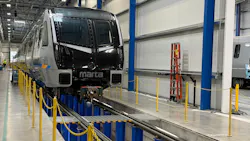
For the MARTA project, the Stadler team responded to the agency’s bid and helped design the final solution. The customized trains are designed to be modular, so the power for the cars is in the middle of the train instead of coming from the locomotive. These trains are in various stages of production, with 10 trains already on site in Atlanta awaiting final certification before beginning passenger service.
The facility itself typically has four active projects happening simultaneously, though this can vary depending on the size of each project. Currently, Stadler US Inc. is actively working on eight projects overall in various stages of design, manufacturing and assembly.
Stadler formally opens newest expansion
The previously mentioned expansion that broke ground in 2024 officially opened on July 1, with Stadler hosting an event to mark the occasion and celebrate its 10-year anniversary in the U.S.
The 245,000-square-foot expansion includes the new welding hall, blasting booth, assembly hall, warehouse expansion and electrical pre-assembly hall. It's expected to generate up to 300 new local jobs, including youth apprenticeships, according to Stadler. The expansion brings the facility’s footprint to a total of 475,000 square feet of manufacturing space.
“This milestone reflects not only how far we’ve come over the past decade, but also our long-term commitment to building trains, creating jobs and investing in American manufacturing,” Ritter told attendees in his speech during the event.
The company is already preparing for its next chapter. Stadler US Inc. just broke ground on an addition to its new welding hall. Once complete, this will allow the company to do on-site CNC machining.
About the Author
 Megan Perrero
Megan Perrero
Editor in Chief
Megan Perrero is a national award-winning B2B journalist and lover of all things transit. Currently, she is the Editor in Chief of Mass Transit magazine, where she develops and leads a multi-channel editorial strategy while reporting on the North American public transit industry.
Prior to her position with Mass Transit, Perrero was the senior communications and external relations specialist for the Shared-Use Mobility Center, where she was responsible for helping develop internal/external communications, plan the National Shared Mobility Summit and manage brand strategy and marketing campaigns.
Perrero serves as the board vice president for LIT, the second vice chair of the American Public Transportation Association’s (APTA) programs and communications committee and is a member of APTA’s Marketing and Communications Committee. She holds a bachelor’s degree in multimedia journalism with a concentration in magazine writing and a minor in public relations from Columbia College Chicago. Her work has been recognized with a first place AdWheel Award, AZBEE Bronze Regional awards, an AZBEE Regional Gold Award and an AZBEE National Silver Award.
 Noah Kolenda
Noah Kolenda
Associate Editor
Noah Kolenda is a recent graduate from the Craig Newmark Graduate School of Journalism with a master’s degree in health and science reporting. Kolenda also specialized in data journalism, harnessing the power of Open Data projects to cover green transportation in major U.S. cities. Currently, he is an associate editor for Mass Transit magazine, where he aims to fuse his skills in data reporting with his experience covering national policymaking and political money to deliver engaging, future-focused transit content.
Prior to his position with Mass Transit, Kolenda interned with multiple Washington, D.C.-based publications, where he delivered data-driven reporting on once-in-a-generation political moments, runaway corporate lobbying spending and unnoticed election records.