MCDOT, TransLink launch expanded BRT offerings
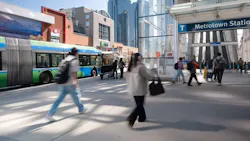
Transit agencies across North America are making strides to expand their bus service options, bringing new connections for passengers to jobs, schools and other major designations.
Montgomery County Department of Transportation (MCDOT) expands US 29 Flash Bus Rapid Transit (BRT) Blue Route to serve four new stops in Howard County
The Flash Blue—whose route was updated this week—is set to provide weekday, rush-hour service every 15 to 20 minutes from 5:00 a.m. to 9:00 a.m. and 3:00 p.m. to 8:00 p.m. between Downtown Silver Spring and Downtown Columbia, Md.
“The extension provides access to more jobs and more housing choices along one of our busiest corridors," said Montgomery County Executive Marc Elrich. “This service connects Montgomery County residents to the Johns Hopkins Applied Physics Laboratory and its 9,000 employeesand Howard County residents to the future Viva White Oak development, which is projected to bring 9,000 new jobs and 5,000 homes to our region. By taking a regional approach to transit, we are expanding access to opportunity and supporting smart, sustainable economic growth.”
The US 29 Flash BRT, which operates a daily Orange route and a weekday, rush-hour Blue route, has been in operation since October 2020. The US 29 Flash BRT is consistently one of the county’s most heavily used bus routes, serving more than 2,700 passengers each weekday and more than 16,000 passengers per week.
The expansion is designed to bring faster, more frequent bus service to four of Howard County’s most active hubs, with new stops at:
- Columbia — Merriweather Drive
- Columbia — Little Patuxent Parkway
- Johns Hopkins University Applied Physics Laboratory (APL)
- Maple Lawn Boulevard
Upon opening, the Flash stops in Howard County have temporary signage until permanent stations are put into place later this year.
The county says that Flash BRT, like all Montgomery County Ride On buses, is free to ride since a fare-free policy was instated in June 2025.
“Flash is a fast, reliable and efficient transit system that will serve the US 29 corridor, connecting Howard County communities to [Washington Metropolitan Area Transportation Authority (WMATA)] service and the broader Washington, D.C., region,” said Howard County Executive Calvin Ball. “We are excited to partner with Montgomery County to launch this landmark extension of the Flash Bus Rapid Transit service into Howard County, adding new stops and peak hour service to Maple Lawn, the Johns Hopkins Applied Physics Laboratory and Downtown Columbia.”
The new stations also bring increased connections to regional transit networks:
- Riders from Montgomery County will gain direct access to the Regional Transportation Authority’s transit system in Columbia, with expanded options to reach destinations in Howard, Anne Arundel and Prince George’s counties.
- Riders from Howard County will be able to directly access more than 30 Ride On and Metrobus routes, Metrorail, Maryland Area Regional Commuter (MARC) and the future Purple Line via the Silver Spring Transit Center. These connections provide access across the metropolitan Washington region.
“Flash provides an exciting and convenient new travel option on the US 29 corridor,” said MCDOT Director Chris Conklin. “The expanded service benefits both Montgomery and Howard County. With this new service, Montgomery County residents can use transit to access the Columbia Mall and Merriweather District for shopping, dining and job opportunities and also access other major employment centers, including the Johns Hopkins University Applied Physics Laboratory. Howard County residents will have direct access to shopping, dining and cultural attractions in Downtown Silver Spring and can also access the wealth of opportunities throughout the National Capital Region by connecting to Metrorail, MARC, the Purple Line and [WMATA’s] and Ride On bus services at the Silver Spring Transit Center.”
The department notes that the project is the result of a partnership between Montgomery and Howard Counties. Howard County funded and is constructing the new Flash stations, contributed local funds toward the purchase of new zero-emission electric buses and is funding the operating cost of the service extension. Montgomery County will operate the service. Federal grants were also used in the vehicle purchases.
In addition to the Howard County expansion, MCDOT also notes it is advancing projects along the US 29 Flash route to improve corridor travel time, increase pedestrian and bicycle access and improve safe connections for all transportation modes along the corridor. Improvements include the addition of dedicated bus lanes, upgraded traffic signals and safety enhancements for pedestrian and bicycle connections.
The US 29 corridor is the first of a total of eight planned Flash BRT routes in Montgomery County, according to the department. A second corridor along Veirs Mill Road, from Montgomery College Rockville to Wheaton, Md., is planned to open for service in 2028. Flash BRT stations feature real-time information displays, lighting, seating and enhanced pedestrian infrastructure to provide safe station access.
TransLink launches R2 RapidBus between Phibbs and Metrotown under budget and three months ahead of schedule
TransLink is launching a new regional transit connection three months ahead of schedule and under budget, with the R2 RapidBus extension to Metrotown now open for passenger service.
The new R2 Marine–Willingdon RapidBus was extended from Phibbs Exchange to Metrotown Station, via Hastings Street and Willingdon Avenue. The new route connects riders to a corridor that provides access to approximately 98,000 jobs, as well as major post-secondary institutions, town centers, shopping areas and two SkyTrain lines.
“People rely on transit every day to get to work, school and where they need to go. Delivering the R2 extension three months early means customers will have more direct connection across one of Metro Vancouver’s busiest corridors sooner,” said TransLink CEO Kevin Quinn. “The extended route will connect people to nearly 100,000 jobs and key destinations across the North Shore, Vancouver and Burnaby, demonstrating the impact we can have when we invest in better transit connections.”
More than 14,000 transit trips are made each weekday between Phibbs Exchange and Metrotown, according to the agency, showing what it says is a strong demand for travel along this corridor. The new route will serve destinations, including Park Royal, Capilano Mall, Lower Lonsdale, Lower Lynn Valley, Burnaby Heights, Brentwood Town Center, BCIT and Metrotown — while providing connections to SkyTrain’s Expo and Millennium lines.
The existing R2 RapidBus already carries more than 1.9 million boardings each year. Extending the route to Metrotown will:
- Create a direct connection between Park Royal and Metrotown, eliminating the need to transfer at Phibbs Exchange.
- Provide frequent, all-day service seven days a week, including buses every six to seven minutes during peak periods.
- Add capacity along the corridor with 60-foot buses, offering approximately 50% more room than standard buses.
- Improve access to major employment, education, shopping and transit hubs across three municipalities.
The agency reports that 14 bus stops have also been upgraded to accommodate larger buses and improve accessibility, including the addition of tactile walking surface indicators and accessible loading areas. Nine new bus passenger information displays have been installed, providing real-time information and text-to-speech functionality for customers. Eight new stops have also been added along the route, with two new bus shelters in Burnaby.
“The extended R2 RapidBus service provides a one-seat link between the North Shore and the SkyTrain network, giving people in North and West Vancouver a direct transit connection to the broader region,” said MLA for North Vancouver–Lonsdale on behalf of British Columbia Minister of Transportation Mike Farnworth. “Frequent, comfortable service means more people can choose transit, taking pressure off some of the busiest routes on the North Shore. Delivering it ahead of schedule shows what's possible when partners invest in transit together. This is a huge step forward, and there's more to come.”
The new R2 service replaces the #222 Willingdon Express between Phibbs Exchange and Metrotown. Unlike the #222, the R2 will provide all-day service, seven days a week, with more capacity to help address crowding along the corridor. Route 130 will continue to provide local service, with most trips terminating at Kootenay Loop. The R2 extension does not include changes to bus priority or HOV lanes in Burnaby.
To coincide with the R2 extension, #245 service is also being increased this fall to improve transit for Capilano University students.
Launching the R2 extension ahead of schedule—and under budget—is part of TransLink’s work to deliver service funded through the 2025 Investment Plan quickly and responsibly, providing more capacity and better connections as Metro Vancouver’s population and economy continue to grow, according to the agency.
TransLinks says this R2 extension reflects a shared commitment, made possible with support and collaboration from the Mayors’ Council on Regional Transportation, the city of Burnaby, the District of North Vancouver, the city of North Vancouver, the District of West Vancouver, the city of Vancouver, xʷməθkʷəy̓əm (Musqueam Indian Band), Sḵwx̱wú7mesh Úxwumixw (Squamish Nation), səlilwətaɬ (Tsleil-Waututh Nation) and the province of British Columbia.
The agency also notes that planning will also continue for future BRT and other possible rapid transit improvements in this part of the region. A decision on the final route option for BRT in Vancouver and Burnaby will be made in 2027.
“The extension of the R2 RapidBus to Metrotown is a major win for Burnaby residents and everyone who relies on transit to move throughout the region,” said Burnaby Mayor Mike Hurley. “As Burnaby continues to grow, investments in high-quality transit are essential to keeping people connected to jobs, education, and services across Metro Vancouver.”
About the Author
 Noah Kolenda
Noah Kolenda
Associate Editor
Noah Kolenda is a recent graduate from the Craig Newmark Graduate School of Journalism with a master’s degree in health and science reporting. Kolenda also specialized in data journalism, harnessing the power of Open Data projects to cover green transportation in major U.S. cities. Currently, he is an associate editor for Mass Transit magazine, where he aims to fuse his skills in data reporting with his experience covering national policymaking and political money to deliver engaging, future-focused transit content.
Prior to his position with Mass Transit, Kolenda interned with multiple Washington, D.C.-based publications, where he delivered data-driven reporting on once-in-a-generation political moments, runaway corporate lobbying spending and unnoticed election records.