Bus Rapid Transit Drives Ridership Growth and Economic Development
At a time when construction costs are ballooning, supply chain and inflation impacts are unpredictable and population migration is changing, regions are reassessing whether a rail corridor that may take a decade or more to come to fruition is still the best option.
New transit services and investments want to drive economic development. According to the American Public Transportation Association, every $1 invested into public transit translates to $5 in economic benefits. Fixed-route buses add value and serve the community well, but in a corridor that’s heavily trafficked, sometimes a higher capacity option is necessary—especially if a rail mode was being considered.
Enter bus rapid transit (BRT). By no means new to the industry; however, in recent years, a number of transit agencies are turning to this more affordable option to drive ridership growth, attract new riders, enhance the passenger experience and drive economic development. Examples range from Pinellas Suncoast Transit Authority’s Spark service and Twin Cities’ Metro Transit’s METRO E Line to Miami-Dade County’s Metro Express BRT service.
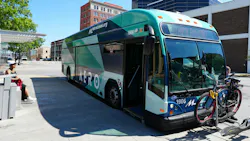
All of these ring true for Tulsa, Okla.’s, MetroLink Tulsa. After MetroLink Tulsa launched its first BRT service, the Aero, in 2019, about one third of the agency’s ridership hails from this route—the Peoria Route.
A catalyst for economic development
Stemming from the PlaniTusla 2010 plan, where 79% of residents identified new economic and job opportunities as a high priority, the city recognized Peoria Avenue’s significance in connecting a large portion of residents to jobs and services. A majority of the population lived within a 10-minute walk of the corridor; this was also the highest ridership corridor for MetroLink Tulsa. These factors, backed by the 2010 plan, led to the city identifying Peoria Avenue as the first BRT corridor.
“[The city] wanted to see Peoria really grow with the amount of economic development that they had planned and they had already constructed,” said MetroLink Tulsa General Manager Scott Marr.
MetroLink Tulsa Director of Maintenance Randy Cloud added that “the number of people that it was going to serve was just pretty beneficial.”
Of course, a large project like this requires funding. Enter Vision Tulsa, an extension of Vision 2025, which was a sales tax approved by voters in 2003. Vision Tulsa was presented as the city’s capital program and sought to expand the original sales tax, with a percentage going towards transit. In 2016, voters were asked to approve, among other propositions, a .085% sales tax rate for street maintenance and public transportation. This permanent tax funding was restricted to constructing, operating and maintaining public streets and public transit systems in the city, as well as funding capital projects, operations, maintenance, procurement and salaries for public transit.
When pitching this proposition to voters, the city highlighted two BRT projects that would be constructed with this dedicated funding—one of them being Peoria Avenue. The proposition passed, and planning commenced for the first BRT corridor.
Led by the Tulsa Planning Office, in partnership with the Lakota Group, a land use study was completed to assess the areas for seven of the 19 BRT station locations to maximize investment and ensure private properties would benefit from the BRT stations. Specifically, it recommended land use, zoning, infrastructure and economic development opportunities for key station areas. By May 2017, the city council adopted the framework.
While this framework prioritized land use to maximize economic prosperity, MetroLink Tulsa worked with HNTB on the placement, design and branding of the BRT stations. Marr notes they “definitely had some hurdles” with some local businesses saying they didn’t want a BRT station next to their building—though Cloud adds the city was able to take the lead in these discussions.
“We did meet with a few of the landowners, the property owners and explained to them what we would do to protect their interests and stuff, but the majority of those conversations were held by the city of Tulsa,” Cloud said.
However, thanks to public transit serving as an economic catalyst, Marr believes the businesses’ tunes would be different today.
“I think if we were to interview those business owners that were a little hesitant back when it started in 2019, even 2018, I think there would be only positive feedback because we see the economic development and the impacts it has on our community,” Marr said.
The Aero’s debut
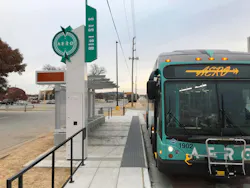
Since Peoria Avenue transitioned to BRT service, ridership on this corridor has doubled. Marr and Cloud point to a number of things: frequency, station amenities and specialized branding.
“I think anytime you have a route that provides more frequency than the rest of your service, you're going to see the benefits from that,” Marr said.
The Peoria BRT operates on a 20-minute frequency Monday through Saturday from 5:30 a.m. to 11:00 p.m. and 30-minute frequency Sundays from 7:30 a.m. to 7:30 p.m. The 18-mile route has 52 stations featuring amenities like shelters, seating, bike racks, level boarding, real-time information, onboard Wi-Fi and charging. Passengers can pay for trips through a variety of methods, including tap to pay with debit or credit cards and the GoPass app. Of these features, Cloud shares the bus arrival signs are the most popular amenity riders want to see more of.
In the spirit of reliable arrival information, Marr shares that the agency is testing transit signal priority on the Peoria corridor.
“But we run a very good on-time performance—94, 95%. So, a lot of those times those buses, because of the 20-minute frequencies they’re not running down, but it is something that is [being tested] on Peoria today,” Marr said.
Since Aero’s debut, Cloud and Marr agree: “It’s greatly exceeded our expectations.”
This sentiment is shared amongst the operators as well, with Cloud describing the Aero as the “premiere route.” MetroLink Tulsa Marketing Manager BreAnna McCutcheon agrees, noting the operator comments she’s overheard.
“That’s one of the routes that they really like to run, so there’s basically a bidding war for them to get that route... So, it’s kind of for them a luxury to get the Aero route,” McCutcheon said.
Capitalizing on BRT’s success
When voters passed Vision Tulsa, the proposition listed two BRT corridors: Peoria and Route 66. According to the city’s planning office, Tulsa is known as the “capital of Route 66” with 28 miles running through the region and a history dating back to the road’s creation. This November marks the road’s 100th year.
It’s this centennial that drove the city to identify 11th Street as the next BRT corridor.
“I think whenever they thought of a BRT on Peoria, that was great. That was a very busy route. But with Route 66, with the centennial and the tourism aspect of it, I think that's why the city of Tulsa chose 11th Street for us to have the next BRT,” Marr said. “The city's put a lot of money into that street and business owners have as well to try to get tourism to pick up.”
Marr adds they anticipate similar, if not even better, ridership and development along 11th Street, adding there is “unlimited opportunity [for economic development] on 11th Street for the future.”
The city, agency and operators alike are excited for the second BRT route to come online, especially given the uniqueness of this corridor.
“With this being on the historic corridor of Route 66, I think [operators] are just excited because they get a different type of ridership with that tourism aspect,” McCutcheon added.
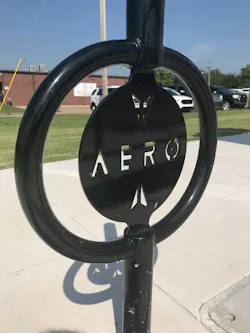
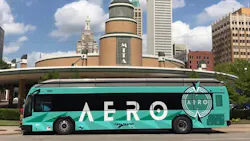
The historical importance of this corridor is being prioritized throughout the planning process. Even the Aero brand stems from the city’s history. Cloud explains the city wanted to represent its deep history with the aeronautic industry while recognizing their Native American culture, “so they combine[d] the aeronautics and arrowhead to create the brand name.”
This thoughtfulness is especially important with station locations and designs. For the 11-mile corridor, the agency is leveraging funding from the sales tax and a federal RAISE grant to work with HNTB and the city to locate, design and build all 44 BRT stations. As far as station design, Cloud explains they’re aiming to keep them very similar to help cut down on the number of spare parts needed to keep up the infrastructure, helping reduce operating costs. However, due to the nature of the corridor, McCutcheon shares they’re working very closely with the businesses “because it has such an eclectic feel to it.”
“We actually want to keep the integrity of the brand intact with our stations and making sure that they still look cohesive, but we also don't want it to stick out like a sore thumb in front of their business,” McCutcheon said. “Especially with the rich history that Route 66 has to offer and that artistic value that it has as well.”
Currently, MetroLink Tulsa is working with the Federal Transit Administration to complete the National Environmental Policy Act review process. McCutcheon shares they’re just beginning to have community meetings and open houses and are starting to make plans for a groundbreaking ceremony. As the project progresses, Cloud shares they’re excited to build upon and learn from their first BRT.
“We're taking all the lessons we learned from Peoria and incorporating that into the design for the Route 66,” Cloud said.
If the second BRT route exceeds expectations like the first, future Aero corridors may come to MetroLink Tulsa’s transit network.
About the Author
 Megan Perrero
Megan Perrero
Editor in Chief
Megan Perrero is a national award-winning B2B journalist and lover of all things transit. Currently, she is the Editor in Chief of Mass Transit magazine, where she develops and leads a multi-channel editorial strategy while reporting on the North American public transit industry.
Prior to her position with Mass Transit, Perrero was the senior communications and external relations specialist for the Shared-Use Mobility Center, where she was responsible for helping develop internal/external communications, plan the National Shared Mobility Summit and manage brand strategy and marketing campaigns.
Perrero serves as the board vice president for LIT, the second vice chair of the American Public Transportation Association’s (APTA) programs and communications committee and is a member of APTA’s Marketing and Communications Committee. She holds a bachelor’s degree in multimedia journalism with a concentration in magazine writing and a minor in public relations from Columbia College Chicago. Her work has been recognized with a first place AdWheel Award, AZBEE Bronze Regional awards, an AZBEE Regional Gold Award and an AZBEE National Silver Award.