Right-sizing the Garage for Zero-emission Fleets
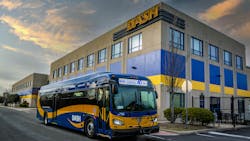
For much of the past 15 years, the transition to zero-emission buses has been framed around the vehicles: the type of propulsion, range viability, refueling speed and the time needed for procurement. But as more transit agencies move from pilots to full fleet conversions, a different challenge has emerged. Bus storage and maintenance facilities—many of which were designed decades ago for diesel-based fleets—are now pacing how fast transit agencies can get zero-emission buses into full service.
Across North America, agencies are discovering that right-sizing their facilities for these evolving fleets is less about electrifying existing depots and more about rethinking power, space and workflows from the ground up. From smaller systems that have had to fund this transition without access to formula support, to large networks that are managing multi-site projects, the decisions made at the facility level are shaping the zero-emissions future.
Whether sourcing funds, ensuring utility access, evaluating what technology will persist or rethinking maintenance shops to support new needs, agencies are learning what it means to make the transition to a right-sized zero-emissions facility. From agencies just breaking ground to those who are already running a 100% zero-emission fleet, each transition provides a wealth of lessons to make an ever more common process easier for the next agency taking the plunge.
Alexandria Transit Company expands without formula funding
The Alexandria Transit Company, which operates DASH bus service, broke ground on its facility expansion project at the end of 2025. The work is set to expand the footprint of its current William B. Hurd DASH Maintenance Facility to house 24 overhead electric bus chargers, as well as fittings for a possible future solar array and microgrid battery setup. This expansion comes after a successful agency pilot of six electric buses in 2021, proving the technology was suited for the region.
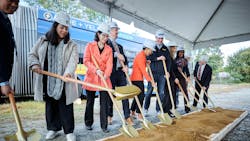
Since its pilot, DASH has procured more electric buses, bringing the total in its fleet to 16. According to the Alexandria Transit Strategic Plan’s fiscal year (FY) 2026 update, the agency is set to adopt 27 new electric buses over the coming years via federal low-no emission grant program funding. The problem? The agency’s current infrastructure isn’t yet ready to support that many electric buses, prompting the facility upgrade. DASH was able to install enough chargers to power its initial pilot vehicles, however, it ran into limitations at the utility level that required intervention from its power provider before it could add more.
While DASH received federal grant funding for the buses themselves, the agency isn’t a direct recipient of federal formula funding and is using its discretionary budget for the facility transition. This means it had to come about the funds for the expansion through other, more localized streams of capital and combine it with another project to ensure it would receive adequate support.
“We had additional funding to fund further charging infrastructure to support the continued transition of our zero-emissions program, so we took those funds for charging infrastructure and combined it with the funds for facility expansion,” said DASH Chief Infrastructure and Development Officer Raymond Mui. “We turned that project from a project that was only going to be a new facility to house buses into a facility that would house and charge buses.”
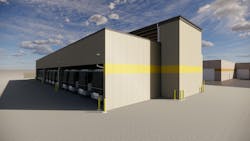
Funding for the facility expansion comes from a combination of regional, state and local grants that the agency has been awarded over the last few years. These include part of an $11 million Virginia Smart Scale grant from the Department of Rail and Public Transportation and community choice funds from the Northern Virginia Transportation Authority.
None of these funding sources were guaranteed. Instead, the agency has to compete for its share, though it won most of the funding opportunities it sought, according to Mui. Because of this, the agency has to take a different approach in how it’s planning for this transition. Mui says DASH is doing aspirational planning, ensuring it’s ready to go with zero-emission plans if it wins awards, while also having a backup plan to fulfill state of good repair needs if the funding isn’t awarded.
As DASH’s transition is more than half a decade in the making, the agency has learned a multitude of lessons along the way. DASH began its transition at a time when the technology was less established and had no real standard, meaning it had to make choices about how to proceed without knowing what the future held.
“We took somewhat of an unconventional approach of mitigating risks and dividing eggs into different baskets,” Mui said. “So, when we first started in 2019, at that time, zero-emission technology was still very much in its infancy. The approach we took differed from the approach that a lot of our peers took. We decided to split our projects both on the infrastructure side and on the bus manufacturer side. We divided the project in half and gave it to two competitors.”
This allowed the agency to spread the risk around and test different technologies simultaneously, helping it fortify its plans for the full expansion and plan for interoperability as more technology enters the equation. It also prepared DASH for when one of its original bus providers went out of business, meaning the impacts didn’t reverberate throughout its entire fleet of electric buses.
As for its current facility expansion that’s underway, the agency has completed the final design for the project and is in the process of finalizing building permits while also coordinating with utility companies to ensure the power needed for the facility is available. The new facility is expected to open in 2027.
BC Transit makes expansion sprint with eight synchronous projects
In Canada, BC Transit is rapidly upgrading its facilities to be ready for a zero-emissions fleet. The agency currently has eight charging infrastructure projects underway at various stages of design and construction. The most recent project, Whistler Transit Center, began its upgrade last November. The majority of these projects are set to come online within the next two years.
The agency is taking a phased approach to the adoption of the technology, starting with a deployment of 125 electric buses throughout the province over the next two years—or just over 10% of the agency’s fleet of 1,200 buses.
While the end game is the same across the board—providing charging infrastructure—the road to get there at each facility isn’t identical. BC Transit must coordinate with multiple utility companies across the province to ensure it has the electrical support needed but also contends with the fact that no two facilities have the same needs for the upgrade.
“One of the things we’ve done that’s been really helpful is to have an internal senior electrical engineer that has been able to be part of the design process with our engineering consultants to make sure that those unique considerations… are incorporated into those projects,” said BC Transit Electrification Program Director Chad Berndt.
Berndt continued, explaining that the agency was considering the unique aspects of the site both for today and for how the site may evolve 20 years down the line since it’s essentially locking in the format of the depots with the installation of the charging infrastructure.
Like DASH, BC Transit is also wading through a sea of evolving technologies. At first, the agency considered a charging approach that would allow one charging unit to charge multiple buses but only does so one after another instead of simultaneously. It landed on a parallel charging solution that allows for simultaneous charging, but meters the speed depending on how many vehicles are connected—just one example of the learning the agency did in its planning phase.
The agency is also not calling this a done deal either. Berndt notes that the agency is continuing to explore other options for the future such as pantograph chargers or inductive chargers.
That sentiment continued about the entire process as each installation hosts different needs and challenges, and that the transition is going to force technology or infrastructure needs that weren’t required of prior vehicle types. Berndt notes that this transition doesn’t just stop at the vehicles and their charging posts, but could require more IT support and support from positions it may not know it needs yet.
“There’s a technology transition that’s happening,” Berndt said. “Just like when we transitioned from coal to oil or from horse and buggy to combustion cars, there’s an underlying technology transition that’s happening, which public transit is part of. We can accelerate it or slow it down depending on what our goals and objectives are in the community, but in general, that transition seems to be progressing globally.”
Currently, BC Transit has 25 fully electric buses running in the province after launching an additional 15 at the end of 2025. The agency is working to ramp that figure up with the completion of its spread of facilities it’s upgrading, which it plans to conclude throughout 2026 and 2027.
Santa Maria Regional Transit (SMRT) uses zero-emission upgrade as a ridership recovery tool
SMRT has completed its upgrade to a fully zero-emissions fleet and requisite infrastructure as of last October, now hosting 40 battery-electric buses after its most recent delivery of the final six from GILLIG. The agency has also electrified its entire support fleet, paratransit service and microtransit service. SMRT still uses diesel buses in its fleet that haven’t met the end of their useful life.
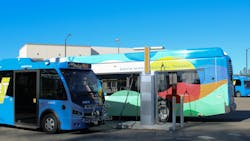
SMRT began its zero-emissions transition more than half a decade ago to keep in line with California’s goal to get its transit agencies over to zero-emission technologies by 2040, but also because the agency saw a path for major savings by taking the leap when it did.
“We found that the transition from [internal combustion] engines to electric vehicles had a potential for a huge financial payoff of cost savings in going from diesel fuel—volatile fuel prices—to pretty stable electric fuel prices,” said Santa Maria Transit Manager Gamaliel Anguiano.
The agency put that to the test by piloting two electric buses in its fleet starting in 2022. The results of the pilot were considered such a significant success that SMRT opted to accelerate the rest of its transition due to the payoff it knew it could achieve.
SMRT also worked to further the transition as speedily as it could in an effort to recoup ridership after the pandemic by offering a new experience to its passengers. Beyond just being electric, the new buses feature a bevy of passenger amenities, including medical grade air purification, antimicrobial copper surface coatings, device charging, Wi-Fi, personal infotainment screens and artificial intelligence technology.
It went all out with the features of these buses in an effort to future proof. Anguiano notes that first-party installation at the time of building makes these amenities cheaper and easier to add than if it attempted to retrofit them to its existing fleet.
“We felt there was enough reason to be aggressive than to be cautious,” Anguiano said. “The payoff maybe felt like high risk, but there was a high reward to accomplishing this—from the financial aspect, from the maintenance aspect and from a ridership recovery aspect as well. The COVID pandemic really scared off a lot of ridership, and in order to win back our community, we’re not only going to have to restore what we lost, but we were going to have to present ourselves in a whole new look.”
Because the agency was positioning this upgrade in part as a ridership recovery tool, planning for the fleet electrification looked a little unconventional. SMRT wasn’t just looking at current ridership stats, but also at projections of what usage could look like if it built out its system and made such an upgrade. This allowed the agency to overbuild for what it may need today as it was thinking of what it might need 20-50 years down the line.
It leveraged unutilized real estate in its portfolio to expand its facilities for both charging and storage, noting that the installation of chargers means that buses can’t be as tightly parked as they once were. SMRT took this approach as a means to only need to touch the site once to facilitate the needs of its future. Instead of installing just enough chargers to be able to cycle charge its fleet of buses, SMRT invested in dual chargers in each bay of its facility, even though that’s more chargers than it currently needs.
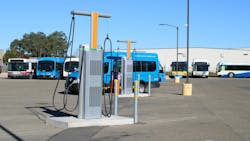
“In our world, we always kind of want to build just enough, just to save a few pennies, but that seems like a penny wise and a pound foolish,” Anguiano said. “You really need to build for the next 50 years, otherwise you’re disrupting your environment multiple times.”
The positive results SMRT has experienced range wide, resulting in fuel savings, cleaner, quieter air at its transit centers and in its local streets and positive feedback from both riders and operators alike. Passengers have noted liking the little things, like USB ports and a quieter ride, where drivers report feeling safer with the instant torque that allows them to get back up to traffic speeds much faster.
While no two transitions will look the same, agencies are proving that it's feasible while helping chart the course for the technology that makes it all tick.
For perspective from the consultant side, check out Mass Transit magazine’s Q&A with Mohammad Kharouf, Technical Director at the Canadian Urban Transportation Research and Innovation Consortium on the importance of futureproofing for bus fleet electrification.
About the Author
 Noah Kolenda
Noah Kolenda
Associate Editor
Noah Kolenda is a recent graduate from the Craig Newmark Graduate School of Journalism with a master’s degree in health and science reporting. Kolenda also specialized in data journalism, harnessing the power of Open Data projects to cover green transportation in major U.S. cities. Currently, he is an associate editor for Mass Transit magazine, where he aims to fuse his skills in data reporting with his experience covering national policymaking and political money to deliver engaging, future-focused transit content.
Prior to his position with Mass Transit, Kolenda interned with multiple Washington, D.C.-based publications, where he delivered data-driven reporting on once-in-a-generation political moments, runaway corporate lobbying spending and unnoticed election records.