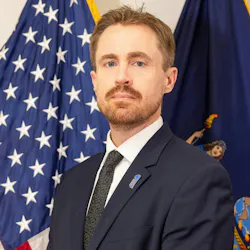
One word to describe myself: Relentless
Alma Mater: Arizona State University
Fast fact: I co-authored the first-of-its-kind NASA technical report examining the effects of Positive Train Control on train crews using C3RS — the railroad industry’s confidential close call reporting system — data and interviews.
Best transit experience: Nothing beats the MTA network and Metro-North Railroad. A close second is taking Valley Metro light rail straight into Sun Devil Stadium on game day.
When he entered the field, Brian R. Piña was a switchman and conductor for BNSF Railway. However, he was passionate about understanding the full breadth of the rail industry, so he deliberately moved over to passenger rail, where he joined the Alternate Concepts team operating Valley Metro’s light-rail system in Phoenix. From there, he went on to NASA’s Ames Research Center, where he was part of the Confidential Close Call Reporting System (C3RS) team. He spent three years studying the barriers of why railroad workers don’t report safety concerns. His work culminated in co-authoring a report that examined the effects of Positive Train Control implementation on train crews using confidential close call data.
As he’s progressed in his career, safety has been at the core of his journey. Working as a conductor, analyst and manager provided a unique perspective, which to this day shapes the decisions he makes in his current role of vice president of system safety at Metro-North. In his current role, Piña oversees all of Metro-North's safety portfolio, including operations safety, risk reduction, SMS, emergency management/FLS, environmental compliance, reporting and data and operating rules. Through his experience, Piña learned the key to a robust safety culture wasn’t about programs or policies; it was about trust. Piña embraces the belief that building trust comes from watching how leadership acts over time and centers this in his work at the agency.
For example, when he started at the agency, he set out to change the safety reporting culture. He worked to build trust with employees that something would be done when a report was made and that speaking up was worth the effort. Today, the change is measurable, with the agency’s voluntary reporting levels among some of the highest in commuter rail.
These efforts led to Metro-North earning a Safety & Security Gold Award from the American Public Transportation Association for its C3RS implementation. Metro-North was also recognized by the Volpe National Transportation Systems Center as a national model, with a case study other agencies now reference when building their own programs.
Outside of Metro-North, Piña served on the Federal Railroad Administration’s (FRA) Safety Advisory Committee C3RS Working Group. He also organized the first C3RS Rail Industry Symposium at Grand Central Terminal in 2024 and hosted it again in 2025.
For Piña, safety is not merely a department—it's a test of organizational character. He subscribes to the philosophy of when employees trust their personal safety is the priority, they engage differently with their work, colleagues and organization. He believes it’s this engagement that produces operational excellence, and it takes intentional leadership to create and sustain this culture.
Is there a specific experience that led you to where you are today?
In 2023, I was offered a chance to rebuild one of the most scrutinized safety programs in commuter rail. I took it. I moved my family from Arizona to New York, joined a railroad I had never worked for, and got to work. What I found joining Metro-North changed how I think about what this industry is capable of: leadership, labor and management actually working together, and for the first time in my career, true mentorship.
What do you enjoy most about your job?
No two days look the same. One morning it’s a safety committee, the afternoon it’s emergency management planning, the next day it’s environmental compliance or operating rules. This job demands that you be confidant with many hats and to always be ready. I like that. It keeps you honest. And walking into Grand Central Terminal every morning to do the work doesn’t hurt either.
What’s the most challenging part of your job?
Every safety officer wants problems solved yesterday. That instinct is right, but safety culture doesn’t work that way. You can’t change a culture overnight. Changing what people believe, how much they trust, whether they buy into safety programs and processes—that takes time. In railroading, it can take generations. The most challenging part of this job is knowing that the work you do today won’t fully take root until long after you’re gone. You are planting seeds for trees you’ll never sit under. Learning to be okay with that is the job within the job.
What accomplishment are you most proud of?
Look up the Volpe National Transportation Systems Center’s C3RS report for the FRA In 2024. Metro-North is the only railroad in the country cited by name for its implementation. That acknowledgement happened because of a lot of work building trust with both labor and management. I’m proud to have been part of that.
What accomplishment would you like to work toward?
I want to chase operational excellence in this industry for as long as it’ll have me. The industry has given me and my family a good life. That comes with a responsibility. I intend to leave this industry better than I found it.
What’s your best advice from your area of expertise?
Take calculated risks when it comes to taking on responsibility or a job opportunity; chances at stepping up don't wait, and most people won’t take them. That’s your edge. Talk to everyone: the people who agree with you and especially the ones who don’t. The best insight you’ll ever get is sitting across from someone who sees it differently. And be honest... about what you know, what you don’t and what you’ve accomplished. Own your failures completely. Claim your wins.
About the Author
 Megan Perrero
Megan Perrero
Editor in Chief
Megan Perrero is a national award-winning B2B journalist and lover of all things transit. Currently, she is the Editor in Chief of Mass Transit magazine, where she develops and leads a multi-channel editorial strategy while reporting on the North American public transit industry.
Prior to her position with Mass Transit, Perrero was the senior communications and external relations specialist for the Shared-Use Mobility Center, where she was responsible for helping develop internal/external communications, plan the National Shared Mobility Summit and manage brand strategy and marketing campaigns.
Perrero serves as the board vice president for LIT, the second vice chair of the American Public Transportation Association’s (APTA) programs and communications committee and is a member of APTA’s Marketing and Communications Committee. She holds a bachelor’s degree in multimedia journalism with a concentration in magazine writing and a minor in public relations from Columbia College Chicago. Her work has been recognized with a first place AdWheel Award, AZBEE Bronze Regional awards, an AZBEE Regional Gold Award and an AZBEE National Silver Award.