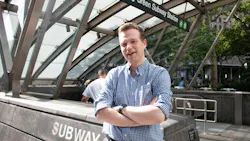
One word to describe yourself: Resilient
Fast fact about yourself: I’ve been to every Whole Foods Market store in nine states/provinces, 18 on their opening day and a total of 232 stores across 28 states/provinces and three countries.
What’s your best experience on transit and what made it memorable? Riding the NYCT’s Museum’s Holiday Nostalgia Train every December—the combination of subway cars that are nearly a century old and a group of friends who somehow all show up on the train at the same time without planning ahead can’t be beat.
Kurt Raschke serves as senior director of subways systems at the Metropolitan Transportation Authority’s (MTA) New York City Transit (NYCT), where he leads system integration for the systemwide deployment of Communications-Based Train Control (CBTC). He joined the MTA in 2014 in the wake of Superstorm Sandy and has grown continuously within the organization, taking on progressively larger responsibilities at every stage.
When the pandemic struck, he stepped far outside any formal job description to develop NYCT's contact tracing program from scratch: designing the procedures, training 200 exposure investigators and personally managing the operational response—work recognized with NYCT's Hero of the Week award. He then automated the entire notification pipeline end-to-end.
In his current role, he engages across the full CBTC project lifecycle—from design and procurement through construction, testing, commissioning and long-term obsolescence planning—representing the department of subways in one of the MTA’s largest and most complex capital programs.
Raschke helped develop TunnelView, a virtual walkthrough system of subway right-of-way locations that gave planners and engineers an entirely new way to assess sites remotely. He later designed NYCT's Supplemented GTFS feed, an open data solution that communicates complex planned service changes to third-party apps and consumers in real time. He has brought that same instinct to CBTC, contributing technical expertise to NYCT's CBTC Interface Interoperability Specification, leading work on automatic train supervision enhancements and next-generation positioning technologies. He also organized the first CBTC Data Summit to drive stakeholder engagement around the new data streams CBTC will generate.
He shapes implementation strategy for CBTC across the entire project portfolio, supports organizational transformation planning so the department of subways is structurally ready to operate a CBTC-enabled network and builds the data pipelines and analysis tools that will make that data actionable. Before this role, as senior director of subways coordination and solutions, he simultaneously served as acting manager of the performance analysis unit—overseeing executive-level dashboards and analyses used by leadership for critical service decisions—while also providing strategic oversight across platform screen doors, track intrusion detection, ATS-B expansion and the Transit Tech Lab. He has also contributed to planning for future CBTC expansion to the A division and integration with new rolling stock.
Raschke was a founding member of the team that relaunched Transportation Camp NYC in 2015, growing into the co-chair role by 2019. Earlier in his career, he volunteered with Mobility Lab in the Washington, D.C., region, launching and maintaining a pilot installation of the OneBusAway open-source transit information system and developing software to convert proprietary agency data into open, standardized feeds. He also contributed directly to the OneBusAway open-source project itself, building new features and advocating for broader adoption.
What’s the most challenging part of your job?
The most challenging part of my job, but also the absolutely most enjoyable part, is the incredible variety. My team and I are constantly responding to changing conditions across the entire portfolio of projects that we work on. It is truly the embodiment of never a dull moment. Every day brings new challenges, but also new opportunities. These aren’t just technical challenges, either. It is as much about navigating human and organizational challenges (the soft skills) as it is the technical challenges of bringing cutting-edge technology to a century-old subway.
What is the accomplishment you’re most proud of and why?
After joining the Recovery & Resiliency team at NYCT, I was handed the mandate to build Google Street View for the subway. I had a vague concept of how I would do this, but there were many unknowns. I ended up navigating a range of organizational and technical challenges to install spherical cameras on our track geometry cars, develop procedures for data collection and then implement a first-of-its-kind application for viewing the collected images as virtual walkthroughs of the subway right-of-way.
The resulting system, TunnelView, delivered transformative new capabilities for work planning, condition assessment, asset management and other functions across the subway. I’m immensely proud of the fact that I had the opportunity to take this project from concept to execution and implementation, soup-to-nuts, drawing on a wide range of skills across a number of domains.
What is your best advice you can share from your area of expertise?
When you are working on projects which can take almost a decade to be completed, which are part of a larger portfolio that will go on for decades, you have to be able to celebrate the small wins. It can feel daunting looking at timelines which go out to 2050 and beyond, especially when you hear people around you say things like “well, I’ll be retired before then!” It’s certainly worth keeping an eye on the end goal, even if that is a decade away, but you really have to be able to recognize the milestones along the way and give yourself something to celebrate.
About the Author
 Brandon Lewis
Brandon Lewis
Associate Editor
Brandon Lewis is a recent graduate of Kent State University with a bachelor’s degree in journalism. Lewis is a former freelance editorial assistant at Vehicle Service Pros in Endeavor Business Media’s Vehicle Repair Group. Lewis brings his knowledge of web managing, copyediting and SEO practices to Mass Transit magazine as an associate editor. He is also a co-host of the Infrastructure Technology Podcast.