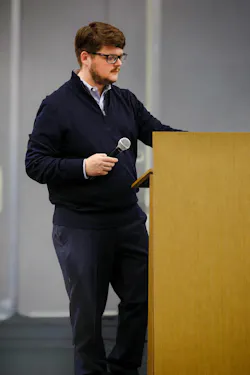
2026 40 Under 40: Forrest Jones, TSSP-Bus/Rail, WSO-CSSD, PTSCTP-Bus/Rail, CIT

One word to describe yourself: Driven
Alma Mater: University of Alabama at Birmingham
Fast fact about yourself: I am a triplet, and I have been a French horn player for over 20 years.
What’s your best experience on transit and what made it memorable? When I attended the Transportation Safety Institute Instructor’s course in Tampa, Fla., I loved riding the Downtown Tampa Streetcar. It was memorable because I am an avid history buff and really enjoyed riding in a historic streetcar; and it was actually my first experience on a streetcar system. It is a must-do anytime visiting Tampa.
With 10 years of experience spanning transit agency operations, training management and systems safety consulting, Forrest Jones has dedicated his career to protecting transit workers, passengers and contractors. Beginning as a bus operator and operator trainer at the Birmingham-Jefferson County Transit Authority, he steadily built expertise from the ground up—progressing to training supervisor at Knoxville Area Transit, then safety and training manager at Keolis Transit America before joining STV as a systems safety manager in 2023.
At STV, Jones has provided critical safety and security certification support for Fairfax County’s The One bus rapid transit (BRT)—a $980 million, 7.4-mile project along Richmond Highway in Virginia—and the Veirs Mill Road Flash BRT in Montgomery County, Md., developing certifiable elements lists, preliminary hazard analyses, design criteria conformance checklists and safety management plans. For the Maryland Transit Administration’s Red Line in Baltimore, Jones developed an original CEL template that now serves as a project standard on a 14-mile light-rail transit corridor. He also managed the sensitive security information program section for Amtrak's $16.1 billion Hudson River Tunnel project, overseeing staff indoctrination, training and compliance across a broad contractor network.
Most recently, Jones led a comprehensive revision of the Port Authority Transit Corporation's (PATCO) public transportation agency safety plan to address state safety oversight agency findings, strengthening regulatory traceability and governance structure for resubmission. On the PATCO Speedline, Jones authored a roadway worker protection plan from the ground up—including initial, refresher, roadway worker in charge and flag person training programs—based on Federal Transit Administration (FTA) regulations and tailored to the operational realities of the PATCO system.
Colleagues say his work on the Valley Metro Crime Prevention Through Environmental Design assessment further demonstrates his range, contributing to a systemwide evaluation across light-rail stations, streetcar stops and support facilities in three Arizona cities.
He holds credentials as a Transportation Safety and Security Professional – Bus/Rail; World Safety Organization – Certified Safety and Security Director; Certified Instructional Trainer; Certified Safety Manager; and Public Transit Safety Certification Training Program, spanning bus, rail, OSHA safety and federal transit safety training. Through his work with Delaware River Port Authority, Montgomery County Department of Transportation, Fairfax County Department of Transportation, Amtrak and the Metropolitan Transportation Authority, Jones has contributed to shaping safety frameworks across the Eastern region.
He is currently completing a master’s in safety engineering from the University of Alabama at Birmingham and is currently researching new hazard analysis techniques tailored for emerging technologies such as autonomous transit vehicles and artificial intelligence (AI) integration. He is an active member of the American Public Transportation Association and currently serves on the Bus Safety Working Group and the BRT Working Group.
Is there a specific experience that led you to where you are today?
My story really begins in Birmingham, Ala., as a bus operator. Starting as an operator gave me a deep, personal understanding of what's at stake for the men and women who show up to move their communities. It also provided a healthy perspective about the challenges and intrinsic hazards that frontline transit employees encounter. Public transportation is public service at its most essential, and I fell in love with that mission early. As I moved into training and later into safety, I realized that it was an incredible privilege to serve those who serve our communities.
The responsibility to ensure they were equipped with tools that would make them successful, and that hazards were mitigated as low as reasonably practicable became the mission. Ultimately, the experience as an operator gave me the perspective that public transportation, at its core, is all about people. As a safety professional who now works in major capital projects, I am thankful to have this perspective that drives me.
It is sometimes easy to forget the why in what we do. Sometimes we get into the habit of thinking about safety as simply compliance with regulations. However, safety, much like public transit, is all about people. I am thankful that my road started as a bus operator because it gives me the ability to connect to frontline personnel that I believe is essential for good safety professionals.
What do you enjoy most about your job?
What I enjoy most is the knowledge that the work I do every day has real consequences for real people. Every decision I make has a human being on the other end of it. When I develop a hazard analysis, write a safety certification document or build a training program, I know that somewhere down the line, if we do our jobs well, an operator goes home safely, a passenger arrives at their destination without incident, a contractor works in a protected environment. That connection to purpose is something I never take for granted.
I also genuinely love the complexity of this work—while processes across agencies are similar and the safety and security certification process is standardized by the FTA, no two projects are alike, and the challenges keep me sharp. Whether I'm working on a billion-dollar rail corridor like the Hudson Tunnel or revising a safety plan for a commuter line, there is always something to solve, something to improve, something to build and something new to learn. The transit industry is full of dedicated professionals who care deeply about the communities they serve, and being part of that community is something I am truly grateful for every day.
What’s the most challenging part of your job?
The most challenging part of my job has changed as my career has evolved, to be honest. As a bus operator and trainer, the challenge was more personal—making sure the person sitting next to me in the bus or classroom had everything they needed to go home safely or navigating the rush hour traffic while trying to get my regular riders to work. As I moved into agency safety leadership, the challenge shifted more to: how do you build programs and systems that protect the public and each employee across the organization? Much of that work centered around establishing a culture that created a hazard proactive environment and ensuring each employee knew that their voice in identifying hazards was not just welcomed, but essential.
I was able to establish processes that helped keep preventable accidents low even while the system network grew in ridership and service area. That being said, I made many mistakes and probably learned the most from things that didn’t work as I envisioned. Now, working in system safety engineering on major capital projects, the challenge is complexity. I may be simultaneously coordinating with the internal STV team, a state safety oversight agency, a design team and an operating agency—each with different safety cultures, different understandings of the regulatory environment and different risk tolerances. Bridging those perspectives while maintaining rigor and accuracy on aggressive project schedules requires discipline, patience and clear communication, but each version of this challenge has made me a better professional, and I wouldn't trade any of it.
What is the accomplishment you’re most proud of and why?
When I think about what I'm most proud of, my mind doesn't go straight to a project or certification. It goes to people. I think about the operators I trained early in my career who are still out there doing the job safely. I think about the employee who flagged a hazard because we built a culture where they felt safe doing that, and something bad didn't happen because of it.
That means more to me than any document I've ever written. That said, I am proud of the technical work, too. Building the RWP program for PATCO from the ground up and composing various hazard analyses for several projects will outlast my involvement, and that matters to me.
I am also proud to have been chosen by my leadership at STV as the representative for the Safety and Security group for AI at STV. I firmly believe safety isn’t just compliance to standards or regulations. Effective safety is predicated on prevention through design.
Likewise, effective hazard analyses do not simply check to ensure standards are met; they influence the design to ensure that those who use the system, employees and patrons, are safe each day. Good safety work should leave something behind, but at the end of the day, my proudest accomplishment is the journey itself. A kid from Alabama who started driving a bus in Birmingham and is now contributing to some of the largest transit infrastructure projects in the country.
What is an accomplishment you would like to work towards in your career?
There are a few things I am working toward, but the one that sits with me most is contributing to how the transit industry approaches safety for emerging technologies. Autonomous vehicles, AI integration and, advanced sensing systems are no longer distant concepts. In some settings, they are already here, and they are coming in others.
For the most part, the safety frameworks, both practical and regulatory, that we have today were not built with them in mind. I am currently researching hazard analysis methodologies tailored specifically for these technologies as part of my graduate work, and I intend to bring those findings directly into practice. Ultimately, my goal is to have an impact on the safety of the public transit industry as we navigate the world of emerging technologies.
I started this career because public transportation is about people. Every accomplishment I chase going forward is grounded in that same belief. The goal has never been a title. The goal has always been impact.
What is your best advice you can share from your area of expertise?
Never let safety become just a compliance exercise. I have seen it happen at every level of this industry: agencies that treat safety plans as documents to satisfy regulators, project teams that view hazard analyses as boxes to check, organizations that measure safety success purely by whether they passed an audit. That approach will keep you out of trouble on paper, but it will not keep your people safe. Real safety work starts with curiosity; by asking why a hazard exists and what type of mitigating control would be most effective.
It starts with humility by acknowledging that the operator who runs that route every day knows things that never make it into a design specification. It starts with culture—building an environment where people feel safe raising concerns before something goes wrong rather than explaining themselves after the fact—and when something does go wrong, an environment where the root cause analysis looks beyond the individual operator to the organizational conditions that made the event possible.
The technical skills matter enormously, and I have invested heavily in developing mine over the last several years but the best safety professionals I know are not just technically sharp, they are genuinely curious about people and what makes them tick, genuinely committed to prevention through design, acknowledge that every event is preventable at some stage of design and genuinely convinced that every event that didn't happen is a victory worth fighting for. That conviction is what separates good safety work from great safety work.
About the Author
 Brandon Lewis
Brandon Lewis
Associate Editor
Brandon Lewis is a recent graduate of Kent State University with a bachelor’s degree in journalism. Lewis is a former freelance editorial assistant at Vehicle Service Pros in Endeavor Business Media’s Vehicle Repair Group. Lewis brings his knowledge of web managing, copyediting and SEO practices to Mass Transit magazine as an associate editor. He is also a co-host of the Infrastructure Technology Podcast.