Infrastructure Technology Podcast: How automated parking could reshape transportation infrastructure
Key takeaways
- Robotic parking can maximize limited urban space: Mass Transit Associate Editor Brandon Lewis and Roads and Bridges Staff Writer Jessica Parks interview Volley Co-founder and CEO Sam Richardson about how the company is developing automated parking systems that use robotics and artificial intelligence-powered software to fit more vehicles into smaller footprints, helping developers make projects feasible on sites where conventional parking garages may not fit.
- Automated parking could increase parking capacity by 40% to 50%: Richardson explains that the company's robotic system can improve parking yield by arranging vehicles more densely than traditional self-parking garages.
- Automated parking could unlock development on constrained sites: Volley’s initial focus is on projects where conventional parking garages are physically or financially impractical. The company plans to expand into larger facilities serving airports, hospitals, hotels, concert venues and other major developments.
- Transit-oriented development could benefit from robotic parking: By fitting required parking into a smaller footprint near transit stations, automated systems could help developers accommodate vehicles without dedicating as much land to parking structures. This could leave more room for housing, public spaces and other community needs.




 ITP Episode 56 graphics.
In Episode 56 of the Infrastructure Technology Podcast, Brandon Lewis of Mass Transit magazine and Jessica Parks of Roads & Bridges speak with Sam Richardson, co-founder and CEO of Volley, about how automated parking technology could maximize space, reduce construction constraints and change the way communities plan for the future.
Richardson explains how Volley combines robotics and software to park vehicles more efficiently, potentially increasing parking capacity by 40% to 50% compared with conventional self-parking. The conversation explores the technology’s potential to support transit-oriented development by freeing up land for housing and green space, as well as its possible role in accommodating autonomous vehicle fleets. The episode also examines how digital simulations and artificial intelligence can help model system performance, improve the parking experience and support safer, more efficient facilities.
Episode length
47:05
About the guest
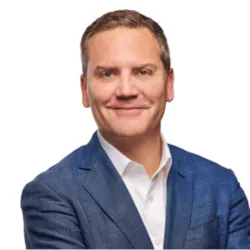
Sam Richardson is co-founder and CEO of Volley, an automated parking technology company that combines artificial intelligence-powered software with robotics to help developers fit more vehicles into less space. Under his leadership, Volley is advancing projects in major U.S. markets while developing the software and infrastructure needed to support the next generation of connected and autonomous mobility.
Here is a transcript from the episode:
BL: Wherever you are, however you may be listening, welcome to another episode of the Infrastructure Technology Podcast. This is episode number 56. I am, once again, Brandon Lewis, the associate editor at Mass Transit magazine. Back with my partner in crime, Jessica Parks, a staff writer from Roads and Bridges. Jess, how's it going?
JP: It's going great. The dynamic duo is returning a lot lately. We've had a very busy Gavin Jenkins, and it's been me and you. I always love it. So I'm excited to see what you have in store for me today.
BL: Yeah, Gavin is still recovering. He is catching up from his trip in Singapore. I'm sure we're going to hear about that next week when he returns to the ITP. But today, Jess, the listeners get a special treat because they're not just getting my interview, and they're not just getting your interview. They're getting us together.
JP: Yes. It is a full Brandon and Jessica episode this week. You'll hear both of our voices from beginning to end. So enjoy.
BL: So we have a wonderful guest for you today. We have Sam Richardson, who is the co-founder and CEO of Valley. We're going to talk a lot about robotic parking, but before we get there, I told Jess, I said, ‘I think today because it's just going to be us two on the podcast. There's no Gavin, there's no Noah today’. I said, "Before we get into this interview with Sam, I think I ought to tell our listeners a little story’, and this does have to do something with the interview today, I promise. So Maz, in case you're wondering if I'm going off the rails here, I'm not. But I want you to imagine a little Brandon Lewis. Around nine years ago. It is the fall of 2017. I am a freshman at Kent State University, which in my opinion is the greatest journalism school in the country, located in Kent, Ohio. It's where you get all my wonderful journalism skills I bring to Mass Transit and the ITP, but I went to school originally to be a sports broadcaster, and we've talked about my love of sports a lot on this podcast. I went originally for TV, found out how hard TV is and said, ‘I don't want to get into TV’. So I found radio. And so this is where the story comes in because that fall for our local radio station there in Kent on campus, Black Squirrel Radio, which was all student ran, I tried out to be a sports DJ or RJ, radio host, whatever you want to call it. And I was one of the last people cut. So yeah, even the greatest people. Listen, Michael Jordan got cut from his college basketball team. I can get cut from being a radio DJ. My story is, so a year later, I come back, and it's different management, and they're asking me questions, and they say, ‘Brandon, did you ever consider having a co-host’? Because you could do a show solo, or you could do it with other people, and I said, ‘Co-host? Are you kidding me? I got so many thoughts up here. You want me to share the spotlight’? And they said, ‘Well, okay, are you going to at least have guests? Are you going to talk and ramble for two hours at a time every week”? And I said, ‘No, I've got to have guests’. But I was worried about, because I have so many thoughts in here and so many things that I talk about, I was worried about not being able to get my stuff in and having to literally share the spotlight with another person. I say this because ever since that moment, since 2018, basically, I've done podcasts on the air, but either I've been a co-host where I am the show lead, or I've been a solo host. So when we started the Infrastructure Technology podcast, it was an adjustment for me when Gavin the majority of the time is in the host chair. And so that's where sort of, ‘Hey, it's Tuesday, it's podcast day’ came about because I'm like, I got to get something in there to start off this show, and I say this because now I've done shared interviews for print where me and Noah a couple times have collaborated on stories, and we've talked to some more people, and we've come together and share notes. But today's interview that me and Jess did is the first interview I've done in my professional career that's going to be on video or audio where I am actually sharing with my co-host officially for a show, an interview that we've done on the air.
JP: That makes a first for both of us because it is the same for me. I have never done a video or audio interview with someone else.
BL: It's different when you are the interviewer interviewing multiple people as opposed to two interviewees interviewing one person.
JP: Exactly. And I mean, Sam handled it with ease, having both of us firing questions at him. He did a great job, too, so we couldn't ask for a better guinea pig for that process.
BL: Yeah. And trust me, you guys are going to learn a lot from Sam Richardson today. As I already said, he's the co-founder and CEO of Valley, an automated parking technology company that combines AI powered software with robotics to help developers fit more vehicles in the West space. Under his leadership, Valley is advancing projects in major U.S. markets while developing the software and infrastructure needed to support the next generation of connected and autonomous mobility. Jess, is there anything else you want to add? Is there anything the listeners should be paying attention to as we kick it over to Sam?
JP: I think just really soak in what Sam has to say. I mean, this is such a future forward-looking episode. I think just really soak it in. I mean, he's brilliant. So listen what he has to say and enjoy.
BL: Soak it in, listeners, watchers, enjoy. Maz, let's take it away to me and Jess's interview with Sam Richardson.
BL: Sam, welcome to the Infrastructure Technology Podcast.
SR: Thank you, Brandon. Thank you, Jessica. It's great to be here with you.
JP: We're happy to have you.
SR: Thanks. Absolutely.
BL: And Sam, we are going to start things off today and tell us a little bit about your role at Volley.
SR: I'm the president and CEO of Volley, which is an automated robotic AI parking system. It's a startup, a proud startup company headquartered out of Denver, Colorado, where I'm sitting now. The company was founded a few years ago and was vertically integrating the robotic build out of this automated system. And we've since, in my tenure, which is just over a year, we've since moved to a outsourced hardware strategy, and we are selling this outsourced hardware strategy with a fully integrated software program, and we're disrupting the traditional and conventional parking industry, which is massive all over the world. Some would say it covers even 30% of the earth we've heard. Certainly in North America, it's a big part of developers and GCs and the construction industry alone, and parking has, and continues to be, a real headache. It also continues to be a financial drain for making deals "pencil." So as CEO of Volley, I've been fortunate enough to sit at the helm of a company that's rapidly growing, rapidly disrupting an industry that hasn't seen technology at this level in some time or ever, and we're just having a ton of fun.
BL: Well, technology and parking certainly fits both of our industries, which is why to our listeners and our viewers on our YouTube channel, me and Jess are doing this interview together today. Now, I got this from your website. It says that Volley Automation uses advanced software and proven robotic systems to efficiently densify parking garages, making garages smaller, fit more cars, or both. My question to you is, how does this system differ from a traditional parking garage?
SR: Great question, and it's a mouthful. I'm glad you got that off the website. I like to simplify wherever I can. One, because it helps me lead better, and two, because I think if you can explain something simply, you're going to attract a whole lot more attention, especially with people that are looking at this as a very new, sometimes intimidating technology, so I'll break it down simply. Volley's in a stage of, call it a 10-year lifecycle to what we think will turn this company from a startup to potentially a very large public company. We've set our goals and our north star to be quite large, and to do that, we've got to start somewhere, so we're at an early stage of growth. We are a startup that moved its business from San Francisco last year to Denver to be kind of more middle America, closer to where the action is, closer to where our biggest investors live, and we're very proudly looking at an industry that has seen automated parking for the last several decades, but the version that clients are seeing far and few between with the cities that you'll run into where you're going to see your car pull in and ultimately some kind of mechanical mechanism is going to take your car and park it for you. But there's very few, if any, examples of consistently high performing automated systems, certainly not using AGVs, autonomous guided vehicles or robots, and as we looked at this, and we're owned and invested by commercial developers, so we're not owned and invested by people that just kind of concocted idea because they're consumers and drive a car. These are real estate guys and girls. These are people that get buildings in every urban market where land is at a premium, is expensive, and parking makes up anywhere from 25 to 40% of the total cost of a new building construction, and you waste a ton of space, mostly with what we call dumb concrete, when you build a conventional ramped garage that have been around for decades upon decades. And so when you put that with just the consumer efforts of attracting people that drive cars and don't like looking for parking spots and would much rather pull in to a spot in any urban market, keep their keys, get out of the car, put it in park, hit a few buttons on their app or on a kiosk and walk to dinner with their wife or husband or partner and never have to go into a garage again for all the reasons we don't like garages, we thought, ‘Man, if we could make that happen through the proliferation of software development, physical AI and turning a company that is going to disrupt this space and make it simple’, we thought that that was a really cool business model, so that's where we are, stage one of that. We have some very aggressive growth goals to be the biggest automated and the best automated parking company, but I want to be really clear with your listeners. While we're at this early stage, we're building automated parking purposely for essential builds. We call it Volley essential. The buildings can't be built because they're on such small land, parcels. They can't be built with ramped garages. There's not enough space. These are in New York City and Boston and Miami and places like that, and so they're coming to clients, the developers are coming to us to address that issue with a condensed and densified automated parking system. We're going to do this for 18 to 24 months extremely well, but we're going beyond just volley essential. That becomes more mainstream with volley economic where we really are competing against somebody considering a ramped garage where you park yourself to a fully robotic automated garage where you don't park yourself, and it still needs to make economic sense. So as we scale, and we're in the parking space, we're really moving towards parking optimization, fleet management, someday five years, six years from now, being that answer in cities for all the autonomous vehicles like Waymos and robotaxis driving around and needing a place to go in and charge and wash and download their data and get ready to turn back out to the street for their consumers in the urban markets, so we have a really healthy growth strategy that starts with Volley essential.
JP: And it’s really interesting to see where it'll go, especially with the growth of autonomous vehicles themselves. I didn't really think of that aspect of it. I think that'll be really cool to see. So my question from the Roads and Bridges side is, so how do you see automated parking changing the way cities design their road networks?
SR: So parking takes up a lot of space. I said that, and I don't think there's a lot of listeners that will deny that. And when you take up more space because of the amount of massive concrete and plumbing and MEP as it's called, mechanical, electrical and plumbing that's involved, you're not just burning a lot of cash as you're development, but if you're in civil engineering, you work for city development, you're looking at how vehicles are moving, but how people are moving, just the general use of land efficiency. Taking a step back, our entire business model centers around space is optimized when you can condense it. We're not making any more land. God's not making any more land. And so we kind of jokingly say, so we are in the business of optimizing land and space, and we're doing it with aN asset class that's really important to people. Vehicles are an expensive asset, but we're doing it in an industry that has an evolved parking beyond just what's called parks, stands for parking access and control and revenue generation. The park system, the gates, the gate takers, the cameras when you're going in and out of garages, that is the QR code that you hit with your phone. That's as far as tech has gone in the parking space, and there's great companies that I admire very much that have done very well in this space, but it stops there in terms of really densification. Nobody has addressed that. City developers are going to look for ways to densify space, to optimize it for urban development, housing, parks, green space. And then when you add in what scares a lot of cities with autonomous vehicles now taking place of drivers and being on the road by the tens of thousands in the next three to five years, where do those cars go? Do they just create traffic jams? And there's an argument that they do unless something like the Volley product, which will be in every urban city market in the next five to 10 years. And as I said earlier, those cars can get off the road, should get off the road all hours of the day and night and do what they need to do to get prepared for the next day. You can only do that, not with valet drivers, not with self park where stalls are 18 feet long by six feet wide. You can only do that through space densification, and the platform robot that sits underneath a tray and sits underneath your four tires of your car allows you to do that Tetris parking and the geometry of that inside of these now closed off parking garages or vaults as we call them, allow you to stuff a garage 40 to 50% more in terms of parking yield for the developer, which is where the economics come in, as well as the benefits of environmental green footprint, the carbon footprint if you will. And then the consumer never has to look for a spot again. So think about the safety just alone. Parking garages are statistically some of the unsafest places on earth, and you remove the person walking through the patron walking through looking for their car in the airport. Now that's closed off to them, and it comes to them through like how you would order your Uber or your Lyft as soon as you hit the button, and it's turned nose out for the patron to drive out onto the street again, so there's a lot of corresponding benefit effect from creating that type of product.
JP: So I agree with you, and I think you did kind of touch upon my next question, but I'll give you an opportunity to expand if you'd like. So how much traffic inside a traditional parking garage is caused simply by drivers searching for a space, and what happens to that traffic with an automated system?
SR: Well, so traditional garages where you park yourself in any city environment, the footprint of that, you're looking at, well, let's talk about the cost first. The cost, at least the United States today with labor costs going up, construction costs, inflation, the cost of capital now, interest rates increasing, materials used to build those spaces, a standard stall, one stall can cost upwards of $75,000 to $100,000 for the developer, so if you have hundreds and hundreds of stalls, you're talking about tens of millions of dollars depending on where you are, whether it's 10 levels or it's one long level like you see at airports, that's above ground. If you build below ground because you have a high water table environment, you're sitting on bedrock like the city I live in, which is Nashville. It's stone, so you have to blast it with dynamite. It's called subterranean parking, dirty, dusty, dangerous and expensive. Every level you go down an environment like that, $5 to $10 million of additional excavation subterranean costs, so the densification economics really pencil very quickly for an automated system, but that automated system with robotics is a lot less expensive than what you see today in say New York City or even parts of South Florida, automated parking systems that use steel racking and rail systems. These products have been around a long time. They're not really software centric. They're very heavy steel hardware centric. They do densify beautifully when they work, but they're a very high cost of capital, tens of millions of dollars, so you aren't really saving the developer much money. You're densifying, but the Volley system densifies, as well as saves the builder a lot of money and then provides an experience for the consumer, and that's kind of the trifecta that we look for.
JP: Definitely. And so do you think automated parking allows developers to build in locations where conventional parking garages simply wouldn't make financial or physical sense?
SR: Volley essential is that to a ‘T’. Volley economic is where we go, let's say in the next two years, two to three years where we are the solution for more institutional development, airports, hospitals, hotels, 500 stall parking lots, city development plans, concert venues. That's where you're going to have larger infrastructure, but being an outsourced technology company and an insource centric software led company, it's our software, it's other people's hardware, allows us to scale to those levels quickly. Because instead of turning a wrench here in Denver where our plant is and making the robots, we'd rather buy it from places in the world that do it today better, faster, cheaper, all over the world, not just China and East Asia and then integrate that with our software so that we can grow into those more institutional larger facilities in the next few years.
JP: Definitely.
BL: So Sam, you mentioned a little bit about the above ground and underground parking. Obviously in transit, we have buses and things like that that are above ground. We have rail and train tracks that are mostly underground. One of the things in transit that's been popping up over the past few years has been this idea of transit-oriented development. I don't know how familiar you are with it, but essentially a lot of these transit agencies are putting stations for buses or rails and working with communities right next to housing apartments to give people easier access to transit. My question is, could automated parking make that transit-oriented development easier by allowing developers to provide required parking without dedicating huge portions of a site for those conventional parking structures?
SR: Yeah, absolutely. It's the short answer. I mean, when you take a look at our product today, it's very turnkey, but it's also very niche, and to be successful, we have to move from the niche and the novelty to something more broad scale. So then you start talking about broader transportation infrastructure programs, lots of big words there, but it still comes back to the essence of you have a car, you have a truck, you have something that is protected asset, you need to be able in America to pick up something that weighs eight to 10,000 pounds. That's what an Escalade IQ weighs right now that's got EV batteries under the hood, and there just aren't a lot of things that can move and densify that. So because we're focused on being a company that can have that type of payload, in fact, today we can pick up 10,000 pounds, and we say that to city planners. Their first question is, does it work? And that's going to remain the question until we show the at-scale growth that this company has achieved. Just in the last nine months, we have met with those developers, those city planners, the people that are building out the next stage of mass transportation, and what we're showing them is the projects we've done in Denver, the three we've won in New York, another one in Long Island, five in Montreal. All of these are happening over the next five years. You just can't snap your fingers immediately and show that. So the last point on that that's really kind of broken, punched through the cloud, as I like to say to my team of growth is we are doing everything first on a digital simulated twin. We are creating a three-dimensional view of whatever the client wants us to design with CAD drawings, Revit files or just cocktail napkin ideas. And then we go in with our engineers, and we create a virtual illustration of that, and it's not just this cute thing that you spin around and show to try to close a deal. Because of AI, because we use Claude Fable five, and I don't think there's anything stronger on the planet right now. Controversial these days as AI is on the news about taking over the world, but it is incredibly powerful to create these simulations. And so when you put an illustrated digital simulation with throughputs of that real life rail station, hotel, high-end multifamily development in front of the client, and they see the car throughput at 8:00 a.m. to 5:00 p.m., and they know when the peaks and valleys come, you can just see the blood rush back to their head. They're not so freaked out anymore, and it's been a game changer for us. Again, it's proprietary. We've built it using Claude. We've built it using great engineers. This is the secret sauce of not just the company, I'm sharing this broadly, this is the secret sauce of how we can operate successfully a thousand stall lot in the next few years where before automated parking really capped out at a couple hundred. A couple hundred parking lot's awesome and impressive, but you won't create ubiquity. You won't carve new paths and infrastructure of cities if you stop there.
JP: Yeah, definitely. And it's funny that you said Long Island because I used to cover Long Island, and I mean with the way that their transit set up, everyone's driving to the transit, there's nowhere to park. That'll be like a breeding ground for the automated part.
SR: Well, one of our clients, I won't name, but he's coming here tomorrow to take a look at his project that's kind of being simulated physically now. The digital world is done. The physical world is being simulated in our 40,000 square foot garage in downtown Denver, which I think is the largest automated robotic parking garage maybe in the Western hemisphere, and it's opened all your listeners to check out. It's very cool. But he's coming here in Long Island. He's saying that. He's like, ‘Look, I have a Trader Joe's, which is always filled. I have an open parking lot near the train station going into Manhattan, and I have a hospital right across the street, and it is flooded with people, and there's never enough parking’. And so this is the solution, and he's kind of the visionary pioneer of this. It's going to be really exciting, and it will ribbon cut in the next 18 months.
JP: Awesome.
BL: That's awesome. So Sam, just for our viewers or listeners out there, can you give us a little insight? What would you type into Claude to get a simulation started? Like what would you tell Claude to do?
SR: Well, I mean, some of it is kind of our secret sauce, but what our engineers are doing now is writing the code that operates the autonomous robots, the autonomous EV charging. In the next couple of years, our R&D team will have autonomous car washing while you sleep, your car is parked, and you'll detail your car because you schedule it on our Volley app inside the building. The robot will take you to a section of the garage and detail your car inside and out. I mean, this stuff does exist today. I know people are like, ‘Oh, whatever. I'll believe it when I see it’. I went to different parts of the world in the spring, and I saw this actually happening, so I'm like, ‘Wait a second. How come Americans and Canadians and the North Americans, how come we can't figure that out’? So if anything, part of our strategy is to be that Trojan horse, at least for the hardware to come into this western side of the world and sophisticate up this place with robotics and AI, so we're pretty excited about that, but we'll use Claude strategically in that. We'll use it for code writing. And then ultimately, some of our inputs with any LLM right now is we need to know what a simulation would be at 8:35 AM in downtown New York on 5th Avenue for this high-end residential building 12 months out of the year and show all the inflection points of the last six months studying this from A, B and C. What we've also kind of copied is we're all lovers and users of Uber or Lyft. I'm an Uber guy when I'm not taking a Waymo or Azoox, and we've studied how they created their algorithm to make sure that they could meet demand in certain times in certain cities. Where do we need to be with all of our black cars in this 12 block radius of Manhattan so that we are getting the optimal amount of customer experience, throughput and economic yield? And so we have to make sure we have the capacity in these parts of the city at this time, and the minute that that is over, based upon history, we move more cars to this section of the city, and it may seem really simple, but you can't do it with spreadsheets in human brains. You literally have to use the artificial intelligence that's been afforded to us as a culture the last 24 months, so that's a lot of the best practices we're learning from, and I guess the benefit of being a startup is that you move fast. If you're lucky, you grow fast, but you break stuff too quickly as you learn fast, and you have to so that you can then crystallize what's ultimately going to be your MVP, your minimal viable product, which is the stage we're in right now.
BL: So we've talked a lot today about space, and obviously one of the main goals of public transit is to get less cars off the road, more room for buses, trains, better for the environment, etc. But obviously the robotic has to do a lot with parking, but do you see public trains being that compliment to this software?
SR: I do. We're not going to be ready for that for a few years proudly. Some of the, I call it the boneyard of the automated parking industry, it's a niche industry, but there's a boneyard there, meaning we've had some of our competition fail, and they fail, in my opinion, for 20 reasons, but the two primary reasons, overpromise, under deliver, which we've learned it since grade school and then they run out of capital probably because of the first one. We're not taking on projects that we won't pencil first. It economically makes sense. The digital simulation has to yield throughputs that are of high quality, and we know that the patron experience will be great. The last thing we want is soccer moms, so to speak, honking their horns, queuing up, waiting to pick up groceries in one of our garages, and we're taking a look at where we have to go in a 10-year stretch, but a five-year finite plan, so we're very laser focused on five. We have a vision for 10, and autonomous vehicles, buses, trains, golf carts, boats, space optimization in general through automation is very much on that 10 and five-year focus area, and that's where we think we really just kind of shift into a gear where we're creating, this may sound very audacious, but we are creating an entirely new asset class, and what I mean by that in developer real estate speak is that parking today is an asset class. You build it cookie cutter. There's a few variations, but essentially it's what you and I both know. We drive up ramps, we find a stall ourselves, we go where we're going. That's an asset class. We think if we do this right, and we intend to do it right, that we are creating an entirely new way to specify buildings for the next 100 years that tongue in cheek, your grandkids will say, ‘Man, you pulled into what? And you did It’ and so I won't be around to see that, but I'll be a part of that frontier effort, and that's what keeps us going. We're a proud 25-person company.
JP: That's awesome.
SR: And we were nine people less than a year ago.
BL: Wow. Good for you guys.
SR: We're growing, baby.
BL: Sam, is there anything that we both didn't touch on that you would like to address?
SR: I mean, we hit a lot of things. I think what's really interesting, at least that gives me a lot of longevity and passion, is critical or not, people I think are getting inherently lazier and more amenity driven. And so you do have buildings right now in South Florida that are high-end real estate for very wealthy people where their cars, their asset that some cherish most, they want them parked next to their high-rise living room. They want the car to be on an elevator to go up all the way like a person does, but it's a lift that carries a car up to the 50th floor of a high rise in South Beach, and they want it to open up their den or living room door and get in their car much like Batman would, and they take the elevator all the way down to the street level. And so they're fill in the blank, Bentley is right next to them. That to me is engineering at its finest. It's super cool. And for the uber wealthy, it's, I guess, a cool YouTube video to brag about, and I'm not knocking that. I think it's wonderful, but what we're building here is something for mainstream America, the mainstream world. We start with Volley essential, and we proliferate to valley economic and essentially valley institutional, which is kind of what I said in my last comment about the next 50 to 100 years and the key to doing this is you have to make it affordable for all. And to make it affordable for all, you build scale and then we drive down our unit costs. The system itself will modernize around just the incredible amount of growth in robotics. Robotics is a white hot cool area, and some people think, ‘Oh, it's going to take our jobs’. Well, I don't think so. What we're doing here is actually creating jobs. We're creating them here at Volley, and everywhere we're going talking to parking operations companies, we're saying, we want your people to be trained on how to operate these garages. We don't want to displace them. Yes, there's a labor economic. Instead of 10 people running in their socks to jump through windows, you've seen these in LA, parking cars so close together with people that they have to escape through a window in the car because everything is so close. That's nonsense. By the way, it's dangerous. A key point I'd like to bring up that we haven't yet is we're not here to displace human jobs. We're here to make them more efficient. And frankly, if we do that, then the people that are working a valley garage someday, we'll say that a lot, they're paid more because they're trained at a higher level to operate those. So it's autonomous behind the wall, as I call it. You never have to look for a spot again, but the entry, the consumer interface with our kiosk, the bay that you drive into, that's going to be patron and person led, and that just gives a great opportunity to have some great strategic partnerships with parking operations. I mean, for that matter, government agencies, rail yards. Think about the hospitality valet side of things. In Vegas where I just was for a conference, think about how curated that experience is when you show up to your hotel. We think that that will actually harmonize with a nice synergy.
JP: I agree, and I mean, anytime with these projects, it's a boogeyman, AI, automation, we're going to take our jobs. But exactly, it's transitioning a job from a more hands-on role to a more technical role that has more longevity.
SR: Exactly. I think what limits us is software, so we haven't talked a ton about this, and I don't necessarily think it makes a ton of sense to get as technical right now because I'm not able to as we grow our software side of the business, but the limitation of success was not hardware. It was the software layer that, and in this case, agentic AI, the agent is the robot. The AI is the software that is the central brain that tells the agent what to do. And when you create agentic AI in any operation, particularly robotics, software is the orchestration, the layer that will allow you to do 50 configurations of a six-stall garage or five million configurations of a 200-stall garage, which is just like Rubik's Cube craziness. But when you're going in and saying, ‘I can park this garage differently every hour through agentic AI’, and why would you do that? Well, because it gives more yield to the owner of the building. You park Brandon's car differently on a Tuesday than you did on a Monday because Brandon put in his app that he's parking, he got asked, but he's putting in his app that he's just going to the gym or he's going on vacation for a week and a half and that's simple, but behaviorally, you know how conventional parking stalls work? Either behaviorally as you remember it, or the valet guy, Charlie, knows you.
BL: No, you’re right.
SR: I know Jessica, I know Brandon. They like being up close or they like being a little further away. You know what? They're a dinner party tonight. And so it's all human vault. Well, this is where computers are smarter than humans, and we put all of that behavioral science into that software-led orchestrational layer, and that's where Volley I think scales where other parking companies, frankly, just ran out of capital, or they didn't thread in what's happening right now, which I'm taking advantage of, which is autonomy, AI and robotics all converging to create this groundswell of capability.
BL: Jess, did you have anything else that you would want to add? I think I might've interrupted you. I apologize.
JP: No, it's okay. You answered everything. It was great. Yeah, I don't have any more questions.
BL: Well, Sam, thank you so much for joining us today on the Infrastructure Technology Podcast.
SR: It's been a pleasure, guys. You were great. Thanks for listening.
BL: So we are back. That was our interview with Sam Richardson. And I got to tell you, this robotic parking thing has a chance, I think, to just take over the country. I mean, you're already seeing it. Sam talked about all of these places, whether it's hospitals, churches, sporting events, whether you're parking in lots, parking on the street, the ability to just have these little pop-up sort of parking places and allow the technology to park your car for you. And then not only that, make it so you don't even have to remember where your car is, which I feel like half the time is the battle. It's going to be a huge saving.
JP: And I'll share a little anecdote from that. I went to the casino in Oklahoma this weekend and me and my friends were driving around with our other friend for about 25 minutes looking for our car, so this project would've given me, Sam's technology would've given me 25 minutes back in my life.
BL: And it's so impressive too. And Jess, you can speak on the Roads and Bridges stuff, but from the Mass Transit perspective, the ability to compliment, the whole goal of transportation I said in the interview is to get obviously cars off the road, to get more people to use public transit to save the environment, etc., but the spacing is what's key because obviously with these buses and then you have rails that go underground, they need space to operate a maneuver. And the technology here with these tents, and again, just the ability to park a car in such a space to give more room to bigger vehicles to me is impressive.
JP: Yeah, first of all, I think it has a lot of applications for big developments that are coming in that require a certain amount of spaces that don't want to be encroaching on land that having that stuff. And then I think it also helps with public transit. I mean, it has so many applications and the importance of maximizing space nowadays is just so, so, so real, so I think Sam's technology, we will see it growing and growing and growing fast. It has huge effects in giving people back their time, in creating less traffic delays with people waiting to get into a parking garage, so I just think it'll have a myriad effects that will benefit the surrounding area.
BL: Well, and to your point, the traffic and all that, it also, in my opinion, I guess you would call it the margin of error, if you will. Sometimes you park in a spot, and there's nobody next to you, and you think you park perfectly but then as you're coming out of somewhere, someone parks and maybe they park at a weird angle or maybe they park too close to you, and you can't get out. That is what this technology is really impacting.
JP: Yep. I've had that experience recently. I had a Jeep that was halfway out of its spot, and I was trying to back up out of my spot. And so I'm packing up straight. It's perpendicular to me, the Jeep. I could barely get out of my spot. And so it'd be nice to eliminate situations like that. It would've saved me a headache.
BL: And I also found it interesting too that Sam pointed out that the company was very specific in where they wanted their headquarters. They're currently testing a lot of this stuff in Denver, Colorado, and he said one of the reasons for that is because in winter while Denver does get snow and occasionally, obviously a lot of it, because of the sun and because of the weather, because the atmosphere, it dries up really quickly, so it does give them the ability to, even with the potential of bad weather, really test it in all four seasons because for the most part, even in Denver, it goes from 20 degrees to 60 in a couple hours.
JP: Yep. And Sam was nice enough to invite me and Brandon to Denver possibly in the winter time. So maybe you'll get a special ITP episode from there, and I will get to hit the slopes.
BL: I will not be hitting the slopes. I am a summer baby, if you will. I cannot stand the cold, even though it's coming around the corner. So for all of you, whether you want to grab your hot tea, your hot chocolate, sit back and enjoy the rest of these ITP episodes, the rest of 2026, that's all we have time for this episode. However, I do want to give some special thanks. Obviously, I want to give a special thanks to Sam for joining me and Jess on today's ITP. I want to thank Karina Mazhukina, our editor of the ITP on all things audio and video. I want to thank Endeavor B2B, our parent company for giving us this platform to record this podcast. I want to thank all of you, whether you are listening on Spotify or on Apple. I want to thank you if you're watching on YouTube at the Infrastructure Technology Pod. I want you to go on social media. Give us a follow, Mass Transit, Roads and Bridges, on X, Facebook, Instagram, LinkedIn. And I also want you to send us an email. I know it's a lot to do, but don't worry. I know y'all can handle it. Send us that email, [email protected]. Jess, did I miss anything?
JP: You did not. As always, you did a stunning, impeccable job. So yeah, nothing from me, but it was such a pleasure working with Sam on this episode, and it's always a pleasure when you and me get to combine forces and do a duo episode.
BL: Thank you. And next week, our true leader, the head of the ITP, Mr. Gavin Jenkins, hopefully he will be back to set me straight after he just gave us the reign for two straight episodes.
JP: Yep, exactly. We might be giving him a run for his money upon his return. Who knows if we want... We might be mutinying.
BL: All right. For this episode of the ITP, I am Brandon Lewis.
JP: And I’m Jessica Parks.
BL: And we will see you next week. Have a good one, everyone. Stay safe. Goodbye.
About the Author
 Brandon Lewis
Associate Editor
Brandon Lewis is a recent graduate of Kent State University with a bachelor’s degree in journalism. Lewis is a former freelance editorial assistant at Vehicle Service Pros in Endeavor Business Media’s Vehicle Repair Group. Lewis brings his knowledge of web managing, copyediting and SEO practices to Mass Transit magazine as an associate editor. He is also a co-host of the Infrastructure Technology Podcast.