Infrastructure Technology Podcast: Making transportation more accessible with technology
Key takeaways
- The growing use of flock cameras: Gavin, Brandon and Jessica kick off the episode by discussing how the technology can identify license plates, vehicle characteristics, time and location, potentially helping law enforcement investigate crashes, hit-and-runs and other incidents. While the cameras can provide valuable information after crashes and improve accountability, the hosts raise concerns about widespread surveillance and data sharing across jurisdictions.
- Onward is designed to bridge the gap between traditional paratransit and conventional rideshare: Brandon interviews Onward Chief Revenue Officer Dmitriy Vanchugov to dive into how Onward’s technology provides assistance for riders who may need additional support, including wheelchair users and people with other accessibility needs.
- The technology is designed to reduce barriers to booking a ride: Riders can access the service through a text-based booking experience rather than needing to download and navigate a smartphone app. Onward's artificial intelligence (AI) assistant, Paige, helps guide riders through the booking process, answer questions and support users in more than 100 languages.
- Accessibility remains a major gap in transportation: The hosts connect the interview to their own experiences and highlight the difficulties wheelchair users can face when accessible rideshare options are unavailable. Whether discussing camera systems, AI or on-demand transportation, the episode explores how infrastructure technology can improve safety and accessibility while raising important questions about privacy and responsible implementation.



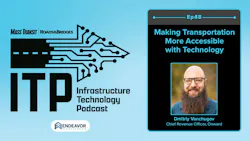 ITP episode 48 graphics.
ITP episode 48 graphics.
Episode 48 of the Infrastructure Technology Podcast explores two sides of how technology is reshaping transportation: safety and accessibility. The hosts first discuss the growing use of flock cameras and automated license plate readers, weighing their potential benefits for investigations and public safety against important concerns surrounding privacy, surveillance and data sharing.
The episode also features Brandon Lewis' interview with Dmitriy Vanchugov, chief revenue officer of Onward, about closing accessibility gaps in transportation. They discuss Onward's assisted, on-demand ride platform, its use of AI and text-based booking and how technology can help connect riders with more accessible transportation options.
Listen time
30:27
About the guest
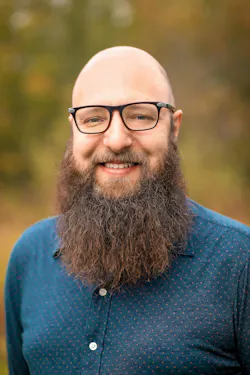
Dmitriy Vanchugov is the chief revenue officer at Onward, an assisted rideshare platform dedicated to connecting riders to the healthcare or economic and social opportunities they need. He brings deep experience building and scaling go-to-market organizations in high-growth environments, with a career rooted in transit and mobility.
Before joining Onward, Vanchugov served as global head of transit at Uber, where he built and led the business across North America, Europe and Australia. Prior to Uber, he led enterprise software sales and consultant teams at Trapeze Group, a leading global provider of transit technology solutions. At Onward, Vanchugov leads the company's market expansion strategy, focusing on deepening partnerships across transit agencies, health systems, health plans and PACE programs.
Here is a transcript from the episode:
GJ: Welcome to the Infrastructure Technology Podcast. I'm Gavin Jenkins, head of content of Roads and Bridges, and with me, we have Brandon Lewis, associate editor of Mass Transit, and Jessica Parks. She is the staff writer at Roads and Bridges. How are you two doing today?
BL: Boy, I'm doing great. It is a Tuesday, and that means it's another podcast day.
JP: I'm doing great. Happy to be here.
GJ: Yeah, Jess is tired. Jess had a lot of travel. She was in South Carolina for a work trip. We send people all over. We're always traveling here at Roads and Bridges and Mass Transit. And today, we're going to be talking about flock cameras. But first, Brandon, tell us who we have. We have an interview coming up that you did. I don't want to mispronounce this guy's name.
BL: Okay. So today I am interviewing the chief revenue officer at Onward, and he is known as Dmitriy Vanchugov.
GJ: That's a name. It looks, see, I would've pronounced it Vanshugoff.
JP: It's easier than it looks.
GJ: It is much easier than it looks. Before we get to that interview though, we need to address the issue of flock cameras. We will have an entire episode about flock cameras coming in the future, but we need to talk about this right now. It is huge. It's all over the news, and it's something that we talked about during our first season of the show when we talked to AT&T about putting cameras in intersections to increase safety. But flock cameras are primarily an automated license plate reader and vehicle identification system, and they're not conventional traffic safety cameras or speed cameras. There's a distinction there. Flock camera, it has become one of the most widespread ALPR networks in the U.S. This is the one that is crazy. There's 120,000 cameras deployed nationwide, according to some recent reporting. The technology is now present in thousands of communities and growing in numerous cities. So let's talk about what they do. They read license plates. They get the vehicle's make and model. They can pick up the color and other distinguishing vehicle characteristics and the time and location. And there is a traffic safety argument for flock. It can help solve crashes and hit-and-runs, and it gives law enforcement valuable information on fatal crashes, hit-and-runs, like I said, serious injuries and crashes, and also can help out with keeping pedestrians and bicycle riders safe, or if they get hit, find out who hit them. Brandon, what do you think of flock cameras?
BL: Yeah, so there's obviously with everything, there's a positive and there's a negative aspect, and I do like the fact that in theory, these cameras are designed to help make roads, bicyclists, every one of us safer. I think the issue though comes in when you are dealing with all of this identity and as data at once, and with the power that we've seen with AI and technology developing now, how much of that data can be translated into potentially invasion of privacy?
GJ: Yeah, the data usage, I mean, there's a lot of reasons people like it. There's a lot of reasons why people hate it, but the data thing is pretty big. What do you think, Jess?
JP: Yeah, I get that it makes places safer. You have more access to finding the crew cause of an accident, all these different things, but I do think it has some negative aspects when it comes to how often it's being used. It could just track you for God knows how long.
GJ: That is so true. You can be tracked across the country almost. And so a camera can be installed in one town. It doesn't necessarily mean that the data stays within that town. Agencies can participate in networks that allow searches across jurisdictions. So critics therefore worry about situations where if you drive across several states, cameras record you, investigators can reconstruct your movements without ever stopping you. And so it becomes a misuse of law enforcement and an invasion of privacy without going through the proper channels of having a warrant or that sort of thing, and it can be pretty dangerous, but the thing is we're all sitting here going, ‘Oh, but it also makes us safer’, but does it make us safer? Is it preventing the car accidents? Is it preventing the car crashes?
BL: Well, and the other thing is if you're on a bicycle, what have you, or you are in a car, you sort of feel like that is my sanctum. That is my privacy. Whatever I do in there is none of nobody's business, so the tracking a movement thing is also an issue as well that it can literally track your exact movement.
GJ: Yeah, absolutely. I mean, look, I think that if there's a car accident in an intersection and there's he said, he said or he said, she said type situation where it's like, no, you caused the accident. No, you caused the accident. It can help determine who caused the accident. Definitely. But is that worth it? Is that worth giving up all that data? And then they're not infallible. They can misidentify people or cars. The technology isn't there yet to be foolproof, so there can be false positives. There's a lot here. And the thing is as we continue to cover technology in relation to mass transit and roads and bridges and infrastructure in general, cameras are going to be a huge part of our discussion, and I think it's why we wanted to bring it up now so you, the listener, can know, oh, this is on their radar. They're not overlooking this, and it's something we'll dig into in a later episode, and we'll go really in-depth to the pros, the cons, some of the myths and misconceptions about it, and we'll suss out what's fact and fiction on flock cameras and cameras in general in the infrastructure world. But for now, I think we should probably just leave it at that. There's pros and cons. That's where we are. All right. So with that being said, let's get to Brandon's interview with, I'm going to say it right, Dmitriy Vanchugov.
BL: Vanchugov, yes.
GJ: Alright, take it away, Brandon.
BL: And Dmitri, thank you for joining me today on the Infrastructure Technology Podcast.
DV: Awesome, Brandon. Yeah, really excited to be here, and I think maybe before we dive into questions, I could share a little bit of my background and how I ended up at Onward and working on this Denver RTD project. So to start my career, I spent 12 years at Trapeze Group, at the time the leading software transit company in the world, helping transit agencies deploy software solutions that help them modernize and run their daily operations, scheduling, dispatch, passenger from nation, you name it. We even helped transit agencies deploy modern asset management solutions for both fixed route and paratransit rolling stock to help them maintain a state of good repair across operations, and as a result, I learned this industry from the inside, having the opportunity to work with nearly all transit departments within a transit agency on critical integrated technology infrastructure that power their everyday service, so I understand what it takes to run a paratransit program, what keeps operations managers up at night and where technology and operations gaps have been historically. And from there, I moved to Uber, first as their head of transit partnerships and ultimately as the global head of the transit business. And in that role, I was on the other side of the table rather than working from inside the transit agency. I started collaborating with transit agencies to understand how ride-sharing like Uber can actually compliment what public transit does every single day and what I saw clearly was that Uber is excellent at what they do. On demand, same day ambulatory ride. The product works beautifully for that use case, but there was this entire population of riders, higher acuity, maybe ambulatory, but needing more assistance or maybe even wheelchair bound, where the current market offering was not yet successful in bringing these riders same-day options, and the supply wasn't there, reliability wasn't there, agencies were stuck. Having spent 12 years at Trapeze before joining a ride-sharing company, I understood why. The traditional tech, transit tech was never designed for on-demand and the new ride-sharing platforms were never designed for this population, so there was a gap in the middle that nobody was solving effectively, and that gap is what brought me to Onward.
BL: So let's talk about the Onward technology itself. What is it, and then how is it implemented?
DV: Yeah, so think of us as an assisted ride-share platform, similar to the consumer platforms that we all know and used and previously mentioned, but purpose-built for higher acuity riders that access our services through the B2B or B2G partnerships that we form with organizations that already serve those riders today. That's the focus, partnerships with programs for all-inclusive care for the elderly or PACE programs, health systems and hospitals and of course, transit agencies. When you look at our partnerships, we have to live in three different technology worlds, the rider experience, live dispatch operations and our partners' operation integration and supply aggregation to be able to serve those riders. Although that technology landscape looks different across industries and even within industries, our tech has to mold around our partner's operations and technology ecosystem that's already there. So for example, in the transit industry, we typically integrate with the larger paratransit software providers to make our rideshare services, our assisted ride-share services available within the core paratransit tech ecosystems, but as the case is in Denver, many rider's choice programs, which are a compliment to core paratransit, remain decentralized where every provider actually has to live in all three of those worlds from a technology perspective, and in the end, our tech ecosystem is tech ecosystem agnostic. We take our partner's lead and meet them where they are, essentially. The technology approach is critical, but flexible. Our mission in the end is really what we talked about on the front end and why I joined Onward. It's to bring on-demand same-day service to underserved populations who need and deserve those options just like the rest of us, and of course, technology plays a big role, but I want to zoom out in terms of how the product works a little bit and talk about the supply side of things because I think that's really the secret sauce. So to bring it back to RTD, the foundational insight in our latest project in Denver, which was focused on wheelchair accessible service to some degree, is that wave supply in most cities isn't absent, it's fragmented. There are local operators, NEMT providers, small to medium fleets that have the vehicles and trained drivers. They're already serving Medicaid participants, health systems, adult day programs, but they don't have an efficient or effective way to connect a transit agency demand, or they don't have the capacity to maybe take on an entire transit contract, so this is where Onward’s technology comes in is we aggregate that local wave supply on our platform. We vet the operators and credential the drivers and then we give them better access to consistent trip volumes coming from transit agencies, which then allow them to scale in a flexible, non-dedicated way with us. They can run their core business while taking additional demand from the onward platform that we generate for them. So when it comes to wave service, we're not building a fleet, we're building a network in a local, first, reliable strategy where everybody wins. And the last piece I'll touch on from a technology perspective is the rider side. The rider-facing technology is incredibly important for the rider's experience to be able to actually access the service that we put out there with our transit agency partners. And in contract scenarios like Denver RTD where riders interact with our technology directly rather than in core paratransit, where we would typically be integrated with a Sparelabs or a Rideco, and we're in that ecosystem to provide service. We built a rider-facing technology actually through SMS textbooking, something we call Text2Book, and it's been incredibly successful in Denver. And just to give a little background on Text2Book, we partnered with the AARP H-Tech Collaborative to really understand what older Americans from varying backgrounds want in their transportation technology, and the results were extremely clear. They don't want to download another app. They don't want to remember another password, so that was sort of our north star as we built this technology. And today in Denver, over 75% of Wave participants actually book their own trips directly using our Text2Book, feature where all they have to do is text ‘book’, and they get a workflow right within the text messaging app that comes up that allows them to validate their account just by remembering their date of birth, no passwords, no apps to download and off they go booking their own trip, managing their own trip. We do also offer a good old-fashioned call center as well for riders who don't have access to web-based or smartphone technology. So riders do have the option, those 25% in Denver, to call in and book rides through our tech platform over the call center.
BL: So let's take it from a rider perspective. I want to book a trip. So all I have to do, let's say is pull out my smartphone, or I could call, but let's take it from the texting standpoint. So I basically will I just text the word ‘book’ to a certain number, and this feature will pop up? And what do you see on the front end? Do you put in your information on where do you want to go? And then they give you times or how does it all work?
DV: That's right. So you simply text ‘book’ to the particular number that's associated with your transit agency, and it'll recognize your phone number that you're texting from, and it'll ask you to confirm your date of birth. Once you put in your date of birth, you get a link, which you click on, and then it expands a new window right within your text messaging app that allows you then to put in your origin.
BL: Oh, so you don't even have to go to a different website, a browser. It's all right there within your own text messaging app.
DV: Exactly. When I joined Onward, I was blown away by this technology. I haven't seen anybody else doing it, but the adoption numbers speak for themselves. We have other programs.
BL: Yeah, because I mean usually from my experience, again, I'm based in Cleveland, and I know that we didn't talk about this before you came out, but I'm a paratransit user myself. So the way that we do it is we have a separate app that's based off of GCRTA, but we can go in, it's their own specific app. It's not through the texting portal, and it's just a scheduling system. So what you're saying is basically if I text this number, I would have to be assumingly already registered for an account that Onward supports whatever agency that may be. But as long as I'm logged in for that account, I can do it right through the app. I can schedule rides. And you're saying this works same day as well?
DV: Yes. Exactly right. There's not a dedicated app. You simply do have to go through the eligibility process with your local transit agency. Once you're an eligible rider in their database, it flows into the Onward system, and it'll automatically recognize you when you try to initiate service.
BL: Can you talk about the artificial intelligence, the AI chat agent Paige? What is its role?
DV: That's right. Our AI chat agent, which is available through the Text2Book flow, or if you use our web booking product as well, we do have the option for riders to log into a website to manage their account, book trips, manage trips. And there you can use our AI assistant to ask it any questions, to help you make a reservation. The cool thing about Paige is that she speaks over 100 languages, so it really helps eliminate those barriers for writers as well.
BL: Is there a button that pops up? Is it visible on the side of the screen or is it a pop-up when you enter the site that says, ‘Hey, I'm Paige. Do you need help’? Or where do riders find it?
DV: That's exactly right. Paige is on the side of the screen, says hello to you as you enter the environment, and you can interact with Paige if you have questions for Paige, or you can minimize Paige off to the side if you're happy to self-serve, and you don't need any support that day, but it comes right up as you enter any of our environments.
BL: How long has Page been deployed? Because as you know, the AI chatbot's been deployed up all over agencies and not even transit, just general websites now. Your typical website, I feel like some of them now, I think maybe even Amazon might have an AI assistant at this point. How long has that technology been in the works?
DV: We deployed Paige for our project with the city of Hayward in the summer of 2025. We won in the Bay Area of California a contract to run a city-sponsored paratransit program, and we won a turnkey contract there where we were offering wheelchair service, we're cross-dispatching Ubers, and we offer our own companion rides, which is a high acuity TNC level service where drivers are trained and certified to meet all specifications of the particular industry or segment that they're serving. So Paige has been around for just over a year at this point, and riders really love it, both the Text2Book experience and the chatbot to support them with anything they may not understand in the system or about how their trips work.
BL: And technology is developing so fast, and there's a lot of these TNCs now that have recently upped up and are doing similar things to what Onward has been doing. But from just an Onward perspective, is there room to expand the technology, or what do you guys see as the next steps?
DV: For sure. So Denver is not a one-off. We're actively building the same flywheel of partnerships that we built in the Bay Area across the country. So we're working with transit agencies, hospitals, senior transportation programs, Medicaid and EMT. Phoenix is a great example. We initially partnered with Phoenix Valley Metro Paratransit Program to support their paratransit riders. And then as we started to create the flywheel of efficiency and more demand coming onto the platform, we partnered with a hospital system called Honor Health to support their patient transportation needs.
BL: Oh, so you guys aren't just doing agency paratransit, you're doing medical transportation as well.
DV: That's really where Onward came from. Our founder, Kim Petty, has over 20 years of experience in the field and has experience with ambulance transportation. That's really where Onward was born, is coming out of the health systems to create a service that sits in between an ambulance and a regular Uber ride.
BL: That is awesome to hear. Well, Dmitri, thank you so much today for joining me on this episode of the Infrastructure Technology Podcast.
DV: Oh, thank you so much for having me, Brandon. Very much appreciate it.
GJ: And we are back. That was Brandon's interview with Dmitriy Vanchugov. And Jess, what did you think?
JP: I thought it was a really great interview, Brandon. Dmitri is very captivating. I thought it was really interesting that the service he offers does not require an app. They're making it easy for riders to use their services. You just text ‘book’ and get everything you need in a text messaging app. I think that is really being aware of your clientele and not enough companies do that, so I thought that was really interesting.
BL: Yeah, exactly. I mean, think about if you guys wanted to book a rideshare on-demand, what have you, similar to an Uber, instead of opening up that app, you literally just text ‘book’ to this number, and the whole scheduling software pops up right there for you. You don't need to download an app, you don't need to do anything. And I really like Dmitri's story because before Onward, he was working at Uber, and he said Uber does great with what they are designed to do, which basically is on-share rides quick and all that. But it did not give really a platform much for people with wheelchairs or people with disabilities to be able to get a ride quick, which is why he ended up going to Onward and starting this technology. And now they partnered with Denver RTD and their paratransit system, and they're working to partner with more agencies across the country. So yeah, really great stuff there going on.
GJ: Yeah, absolutely. And this country really has an accessibility problem, and it's really great to see companies like that trying to attack that issue. I mean, it goes as far as our sidewalks, to our buses, to even Ubers and ride-shares, and it's really great. It was a really interesting interview.
BL: So obviously we've talked a lot about my situation, accessibility here on the podcast a lot. And I don't even know if you guys know this. Here in Cleveland, Uber or Lyft right now does not offer wheelchair accessible rides.
GJ: That's crazy.
BL: Any ride that I get, if it's not from a paratransit system from GCRTA, it would have to be by a relative or someone I know. If I got stuck somewhere in my wheelchair, I couldn't just call an Uber and get picked up.
GJ: Yeah. My brother's in a wheelchair as well, and he has a minivan that is tricked out. He drives it with hand controls. It has a ramp. It takes him a few minutes to get in and out of the van because you have to go up and down the ramp and then get out of the chair and get into the driver's seat. And if it's not for that van, before he got that van, there was a board that he would have to put from his seat into the car and slide into the board. And then you'd have to collapse his wheelchair and put it in the trunk if it would fit. And so it was a whole process, and that process, not everyone can do that, obviously. And for Uber to not address that, I mean, Uber's been around for how long? So has Lyft. They've been around since what, 2013, 2012?
JP: Before because I was using it in.
GJ: Yeah, sorry, 2013. I know when Uber started.
JP: I was using it in college. I always mixed up that. I graduated high school in 2012.
BL: You know what's funny guys? And just to go back a little bit in our intro and talk about flock cameras, I guess I have a different perspective because I don't drive at all, so I've had the conversation before. Some medical professionals have asked me if I wanted to drive and use a handheld car like your brother does Gavin, and I've always said it's not me, but I don't trust other people around me. And my reaction time, I feel like would not be beneficial to get behind a moving vehicle.
JP: My stepdad was in a wheelchair, too. And Gavin, he actually had one that the driver's seat was out and then he could just drive in and then the wheelchair would lock into the driver's seat.
GJ: Oh, interesting. That's an interesting difference on it. Yeah. My brother travels. It's not easy. Right now, he's in San Francisco. Last month, he took his wife and his daughter on a Disney cruise, but it's not easy. It's a lot of work, it's a lot of patience, and it's a lot of planning. And to bring it full circle, apps like this, or not an app, it's not an app, it's a text message. But still, I mean, companies like this that are trying to make our infrastructure and our transportation a little bit more accessible, it's something that we really need.
BL: Well, and now this technology also has an AI component to it that speaks over 100 languages. And so anybody in the world that doesn't necessarily speak English can use it. And again, you text this number, and it pops up, and the AI will walk you through. If you want to go here to here, here's the times, here's what's available, and you don't have to type anything in. It is a step-by-step automated process.
JP: That's awesome, and it's breaking down barriers for inaccessibility. And also with language, it sounds like it's doing a lot for the communities
GJ: It's helping.
JP: Yeah, it’s helping
GJ: Yeah. We're all about helping. Positive. Positive. If it's not a positive, what are you doing?
JP: Yeah, exactly. Bringing positive change. We love to see it.
GJ: There you go. Yeah, we love to see it. And we want to thank Brandon for such a great interview. I want to thank Dmitri for joining Brandon. And we will have that flock camera discussion in the future. And what we'll do is, I mean, we'll break it down, it'll be real simple, as if flock cameras had existed in the movie Speed, then Dennis Hopper gets caught putting the bomb on the bus. If the flock camera existed in the world of The Fugitive, then Harrison Ford gets arrested before he solves the murder of his wife and finds the one-armed man. So obviously there's pros, there's some cons.
JP: Exactly.
BL: And Brandon hasn't seen either of those movies. And I mentioned both of them in our infrastructure draft last week. And Brandon, wait, you said you'd never even heard of Speed?
BL: Correct. Never
JP: You heard of The Fugitive?
BL: I've heard of The Fugitive only from Gavin because he's talked about it so much on the podcast.
GJ: I will continue to talk about The Fugitive because it is one of the best movies ever made.
JP: Gavin, I really think you just summarized the debate of flock cameras.
GJ: I did, perfectly. Speed versus The Fugitive.
JP: That needs to be a conversation more at the forefront.
GJ: Well, we'll dig into that on a later episode. We also want to thank EndeavorB2B, our parent company, for giving us this podcast, and we want to thank you, the listener, for joining us and listening to our ridiculousness. And that's all. Write us at [email protected]. And for Roads and Bridges, I'm Gavin Jenkins.
BL: I'm Brandon Lewis.
JP: And I'm Jessica Parks.
GJ: And we will see you next time. Goodbye.
About the Author
 Brandon Lewis
Brandon Lewis
Associate Editor
Brandon Lewis is a recent graduate of Kent State University with a bachelor’s degree in journalism. Lewis is a former freelance editorial assistant at Vehicle Service Pros in Endeavor Business Media’s Vehicle Repair Group. Lewis brings his knowledge of web managing, copyediting and SEO practices to Mass Transit magazine as an associate editor. He is also a co-host of the Infrastructure Technology Podcast.