U.S. transit agencies implementing fare gates on light-rail systems for farebox recovery
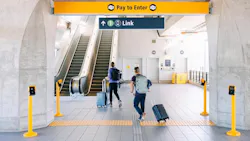
Transit agencies across the U.S. are adding fare gates to their light-rail systems in an effort to bolster safety and security, and improve farebox recovery efforts.
Sound Transit to pilot fare gates at up to 14 stations in coming years
The Sound Transit Board approved a pilot program to install and test fare gates at up to 14 stations on the Link 1 and 2 Lines, a move that the agency says aligns the transit system with other systems throughout the world.
Sound Transit notes that Link stations were designed without fare gates or turnstiles, relying instead on passengers having proof of payment—a system the agency says is a common fare structure for transit systems with street-level stations, including Portland MAX, the Denver Regional Transportation District, Valley Metro in Phoenix, Dallas Area Rapid Transit and the San Diego Trolley.
For years, the agency says this proof-of-payment system worked well for Link, which was initially a relatively small system serving many street-level stations. Board-requested studies in the past indicated that the cost of installing fare gates would be greater than the fare revenue they could recover.
As the Link network has grown and matured to become a system of more than 60 miles and 50 stations (and with 39 more stations to come with Sound Transit 3 expansions to West Seattle , Everett, Tacoma, Ballard and Issaquah, Wash.), the board requested that the agency take a renewed look at whether the proof-of-payment system is still the best fit.
A new implementation study published earlier this year determined that fare gates make financial sense now that the Link system has expanded, according to the agency. Specifically, Sound Transit says the estimates show a breakeven point for capital and operational expenses at around two to three years after fare gate implementation.
Beyond the breakeven point, the study showed fare gates have the potential to significantly increase fare compliance rates and fare revenues.
Sound Transit notes that board policy states that farebox revenue must recover a specified percentage of operating costs, also known as “farebox recovery.” For Link light rail, the agency’s farebox recovery target is 22%—a goal the agency notes as important as it faces what it describes as “continuing cost pressures.”
The agency’s preliminary assessment, which models three different scenarios, estimates that fare gates can ultimately increase net revenues from fares by $32.8 million to $82.7 million per year.
Some other transit agencies experiencing similar post-pandemic downward trends in fare compliance have recently implemented fare gates upgrades. The Southeastern Pennsylvania Transportation Authority opted to install full-height fare gates, Bay Area Rapid Transit finished its fare gate upgrade last year four months ahead of schedule and New York Metropolitan Transportation Authority, who’s been piloting new fare gate designs over the last few years, have improved their fare recovery rates and saw additional benefits to passenger experience, including increased safety and cleanliness, clearer wayfinding, consistency with other systems and metering and crowd control for large events.
Sound Transit says it will study these metrics during the pilot to determine whether fare gates provide similar benefits in the region.
In the first phase of the pilot, Sound Transit says it will need to address challenges it hasn’t had to consider before, like ensuring ADA compliance and accessibility in fare gate designs. It’ll also focus on specific considerations for people who might need new fare media, like passengers who qualify for reduced fare permits, youth and other riders who don’t currently have it.
While adding fare gates will require behavior change by Sound Transit passengers, the agency says that the upgrade will also help to clear up confusion regarding when and where passengers need to pay for their ride.
Now that the pilot is approved, Sound Transit says it will begin the contracting process to manufacture, deliver and install the gates. The agency notes that this will take a few years to develop. Installation for the fare gates is currently targeted for around 2029–2030.
Simultaneously, the agency says it will be working to develop public engagement strategies and technology solutions to support a smooth rollout. To ensure informed decision-making around whether to continue, modify or expand the pilot, the agency notes that staff will present a comprehensive Fare Gate Pilot Evaluation Framework, including specific goals and metrics, for board approval by the end of 2027.
For more details, including which stations are being targeting for fare gate installation and frequently asked questions, visit the pilot program website.
St. Louis Metro installs, activates new fare collection, gate system
The Bi-State Development Agency of the Missouri-Illinois Metropolitan District (St. Louis Metro) activated its next generation fare collection system and automated security gates at 13 MetroLink stations on July 6, part of the upgrade the agency is undertaking to make the system into a safer, more secure and more rider-focused transit experience.
The agency says the activation of the new fare and gate technology represents the culmination of a multi-year investment in St. Louis Metro’s Secure Platform Plan, which has transformed St. Louis Metro from an open-platform system into a controlled-access transit environment designed to enhance safety, security and the overall customer experience.
“This is more than an upgrade, it’s a transformation of how our region experiences transit,” said Bi-State Development Agency President and CEO Taulby Roach. “This is the moment our customers will begin experiencing firsthand how our new fare technology and automatic security gates improve the overall transit experience. We made a promise to deliver a safer, more reliable and more secure transit system, and we’re delivering on it.”
The agency notes that the July 6 activation represents the first phase of a three-phase implementation plan that will introduce fare collection technology and gate access throughout the system. Riders using upgraded stations will be able to validate their fare and access platforms through newly installed automatic security gates using mobile fare technology, smart fare media or tickets purchased using the ticket vending machines.
The first phase includes 13 St. Louis Metro stations, consisting of eight stations in Missouri and five stations in Illinois:
- Central West End
- Civic Center
- College
- Cortex
- Delmar Loop
- East Riverfront
- Emerson Park
- Forest Park-DeBaliviere
- Grand
- Jackie Joyner-Kersee Center
- North Hanley
- Union Station
- Washington Park
Phase two launched on July 27, and when combined with Phase one, brought 26 St. Louis Metro platforms online with integrated fare collection and automated gate access. These locations account for approximately 91% of all St. Louis Metro fare sales systemwide.
Phase Three launched on Aug. 17 after the delivery and installation of remaining Ticket Vending Machines. This final phase activated 12 of the remaining 13 stations, completing implementation across virtually the entire St. Louis Metro network. The new MidAmerica Airport St. Louis Metro Station is expected to come online separately later this year, according to the agency.
About the Author
 Noah Kolenda
Noah Kolenda
Associate Editor
Noah Kolenda is a recent graduate from the Craig Newmark Graduate School of Journalism with a master’s degree in health and science reporting. Kolenda also specialized in data journalism, harnessing the power of Open Data projects to cover green transportation in major U.S. cities. Currently, he is an associate editor for Mass Transit magazine, where he aims to fuse his skills in data reporting with his experience covering national policymaking and political money to deliver engaging, future-focused transit content.
Prior to his position with Mass Transit, Kolenda interned with multiple Washington, D.C.-based publications, where he delivered data-driven reporting on once-in-a-generation political moments, runaway corporate lobbying spending and unnoticed election records.