Accessibility Can’t Pause During Construction: Maintaining Continuous Access Through Transit Station Rehabilitation
Key Highlights
- Maintain a complete, accessible route from the sidewalk to the train, including temporary entrances, signage and connections, throughout all construction phases.
- Conduct thorough route reviews before and after opening changes, walking the entire passenger journey to identify and correct issues in real-time.
- Develop contingency plans for every point of potential failure, such as alternative routes, communication strategies and staff responses to ensure uninterrupted access.
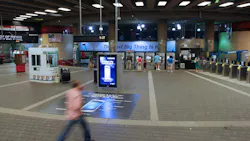
A station under construction is still a station. For the project team, rehabilitation may be divided into design packages, construction phases, work zones, outages and milestones. For the passenger, those divisions do not exist. The station is the entrance available that day, the route through fare control, the operating circulation, the temporary signs and barriers and the path that connects to the train.
This creates a particular challenge for station rehabilitation projects intended to improve accessibility. The completed station may provide step-free access, new vertical transportation or upgraded passenger facilities. Yet the public must continue to navigate the station while those improvements are being built, sometimes for months or years.
A future accessible station cannot be achieved by temporarily abandoning access. Continuous access is not just a closeout condition. It is a design and operational requirement throughout construction.
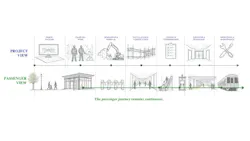
Measure accessibility across the complete journey
An accessible route and an accessible journey are related, but they are not equivalent. A route may remain physically available while becoming difficult to identify. An entrance may remain open while the path beyond it changes. An elevator may be operational, but temporary construction may make the route leading to it unclear. A passageway may retain the required width while a barrier changes sightlines or creates a confusing decision point.
Availability asks whether a route, entrance or service remains. Continuity asks whether the passenger can complete the journey safely and with reasonable independence.
That journey begins before the passenger enters the station. It may extend from the sidewalk to the entrance, through fare control, along passageways and vertical circulation and onto a platform or transfer route. Passengers with mobility, visual, hearing or cognitive disabilities depend on a complete route, consistent information and understandable decision points. Someone unfamiliar with the station cannot rely on memory to compensate for an unclear condition.
A route can be drawn as a line between two points. The passenger journey occurs through a sequence of decisions. Maintaining continuous access therefore requires considering both the physical path and the decisions required to follow it.
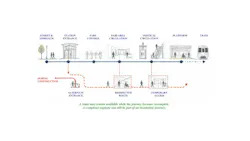
A local construction decision rarely remains local
A station functions through relationships between entrances, circulation, equipment, operations, passenger information and technical systems. A construction decision made in one location can therefore create consequences well beyond the work zone.
Removing an escalator or elevator from service, for example, shifts passengers to another stair, elevator or passageway. That redistribution can affect barricades, fare control, temporary signage, staffing, passenger-flow, crowd management and emergency planning. If work overlaps or the sequence changes, the operating condition must be reconsidered.
The physical work may remain concentrated in one location. The impact does not.
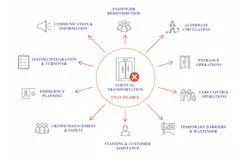
The same principle applies near completion. Equipment that appears physically complete may still depend on testing, life-safety systems, communications, monitoring, power or legacy interfaces before it can enter passenger service. Until those dependencies are resolved, the temporary passenger condition may need to remain.
Coordinating the journey across disciplines
Maintaining the accessible journey cannot sit entirely within one discipline. Designers understand spatial relationships and accessible route requirements. Contractors understand the space and sequence required to perform the work. Operations personnel understand passenger behavior under changing conditions. Maintainers understand equipment reliability. Safety personnel understand emergency movement while station employees know where passengers hesitate or require assistance.
Each group sees a necessary part of the condition. The passenger experiences the combined result.
Maintaining continuity across the passenger journey requires coordination at the project level. The transit agency or project owner can provide the broader perspective needed to connect disciplines, contracts and operating conditions that collectively shape the passenger experience. To support that coordination, responsibilities, approvals and escalation paths should be established before construction begins, not after a route is interrupted. That process should bring together design, construction, operations, maintenance, safety, accessibility and customer communications.
The objective is to make continuity of access part of phase planning before passenger conditions are affected.
Review the route before and after it opens
Temporary conditions are commonly developed through phasing plans, work plans, barricade layouts and operational coordination. These documents are necessary, but a route that works on a plan has not yet demonstrated that it works in operation.
Accessibility should be formally reviewed whenever the passenger journey materially changes. The trigger for review should be a change in the passenger experience, not simply a formal project milestone. Any modification that changes how passengers enter, orient themselves, circulate or reach the platform should prompt a renewed accessibility review—including field-driven changes, outages and revised sequencing.
Before a changed route or circulation condition is opened to the public, the team should walk the complete journey and evaluate clearances, surfaces, doors, lighting, signs, sightlines, decision points and downstream connections. The walk should begin where the passenger begins, not at the edge of the work zone.
Once a changed route or circulation condition is opened to the public, the project team should observe passenger behavior rather than only the physical condition. Repeated hesitation, backtracking, crowding at a decision point or inconsistent staff guidance may reveal problems that were not apparent during the pre-opening walk.
The pre-opening review tests the proposed condition. The post-opening review tests its actual performance. A useful cycle is simple: design it, review it, walk it, operate it, observe it and correct it.
Accessibility resilience begins with planning for failure
If the accessible journey depends on one elevator, entrance, temporary passageway or supporting system, that element is a single point of failure. Good planning identifies that dependency before an outage occurs.
Where possible, phasing should preserve redundant accessible circulation. Where another accessible path cannot be maintained, the project and operating teams should establish an alternative in advance. That response may include another station route, an accessible transportation option, passenger notification, staff deployment, escalation procedures and a realistic restoration plan.
Communication is part of maintaining an accessible journey. Information provided only after a passenger reaches an out-of-service elevator arrives too late. Passengers need accurate information while another travel decision remains possible.
The practical test is not whether the interruption can be explained. It is whether the passenger still has a viable way to complete the journey.
Earlier coordination preserves more options
In my experience, early accessibility coordination does not remove construction constraints. It allows the team to make decisions while options still exist. A route issue identified during phasing may be resolved by adjusting a work-zone boundary, changing the sequence, preserving another circulation element or coordinating a system interface before construction begins.
Once work is mobilized, even a relatively small accessibility correction can trigger a disproportionate chain of changes. Moving a barrier may require revised drawings and signage; resequencing work may require new access periods, approvals and commissioning timelines; an unresolved system interface may extend a temporary condition or require additional testing. What could have been a planning adjustment becomes a field coordination problem.
Late corrections do not stay local. They travel through the project—through design, operations, schedule and field execution.
Accessibility considerations can initially appear secondary to the immediate demands of construction sequencing. Deferring the question does not eliminate it. It simply moves the decision into the field, where options are narrower, schedule pressure is greater and passengers may already be living with the consequences.
Three practices for maintaining continuous access
- Plan the complete accessible journey for every passenger-impacting phase: Document the path from the street to the platform, train or transfer—and back again. Include every temporary entrance, circulation element, sign, surface and connection.
- Verify each changed route before opening it, then observe it in use: Do not rely on a drawing as the final test. Walk the route, observe it under actual operating conditions and establish a rapid process for correcting what does not perform as intended.
- Prepare a contingency for every single point of failure in the accessible journey: Define the alternate route or service, passenger notification, staff response, decision authority and restoration expectations before the dependent element becomes unavailable.
Designing the station people actually use
Transit rehabilitation requires disruption. The goal is not to eliminate every temporary condition. It is to make those conditions intentional and understand how each one affects the complete journey.
Confirming that an accessible route exists should be the starting point, not the measure of success. Project teams must also determine whether passengers can find it, understand the information, navigate each connection and reach the destination it is intended to serve.
A project may be divided among scopes, contracts, disciplines and phases. The passenger experiences one station. Continuous access is the baseline. Designing for the complete passenger journey is how that access can be sustained through every stage of rehabilitation.
About the Author
 Sumedha Singh
 Sumedha Singh
Registered Architect
Sumedha Singh is a New York state registered architect working on public transportation projects. Her experience includes accessibility, construction coordination, testing and commissioning, and keeping stations operational during active work. She has also written and published research on accessibility, universal design and code compliance in transportation infrastructure.