Op-Ed: The Bay Area's urban transit moment: How locals are demanding technology-driven accountability
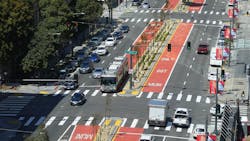
The San Francisco Bay Area is synonymous with innovation—a place where the world looks for answers to complex problems. Yet, when it comes to its own public transportation network, the region faces a precarious financial cliff, one that is similar to that of many other regions. A long-term funding strategy is desperately needed to keep the system operational, and remarkably, the public has offered a decisive green light.
The opportunity before the Metropolitan Transportation Commission (MTC) and Bay Area transit leaders is not just to secure funding, but to fundamentally redefine and modernize the system to meet a new mandate from its riders for continued transit reliability.
The here and now of progress
This unique moment is driven by the provisions of State Senate Bill 63 (SB 63), which authorizes a potential November 2026 transportation sales tax measure. If passed, this measure—a half-cent sales tax in Alameda, Contra Costa, San Mateo and Santa Clara, Calif., counties, and a one-cent sales tax in San Francisco—would generate an estimated $980 million a year.
This revenue is explicitly intended to support transit safety, cleanliness, affordability and, most critically, reliability, while also funding necessary road repairs. The bill also requires crucial financial transparency, oversight and accountability mechanisms, ensuring the money is spent effectively.
Critically, voter sentiment is already aligned with this necessary action. According to a recent EMC Research poll of voters across the five counties, 84% of respondents stated that public transit is important to the Bay Area, with 58% indicating it is very important. This belief translates into political support, as the poll found 56% of voters would support the tax measure. This support is not static; it reflects a growing trust in the system.
The poll noted that the percentage of voters who hold a favorable opinion of Bay Area transit has risen significantly, from 37% in 2023 to 55% today, suggesting that previous, targeted investments are already making a positive difference.
As Bay Area Council Chair Kristina Lawson affirmed, "We’re building a broad, durable coalition because this measure is about both avoiding disastrous service cuts and building the Bay Area’s future."
A blueprint for improvements
The public is ready to invest, but they expect their system to be protected and improved.
The need for this funding is not theoretical; it is an imminent threat to the Bay Area’s mobility. Without a new revenue stream, the region’s transit agencies face service reductions that would cripple the metropolitan economy and reverse decades of environmental progress:
- Bay Area Rapid Transit could face the most severe impact, potentially shutting down two of its five lines. This would reduce service from 4,500 trains per week to just 500, with trains running only hourly and eliminating all weekend service.
- Caltrain would be forced to run trains only once per hour, end service by 9:00 p.m. on weekdays and completely eliminate all weekend service.
- San Francisco Municipal Transportation Authority would face a 50 cut to all bus and Metro lines, including the elimination of entire neighborhood routes and even San Francisco’s iconic historic trolleys and cable cars.
- AC Transit would be required to reduce service by 37%, bringing its operations down to only half of its pre-pandemic levels.
This level of service reduction would not only strand current riders, but also force massive numbers of commuters onto already-congested highways, rendering the entire Bay Area less efficient and less livable.
A model for tech innovation
The mandate for Bay Area agencies to prevent service cuts while improving reliability demands a shift toward data-driven technology, as demonstrated by the Santa Clara Valley Transportation Authority (VTA). Santa Clara VTA’s significant post-pandemic bounce back in ridership, which outpaces the regional average as a direct result of investing in service quality and operational agility, provides a compelling case study.
Santa Clara VTA’s success hinges on moving beyond traditional infrastructure fixes to embrace the next generation of solutions: adopting agile, cloud-based platforms that leverage real-time data analytics. By using these technologies to optimize schedules and maintenance, the agency is effectively sharing performance metrics across jurisdictions and ensuring that resources translate directly into a higher quality rider experience. This proves that strategic technological investment is the most effective path to sustainable recovery and improved system reliability.
For example, cloud-based Transit Signal Priority (TSP) systems are a prime illustration of this approach, using real-time location data to coordinate traffic signals and keep buses and light rail moving efficiently. This is the only way to ensure that the massive new investment from the sales tax translates directly into quick, reliable rides that are more competitive to other modes. Technology transforms a political commitment into a measurable, daily reality for rider satisfaction.
The funding generated by SB 63 would allow agencies to do more than just survive; it would allow them to protect and improve service, keep traffic and emission levels down and support the local economy with fortified access to reliable public transit. The foundation for this future—strong public support—has been laid, as evidenced by the October poll of 2,800 respondents.
The Bay Area has a unique opportunity to continue its legacy of building a model that combines massive regional investment with an uncompromising commitment to technological accountability. This commitment—to use cloud-based technology and shared data to deliver provable reliability—will ultimately enable it to be viewed as a true model of progressive transportation innovation for the rest of the country, as well as the Western Hemisphere. It is a challenge for leadership, but one that promises to make the Bay Area’s transit system as innovative as the technology companies that call the region home.
About the Author
 Timothy Menard