Powering the Future of Mass Transit with Reliable Conductivity: The Huck® Grounding Stud
In the public transportation industry — including passenger rail locomotives and transit bus fleets — electrical reliability is paramount. Modern transit vehicles are high-tech ecosystems packed with sensitive low-voltage systems like passenger Wi-Fi, GPS tracking, security cameras, and LED lighting, alongside high-voltage powertrains propelling hybrid-electric and fully electric (EV) buses or locomotives.
At the center of keeping all these systems functioning seamlessly is a critical yet underappreciated factor: electrical grounding. As Michelle Hanley, Marketing and Product Manager at Howmet Aerospace, points out, "The growing importance of electrification in all products highlights the need for consistent, reliable circuits." She emphasizes that "the more we move to hybrid or electric power generation, the more these challenges rear their heads."
To solve these persistent grounding challenges, Howmet Aerospace offers the Huck® Grounding Stud — a maintenance-free, cold-installed fastening solution engineered on the proven Huck® lockbolt platform to deliver faster installation, safer shop conditions, and unwavering electrical conductivity.
The Engineering Behind Huck®: Vibrational Resistance Meets Superior Conductivity
To understand the innovation of the Huck® Grounding Stud, it helps to look at the history of the Huck® brand. Invented by Louis C. Huck during World War II to eliminate fastener loosening on military aircraft, Huck® lockbolts were engineered to overcome the inherent flaws of traditional threaded nut-and-bolt fasteners. As Hanley explains, "These fasteners aren't just fasteners but also a solution to a problem in a joint. They fill a need in a specific application."
In traditional threaded fasteners, tightening relies on torque, which measures friction rather than true clamp load. Under the constant motion and vibration inherent to railcars and transit buses (as well as the military aircraft deployed during WWII), traditional threaded fasteners will naturally loosen over time. When a threaded grounding stud loosens, moisture can creep in, causing corrosion and breaking metal-to-metal contact.
The Huck® Grounding Stud operates on direct tension rather than torque. Based on Howmet’s advanced BobTail® lockbolt design, the tool grips the pin and swages (deforms) a collar into the pin’s lock grooves under immense pressure.
Key Features of the Huck® Grounding Stud:
• Interference Fit Knurls: The stud features engineered knurls made of metal slightly softer than the structural steel frame.
• Vibration-Proof Lock: Because the collar is swaged directly into the grooves, there is zero room for side-to-side movement under heavy dynamic vibration.
• High Clamp Load & Contaminant Seal. The clamp provides little opportunity for water and contaminants to penetrate the hold.
• Versatile Application. It is designed to deliver dependable electrical bonding across both low-voltage signal lines (Wi-Fi, GPS, lighting) and heavy electrical loads (EV charging stations, power grids, hybrid-electric powertrains).
Overcoming the Skilled Labor Shortage and Improving Shop Safety
For original equipment manufacturers (OEMs) and transit authority repair shops, finding and retaining certified, skilled labor — specifically welders — remains a major bottleneck. Hanley highlights "the labor-intensive process of fabricating the all-important grounding studs required in these systems," where traditional welded or threaded studs require excessive surface and hole prep.
Traditionally, transit manufacturers have relied on welded grounding brackets or welded studs. However, welding studs onto transit vehicles creates several operational challenges:
- Labor Intensity and Process Speed: Grounding is usually performed on nearly finished, pre-painted structures. Welded studs require operators to grind away paint, perform the hot weld, clean the surface, and repaint the surrounding area.
- Hazardous Conditions: Welding exposes workers to excess heat, burn risks, and toxic fumes, requiring localized ventilation and specialized work permits.
- Alternative Ergonomic Hazards: Conventional torque-driven impact wrenches pose ergonomic risks like repetitive wrist strain and high noise levels on assembly lines.
The Huck® Solution: Cold Installation & Labor Optimization
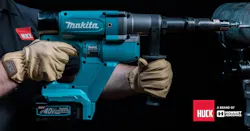
The Huck® Grounding Stud is installed cold in about 20 seconds using lightweight hydraulic or cordless battery-powered installation tools.
As Hanley observes, "The Huck® system reduces reliance on skilled labor with intuitive fastening solutions." By eliminating hot work, OEMs and maintenance depots can:
- Free Up Skilled Welders: Reallocate scarce, highly skilled welders to major structural joints where welding is strictly required, with the added benefit of increasing throughput.
- Train Installers in Minutes: "Installation is so simple, anyone can do it with minimal training," says Hanley. "That reduces training costs and addresses the welding skills gap."
- Enhance Worker Safety: Cold installation eliminates open flames, toxic welding fumes, severe tool vibration, and excessive noise.
Streamlining Quality Control and Maintenance Operations
In transit manufacturing, quality control is rigorous. Inspecting traditional welds often requires time-consuming visual checks, testing, or specialized equipment.
In contrast, the Huck® Grounding Stud features built-in visual inspection capability. As the collar is swaged during installation, small indicator dots on the collar are crushed, providing immediate visual verification that the fastener was installed. Quality inspectors can perform quick spot-checks visually or use a simple hand-held "swage gauge" to verify proper installation in seconds.
Total Cost of Ownership (TCO) Benefits for Transit Authorities
Transit assets are built for long service lives, often remaining in active duty for decades. The Huck® Grounding Stud directly drives down lifecycle maintenance expenses:
• Zero Re-torque Requirements: Maintenance crews no longer need to spend valuable hours checking torque stripe alignment or re-tightening grounding studs during routine preventive maintenance.
• Simplified Serviceability: Built on the BobTail® platform, the stud's pull section does not snap off during installation. If a grounding stud ever needs to be removed due to physical vehicle damage or extreme component overhaul, technicians can easily remove it using a Huck® collar cutter tool without damaging the parent metal.
• Infrastructure Reliability: Beyond rolling stock, the Huck® Grounding Stud can be deployed across depot infrastructure, including EV bus charging stations and power grids, protecting charge times and keeping transit schedules running on time.
A Modern Solution for Next-Generation Transit
As the transit industry accelerates toward electrification, fleet connectivity, and automation, the demand for stable, maintenance-free electrical circuits has never been higher. Hanley sums up the primary advantage of the innovation: "The Huck® Grounding Stud solves the problem of how to scale faster by allowing manufacturers to build more using the same footprint, with the same labor force."
By delivering faster throughput, reducing reliance on skilled welding labor, and guaranteeing long-term conductivity under routine vibration, the Huck® Grounding Stud empowers OEMs and transit authorities to build better, safer, and more reliable vehicles for the communities they serve.