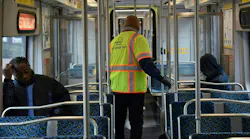
TX: Will DART secure train stations? CEO says gated system is likely 'solution of the future'
In October of last year, police said a man wearing a hockey mask boarded a train at the Pearl/Arts District train station and opened fire, killing a 44-year-old man on board.
At the time, it was the second fatal shooting on Dallas Area Rapid Transit in as many weeks, violence that ignited concerns over the system’s safety and security.
This week, Pearl/Arts District station was brimming with officers who checked tickets and patrolled the platform between tall fences meant to simulate what DART would look like as a fare-gated system.
The 90-day initiative, dubbed Operation Access, features more officers, barriers and fare validation at a handful of rail stations in an effort to create a “safer, more welcoming experience for customers,” according to the agency.
“I walked in the door recognizing safety and security [are the] No. 1 priority,” said DART CEO Nathaniel Ford, who started leading DART in October. “I've got the team hard at work fulfilling that mandate.”
DART is testing security improvements in response to rider concerns and member city pressures after several cities considered cutting ties with the agency this year. The transit system stress-tested its security capabilities during the FIFA World Cup, and is now exploring whether its rail stations could one day look more like Chicago’s or New York’s — with a ticket required for entry.
DART is currently an open system — anyone can walk up to train station platforms without a fare, a cheaper design intended to make boarding easier and improve access. Closed systems have turnstiles, fare gates or other barriers to entry.
Ford said enclosing the system is likely “the solution of the future” if the agency wants to increase ridership and improve security on the system.
A delegation of DART board members and city officials will travel to St. Louis and Seattle next month to see systems that have closed or are in the process of doing so.
‘It would be great to feel safe’
At the West End Station, Lenord Dudley, 68 — or 18 with 50 years of experience, he likes to say — wheeled his walker off the train. A disabled veteran, he relies on DART for transportation and has ridden the system since the 1970s. Earlier this year, he said he was robbed at gunpoint on a bus.
“This station here is really one of the worst points,” he said at West End, one of two stations with barriers and mandatory fare validation checkpoints. “I'm glad to see all this because it makes it safer.”
Safety concerns on DART were highlighted earlier this year, not just after a series of violent incidents, but as several cities put membership in DART to a vote. Leaders in Irving, Plano, Farmers Branch and other member cities cited the millions spent on the system compared to inadequate — and to some, unsafe — service.
“It would be great to feel safe on public transportation and be able to use it,” said Highland Park resident Lucy Washburne, who voted for her town to leave DART. Highland Park became the only member to successfully cut ties with the agency in May exit elections. She doesn’t ride on DART’s trains because of what she’s heard about safety on the system.
The World Cup gave DART a blueprint for controlling and directing access at rail stations. DART Assistant Police Chief Gil Garza said during the international sporting event, the agency invested resources in adding staff, gates and wayfinding at Victory Station, where riders could access the Trinity Railway Express to get to matches in Arlington.
DART officials said FIFA efforts were successful, with no major security issues and positive feedback from riders. Because World Cup preparations paid off, Garza said, DART officials felt confident expanding efforts with Operation Access.
‘A very complex endeavor’
Operation Access was an investment of $850,000 for signage, staffing, barriers and other costs. On average, 10-15 additional uniformed officers are patrolling the light rail system through the initiative.
Security is already an expensive endeavor for DART. The agency has about $70 million budgeted for police, more than the entire operating budget of the neighboring Denton County Transportation Authority.
However, fare enforcement has boosted ticket sales. Since Operation Access launched Nov. 16, ticket sales at the two fare-enforced stations are up 31%, according to DART, and up 13% at other stations.
Enclosing all of DART’s 66 light rail stations could take hundreds of millions of dollars and temporarily disrupt the commutes of thousands of passengers, Ford said. Officials are also evaluating only partially enclosing the system. Data and observations from Operation Access will help inform the decision, the CEO said.
“It's going to be a very complex endeavor,” he said. “To retrofit these systems, it's a tall mountain to climb.”
To stay up-to-date with The News’ Go Team, become a regular visitor of dallasnews.com/traffic and subscribe to our Traffic Tracker newsletter at dallasnews.com/newsletters/traffic-tracker.
© 2026 The Dallas Morning News.
Visit www.dallasnews.com.
Distributed by Tribune Content Agency, LLC.