WA: Will Cascadia High-Speed Rail stop in Olympia, Tacoma and Bellingham?
Washington’s transportation department wants to hear your feedback on a proposed mega-project: Cascadia High-Speed Rail.
Friday, Nov. 13 is the final day for residents to complete the survey from the Washington State Department of Transportation about the potential international rail system that would stretch from Portland to Seattle to Vancouver, B.C.
The project is currently in its “service development plan” phase that’s expected to wrap up in 2028, according to WSDOT’s website. This stage would be followed by a formal environmental review, design and construction.
Cascadia program administrator Ben Tripousis said in a call that the project’s outreach effort aims to better understand communities’ questions and concerns about a high-speed rail system.
The region’s population is expected to grow by some 3.4 million people by 2050, Tripousis said. Paired with that statistic: about 1.8 million new jobs.
“Those folks are going to have to identify the ways to get to those jobs, and we need to provide them with mobility options to get to and from work so that it’s effective and convenient for them,” he said. “The Northwest remains a wonderfully attractive place for jobs and for families, and that’s what really drives those numbers.”
The looming population boom would also add stress to current infrastructure, WSDOT’s website says. An estimated 80% of Interstate 5 in Washington is expected to operate at medium/high congestion by 2050 versus 59% today.
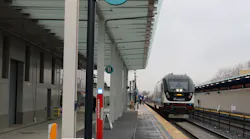
Existing Amtrak Cascades trains top out at around 79 miles an hour, Tripousis said. The future high-speed system would run between 160 mph and 220 mph.
The Amtrak Cascades system wouldn’t be replaced by a future high-speed rail, according to WSDOT.
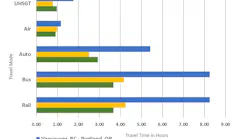
High-speed rail could reportedly offer trips between each of the anchor cities — Vancouver to Seattle and Seattle to Portland — lasting roughly an hour instead of about three hours by car.
Tripousis, who previously worked on a similar high-speed rail project that’s still under construction in California, acknowledged challenges facing Washington state. The straighter and flatter the path, the faster the trains can go, he said.
“And as you know, the topography in the northwest isn’t exactly flat and straight,” Tripousis said.
It will take time to analyze possible locations and “how it could integrate with stations effectively,” he added.
The California rail project, which would connect the Bay Area with Southern California, has faced delays and rising costs, according to Sacramento NBC affiliate KCRA 3.
As for whether there could someday be high-speed rail stops in Olympia, Tacoma or Bellingham? Tripousis said specific station locations are still under review, but that all the cities along the I-5 corridor are being considered as part of that analysis.
The Federal Railroad Administration provided WSDOT $49.7 million in late 2024 to produce a Cascadia High-Speed Rail service development plan, the transportation department’s website says; it also awarded the project $500,000 the year prior. In addition, the state Legislature has given $5.5 million in state match funds.
After the service development plan is completed by the end of 2028 comes environmental clearance, which Tripousis said typically takes anywhere from two to five years. It isn’t yet known what year commuters would be able to hop on a potential high-speed train, though the analysis will help determine that time frame, he said.
It also hasn’t been decided which entity or entities would operate the rail. The service development study will look at possible governance models. Tripousis pointed to one governance example: The ongoing California high-speed rail project has a separate, appointed nine-member board that oversees its day-to-day management.
A Washington high-speed rail system could transport between 1.7 million and 3.1 million riders per year and generate between $160 million and $250 million in annual revenue after opening, according to WSDOT. Tripousis said via email that while ongoing analysis will help paint a clearer picture of where revenue would go, rail systems elsewhere in the world generally commit such dollars to their system’s operation, maintenance and expansion.
WSDOT’s website also cites 2017 estimates that up-front construction costs could range between $24 billion and $42 billion.
The department’s survey includes questions about commuters’ travel habits and priorities, and asks respondents to weigh in on the rail project’s purpose and needs statements. Tripousis said the project’s public-engagement effort lets people participate in the process “and not feel like this project is being foisted on them.
“Because as you might imagine,” he continued, “trying to develop a project of this size in a fairly developed corridor between Portland and Vancouver is going to be no small feat.”
Take the survey by visiting engage.wsdot.wa.gov/cascadia-program.
© 2026 The Olympian (Olympia, Wash.).
Visit www.theolympian.com.
Distributed by Tribune Content Agency, LLC.