CA: New Carlsbad bridge is milestone in effort to double-track railroad corridor
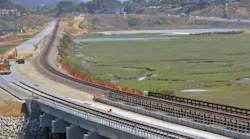
A northbound Amtrak Pacific Surfliner crossed a new railroad bridge at the Batiquitos Lagoon in Carlsbad about 5 a.m. Monday, the first train over another milestone for the 60 miles of track between downtown San Diego and the Orange County border.
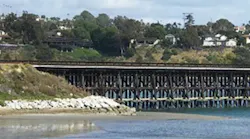
The concrete-and-steel bridge replaced an 80-year-old wooden trestle that will now be removed. Another bridge with a second set of tracks, a twin of the newest span, will be built in place of the old trestle. The entire project, covering six-tenths of a mile between La Costa Avenue in Encinitas and Avenida Encinas in Carlsbad, is expected to be completed in the spring of 2028.
“Now that we have the train on this new track it will be a lot easier to work,” said Omar Atayee, a principal engineer with the San Diego Association of Government, the region’s planning agency.
Construction began in 2024 on the Batiquitos Lagoon double-track project. When finished, the bridge and its railway approaches will be part of a 5.5-mile continuous segment of double track through Encinitas and southern Carlsbad, Atayee said.
Two sets of tracks allow faster and more frequent rail service, he said. Trains traveling in opposite directions can pass each other without slowing or stopping. Also, if one set of tracks is shut down for maintenance or other reasons, the second set can remain available.
Improved train service also helps to reduce congestion on nearby Interstate 5. SANDAG officials have said their goal is to double-track 99% of the corridor by 2035.
About three-quarters of the 60-mile corridor has been double-tracked so far. Bridges are some of the last bottlenecks, in part because of the expense and environmental concerns involved with replacing them.
The Batiquitos project is budgeted for a total of $166 million, of which $111 million is construction costs, Atayee said. The money is a combination of grants from the Federal Transit Administration, the state’s Solutions for Congested Corridors Program, and San Diego County’s Transnet program, a half-cent sales tax approved by voters.
A San Elijo double-track project, with 1.5 miles of secondary track and a new bridge across the San Elijo Lagoon in Encinitas, was completed in 2019.
Construction will begin soon on a bridge and secondary track across the San Dieguito Lagoon in Del Mar. And after the San Dieguito project, next on SANGAG’s list is a double-tracked bridge to replace an old trestle across the San Luis Rey River at Oceanside, Atayee said.
San Diego County’s last and biggest bottleneck is likely to be a 1.7-mile stretch of tracks just south of San Dieguito on the coastal bluff in Del Mar.
Sandwiched between the seaside cliffs and expensive ocean view homes, the railroad right-of-way there has no room for a second set of tracks. Meanwhile, the bluffs erode away at an average rate of 6 inches annually, creeping ever closer to the railway used by Amtrak, Coaster commuter trains and BNSF freight cars.
SANDAG is leading efforts to move the bluff-top section to a new route, a proposed tunnel to be bored beneath the hills of Del Mar. However, the cost of that has been estimated at between $3 billion and $5 billion, and it faces strong opposition from many Del Mar residents. SANDAG has said the earliest a tunnel could be completed is 2035.
Perhaps a bigger obstacle for the future of the train lies in San Clemente, just north of the San Diego County border.
There, the train runs for several miles near sea level along the beach. Coastal erosion is a growing threat, and waves often crash across the tracks during the highest tides. Also, bluff failures on the inland side of the railroad have sent debris onto the right-of-way.
Between bluff failures and erosion, rail service has been suspended for repairs multiple times in recent years. Last week, the California Coastal Commission approved more sand replenishment and rock revetments that are intended to protect the San Clemente segment of tracks where they are for at least another decade.
New damage is likely there during the powerful El Niño predicted for this winter, which could mean more and stronger storms than usual. Transit authorities have only recently begun to investigate the possibility of rerouting the tracks in Orange County, where it would be far more expensive and time-consuming than the tunnel being considered in Del Mar.
Meanwhile, federal, state and local agencies have focused on working together to protect the railroad where it has been since it was built in the late 1800s.
Along with improved service, the new bridges bring environmental benefits.
The concrete-and-steel bridges are longer than the old wooden trestles and have fewer support columns in the water. That improves tidal ocean flows in and out of the lagoons, enhancing water quality and improving the habitat for wetlands wildlife.
“Cormorants are big fans of properly working lagoons,” said Tracey D’Aoust-Roberts, deputy district director of environmental for Caltrans.
“You’ll see the seals coming back because there are more fish here now,” she said, standing at the edge of the lagoon Monday morning. “There are more migratory birds … like the great egrets.”
The Batiquitos project included the restoration of 4.2 square miles completed last year to expand nesting areas for the least tern, a migratory bird that spends its winters in Mexico.
Sand and sediment dredged from the channel beneath the new bridge was placed in an eroded corner of the lagoon between the railroad and Highway 101 to create a wide, flat area for the birds to lay their eggs above the tides.
Broken oyster shells and curved roofing tiles were spread across the surface to encourage the fowl to build their summer homes there. The random materials serve as camouflage for the terns’ small spotted eggs. A chain link fence helps keep out humans and potential predators such as coyotes.
The bridge and nesting sites are in the Batiquitos Lagoon Ecological Reserve, which includes 544 acres of endangered coastal habitats such as intertidal mud flats, salt marshes, transitional zones and willow riparian forest.
Batiquitos Lagoon gets 400 to 600 least tern nests and produces 50 to 100 fledglings per year, making it one of the five most productive nesting sites in California, according to the state Department of Fish and Wildlife.
©2026 The San Diego Union-Tribune.
Visit sandiegouniontribune.com.
Distributed by Tribune Content Agency, LLC.