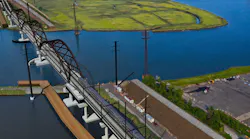
Portal North Bridge enters full passenger service
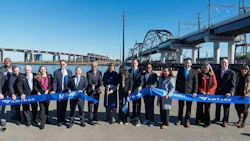
New Jersey Gov. Mikie Sherrill, along with officials from New Jersey Transit (NJ Transit) and Amtrak, gathered in Kearny, N.J., to mark the completion of the Portal North Bridge. Both tracks on the new bridge are now in full service following what the agency describes as a successful five-week cutover process.
“New Jersey commuters deserve to get to work on time and get home to their families without a century-old bridge holding up the entire Northeast Corridor,” Gov. Sherrill said. “With both tracks of the Portal North Bridge now in service, we are eliminating a major source of delays and delivering the reliable transportation our residents and economy depend on. I thank the workers who built this bridge and our customers for their patience during construction. This is a major step forward for Gateway and proof of what we can accomplish when we stay focused on getting things built.”
These efforts mean that the previously used bridge can officially retire after 116 years in service over the Hackensack River. NJ Transit and Amtrak customers are now set to benefit from a modern, more reliable infrastructure, ushering in what NJ Transit calls a new era of dependable service for generations to come. The new Portal North Bridge is a fixed span bridge that does not have to open for marine traffic to pass under.
“Today, our customers begin benefiting from a generational investment that will make their trips more reliable for decades to come,” said NJ Transit President and CEO Kris Kolluri. “The new Portal North Bridge permanently removes a chronic source of delays, allowing marine traffic to pass beneath the bridge without interrupting the trains carrying our customers to work, home and everywhere in between. We know both cutover projects asked a great deal of our customers, and I thank them for their patience throughout this historic transition.”
The transfer of rail service from the old Portal Bridge to the first track of the new Portal North Bridge began on Feb. 13 and finished on March 15, bringing the new span’s initial track into service while the old swing bridge remained operational. Work on the second and final track began on Oct. 9 and concluded on November 16, completing the full transition to the new bridge. and concluded on Nov. 16, completing the full transition to the new bridge. Regular NJ Transit weekend service resumed on Nov. 15. Weekday diversions of Midtown Direct service to Hoboken and cross honoring options have ended with full service resuming between Newark and Secaucus, N.J. Customers are encouraged to consult the timetables for the latest schedules.
“The cutover is complete, and Portal North Bridge is ready to deliver,” said Amtrak Interim President Byl Herrmann. “Thanks to the hard work of our crews and our strong partnership with NJ Transit, both of our customers can now experience the full benefits of the bridge with more reliable, faster service.”
The project eliminates the old swing bridge, which has been the enduring source of major service disruptions for NJ Transit and Amtrak customers traveling on the Northeast Corridor. The new bridge provides:
- Improved reliability and fewer bridge-related delays.
- Increased operational resilience along the Northeast Corridor.
- A modern structure designed to support future capacity growth.
The project was funded by the U.S. Department of Transportation, the states of New Jersey and New York and Amtrak. In January 2021, former New Jersey Gov. Phil Murphy announced the signing of a Full Funding Grant Agreement , which secured $766.5 million in Federal Transit Administration (FTA) funding to support the project’s construction.
“The Federal Transit Administration has been proud to support NJ Transit and Amtrak with the construction of Portal North Bridge through its investment of $926 million,” said FTA Region 2 Administrator Michael Culotta. “The new fixed bridge is a game changer for workers and residents in New Jersey, and it means less delays during our commutes, more family time and better access to education, health care and job opportunities in our region.”
In October 2021, former Gov. Murphy and NJ Transit announced the approval of a nearly $1.6 billion construction contract awarded to Skanska/Traylor Bros PNB Joint Venture for the construction of the new Portal North Bridge. The contract represents the single largest construction award in NJ Transit’s history, according to the agency.
“The completion of the new Portal North Bridge is a milestone for the history books,” said Gateway Development Commission CEO Tom Prendergast. “Today’s achievement sends a clear message: the fast, reliable commute that hundreds of thousands of daily riders have long awaited is on the horizon. Together with the Hudson Tunnel Project, we are making meaningful progress towards a stronger transportation network and proving that we can deliver on the promise of a new day for American infrastructure. The Gateway Development Commission congratulates its partners at NJ Transit and Amtrak on this momentous occasion.”
The Portal North Bridge project spans 2.44 miles of the Northeast Corridor line and includes construction of retaining walls, deep foundations, concrete piers, structural steel bridge spans, rail systems, demolition of the existing bridge and related incidental works. The project is a component of the larger Gateway Program, which aims to eventually double rail capacity between Newark and New York.
The current Portal Bridge is scheduled to be dismantled in 2027.
About the Author
 Noah Kolenda
Associate Editor
Noah Kolenda is a recent graduate from the Craig Newmark Graduate School of Journalism with a master’s degree in health and science reporting. Kolenda also specialized in data journalism, harnessing the power of Open Data projects to cover green transportation in major U.S. cities. Currently, he is an associate editor for Mass Transit magazine, where he aims to fuse his skills in data reporting with his experience covering national policymaking and political money to deliver engaging, future-focused transit content.
Prior to his position with Mass Transit, Kolenda interned with multiple Washington, D.C.-based publications, where he delivered data-driven reporting on once-in-a-generation political moments, runaway corporate lobbying spending and unnoticed election records.
Related
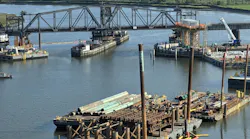 The image shows the construction of the Portal North Bridge.