CA: Rising costs to push San Jose BART extension well above $12.75 billion as VTA looks to trim project
San Jose’s long-awaited BART extension is expected to significantly exceed its current $12.75 billion price tag, prompting transit officials to reconsider how they build out the project.
The Santa Clara Valley Transportation Authority, the agency tasked with constructing the six-mile, four-station line, would not say how much more the project might cost, but pointed to other major transportation projects across the country that have recently spiked in price. VTA is slated to finalize the first cost estimate update of the project in more than two years next month.
With the stress of current market conditions and no additional funding to tap into, the South Bay transit agency is now looking to pivot as it launches a process to trim the project to fit its budget.
“Given the significant resources we do have, this project does have over $12 billion of federal, state and local funding, what’s the best way to deliver the program in a fiscally responsible manner?” Tom Maguire, VTA’s chief megaprojects officer, told reporters at a media briefing this week.
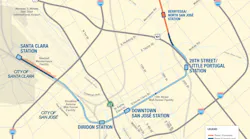
How exactly VTA plans to complete the extension, which will run from the Berryessa Transit Center in North San Jose, through downtown and to Santa Clara, remains unclear. Maguire declined to answer questions from reporters this week on specifics — including whether the agency would have to cut any of the four stations to get within budget. All options, however, will include the use of the $76 million, nearly 54-foot in diameter tunnel boring machine that will take approximately three to four years to dig the five-mile-long tunnel that BART will run through.
During a Thursday morning meeting with VTA’s oversight committee, which oversees the BART project, members expressed desire to potentially complete the project in phases.
San Jose Mayor Matt Mahan, who serves as the committee’s chair, said that they “should be committed to the full vision of the project” — even if it means they can’t open the line all at once.
“We’ve got to remember that over decades we’ve made a lot of commitments to the public and there are a lot of stakeholders out there from East Side San Jose to Santa Clara and everybody in between that has a stake in the project and has been following it, voted for it, voted to tax themselves and so forth,” Mahan said.
Carolyn Gonot, VTA’s general manager and CEO, said in a statement that they are “evaluating all options to advance” the project forward.
“Our focus is on identifying a responsible and financially viable strategy, including the potential for a phased approach to construction, that allows us to move the project forward while remaining firmly committed to completing the entire extension to downtown San Jose and Santa Clara,” she said.
VTA has already undergone a lengthy cost savings effort to close a $700 million to $1.2 billion funding gap when the Federal Transit Administration, under President Joe Biden, said it would allocate nearly $5.1 billion to the BART extension — less than what the transit agency requested — through a grant process that has yet to be completed.
The cost savings effort, however, didn’t yield enough savings to fully close the gap, though Maguire said that the “problem we’re trying to solve would be bigger had we not had those hard conversations” previously.
The process to trim the BART extension project’s budget is also expected to envision a scenario where VTA doesn’t receive the nearly $5.1 billion it’s anticipating. The agency was supposed to submit its formal grant application to the FTA by the end of the year, but with the change in price of the project, it will first have to bring the cost within budget.
The Trump administration has created some uncertainty for not just VTA, but transit agencies across the country that are in line to receive federal funding, which has been slashed since President Donald Trump took office in 2025.
Cost overruns and time delays have long plagued the BART extension project that has been decades in the making — Santa Clara County voters in 2000 approved a 30-year half-cent sales tax increase to fund the new line. It was originally set to open this year and cost $4.7 billion. Transit officials now expect to open in 2037, though that date could change when VTA completes its updated cost estimate next month.
The conditions that are driving up the cost of the BART project are also being felt by transit agencies across the country, Peter Rogoff, a VTA consultant and the former head of the FTA, said during the meeting.
The net input costs for nonresidential construction increased 11.9% from September 2025 to September 2026, according to an analysis by the Associated General Contractors of America.
Los Angeles’ Southeast Gateway project, which will extend the city’s light rail by 14.5 miles, was expected to cost between $4.9 billion and $5.1 billion in March 2024, but an April 2026 projection pegged the price at $10.5 billion. And in Salt Lake City, the cost of a commuter rail project has also grown, going from $966 million in March 2023 to $1.4 billion in April of this year.
Rogoff told the committee that the war in Iran, which has driven up the price of fuel and materials, has contributed to the “overall uncertainty that contractors must price into their bids,” especially since construction is heavily reliant on diesel fuel.
“Increased fuel prices, especially diesel prices, permeates the cost of every other manufacturing process when it comes to building materials,” Rogoff said. “Given how long fuel prices have been elevated, you will not find any contractors loading prices into their bids today that assume that fuel prices will return to the old normal.”
In California, the cost of diesel has been rising faster then the price of regular gasoline, going from $4.80 a gallon in June 2025 to $8.14 a gallon last month.
Trump’s sweeping tariff policies, which Rogoff called “frenetic and unpredictable,” are also leading to increased costs.
Santa Clara Councilmember Suds Jain, who also sits on the oversight committee, told The Mercury News that he felt like this week’s meeting was “prepping us for sticker shock.”
The councilmember, who has been a frequent critic of the agency’s handling of the project, expressed frustrations with VTA’s decision to commit to the giant tunnel boring machine despite the fiscal challenges facing the project.
The tunnel design has long been a point of contention between VTA and some transit advocates who have argued that digging two smaller side-by-side tunnels with shallower stations will be more cost effective than digging one large tunnel eight stories underground.
VTA released a report last year that showed switching its tunnel design could add $600 million to the price tag, but independent experts challenged the findings, calling them “overinflated.”
“It’s a tough position for anyone to be in,” Jain said of the market conditions. “I get that diesel prices and tariffs are real and they’re impacting the cost but it’s not only that. In my opinion, it’s some poor decisions we made along the way.”
©2026 MediaNews Group, Inc.
Visit at mercurynews.com.
Distributed by Tribune Content Agency, LLC.