OCTA Board continues planning for coastal rail fortification along LOSSAN corridor
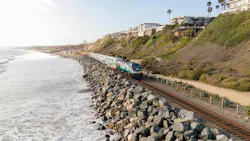
The Orange County Transportation Authority (OCTA) Board of Directors directed staff to continue coordinating with stakeholders, regulatory agencies and the public after it reviewed the Draft Coastal Rail Resiliency Feasibility Report that’s set to be finalized later this year.
The report marks the latest step in OCTA’s Coastal Rail Resiliency Study, launched in late 2023, to evaluate potential strategies for protecting approximately seven miles of the Los Angeles-San Diego-San Luis Obispo (LOSSAN) Rail Corridor through Dana Point and San Clemente, Calif., to the Orange County-San Diego County line.
The agency says that the study focuses on identifying feasible approaches to help protect the existing rail line and maintain safe and reliable passenger and freight rail operations for up to the next 30 years while a separate, state-led effort will examine longer-term solutions for the corridor beyond that timeframe.
“This is an important step toward identifying practical solutions that can help protect this critical rail corridor while continuing to incorporate input from residents, regulatory agencies and other stakeholders,” said OCTA Chair and Dana Point Councilmember Jamey Federico. “The work ahead will require continued coordination among local, state and federal agencies, and we remain committed to advancing solutions that support safe and reliable rail service while continuing to be a partner in broader coastal resiliency planning efforts.”
OCTA notes that the Draft Feasibility Report does not identify a single preferred project or propose one solution for the entire seven-mile corridor. Instead, it provides a more detailed technical foundation for future project development and identifies a toolbox of potentially feasible rail, bluff side and beach side concepts that could be applied selectively based on conditions at specific locations.
The study initially evaluated 23 concepts, including rail-foundation improvements, alternative railroad materials, catchment walls, bluff-stabilization measures and a range of beachside protection approaches. Following technical analysis, public input and feedback from the OCTA Board and regulatory agencies, the refined beach side concepts carried forward in the study all include sand placement and, depending on location, could also include repairing or restoring existing reinforcement boulders known as riprap, engineered revetments, seawalls or combinations of those approaches.
Last year, the agency placed 2,500 cubic yards of sand to help fortify the rail line, adhering to strict permitting limitations and only placing sand above the mean high tide line. These efforts came both as a result of study for what would best solve the issue, and from community feedback.
Any future project would require additional engineering and alternatives analysis, environmental review under applicable state and federal requirements, continued public engagement, permits and approvals from regulatory agencies and identified funding before construction could proceed.
Ongoing coastal rail challenges
Since 2021, OCTA reports that coastal erosion, bluff movement, landslides, high tides, storms and powerful ocean swells have contributed to repeated rail service disruptions in San Clemente, Calif., totaling nearly a full year. OCTA has responded with emergency stabilization work at several priority locations while advancing the Coastal Rail Resiliency Study (CRRS), which is intended to move from repeatedly responding to emergencies toward a more coordinated, proactive approach—both to prevent service outages and to reduce emergency costs, as told to Mass Transit as part of an exclusive update last year.
More than $300 million in state, federal and local funding has been secured for those priority rail protection efforts. Sand placement is also a significant component of this effort.
OCTA is advancing plans to place up to approximately 540,000 cubic yards of sand along the San Clemente coastline to help support protection of the rail corridor after the initial efforts last year. Further nourishment is being coordinated with other planned sand-placement projects in South Orange County. The CRRS will pursue additional sand-placement efforts as one of the rail protection strategies.
The Draft Feasibility Report concludes that the coastal rail corridor continues to face long-term vulnerabilities and that short-term stabilization measures alone will not eliminate risks to rail operations. It also identifies the need for significant interagency coordination, environmental review, engineering and capital investment to maintain reliable rail service over the coming decades.
OCTA says its staff will continue incorporating feedback received during the study process and will return to the board as additional project-development milestones are reached.
About the Author
 Noah Kolenda
Noah Kolenda
Associate Editor
Noah Kolenda is a recent graduate from the Craig Newmark Graduate School of Journalism with a master’s degree in health and science reporting. Kolenda also specialized in data journalism, harnessing the power of Open Data projects to cover green transportation in major U.S. cities. Currently, he is an associate editor for Mass Transit magazine, where he aims to fuse his skills in data reporting with his experience covering national policymaking and political money to deliver engaging, future-focused transit content.
Prior to his position with Mass Transit, Kolenda interned with multiple Washington, D.C.-based publications, where he delivered data-driven reporting on once-in-a-generation political moments, runaway corporate lobbying spending and unnoticed election records.