Phase 1 of L.A. Metro D Line Subway Extension begins passenger service
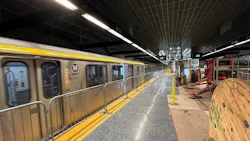
Section 1 of the Los Angeles County Metropolitan Transportation Authority (L.A. Metro) D Line Subway Extension began passenger service on May 8. Riders can now go west beyond the Wilshire and Western station in Koreatown, Calif., with service to neighborhoods and communities, including Hancock Park, Windsor Square, the Fairfax District and Cathay Circle into Beverly Hills in around 21 minutes. Riders will now have access to three new underground stations: Wilshire/La Brea, Wilshire/Fairfax and Wilshire/La Cienega.
“It’s finally opened! LA county residents are now connected from Downtown Los Angeles to Beverly Hills with three new beautiful underground stations making the trip through Mid-Wilshire to experience the culture, cuisine and commerce across diverse neighborhoods faster, easier and a lot more accessible,” said L.A. Metro Board Chair Fernando Dutra. “Today we showed what’s possible when residents, community leaders and local, state and federal government agencies work together in a shared vision to improve the region’s mobility.”
Sections 2 and 3 of the extension are set to open in 2027. L.A. Metro says the full D Line Extension will be a critical connection for the 2028 Olympic and Paralympic Games, with its stop in Westwood, Calif., and the athlete village at UCLA.
“For weeks, the D Line has been the talk of LA,” said L.A. Metro Board Member and LA County Supervisor Lindsey Horvath. “It’s clear Angelenos are ready for the D for what it delivers: less time in traffic, stronger local businesses and easier access to jobs, school, healthcare and the cultural institutions that make the Westside such a vital part of Los Angeles.”
The agency notes Section 1 of the D Line Extension was designed and built with the help of community input and local voices. In addition, the project benefitted from L.A. Metro’s Board-approved small business mitigation programs: the Business Interruption Fund that provides financial assistance to those businesses located along project corridors and Eat Shop Play, which provides them with marketing assistance. Both helped support small businesses in the areas along the project alignment during construction. The Business Interruption Fund awarded 465 grants to 122 small businesses around Section 1, totaling more than $14 million, and the Eat Shop Play program provided free marketing assistance to 52 businesses.
L.A. Metro says that Section 1 of the D Line extension was funded primarily via its 2008 Measure R transportation sales taxes. Local sales tax funding also secured federal matching funds, including $1.25 billion in full funding grant agreement funds, $66.4 million of supplemental New Starts and a $749.3 million loan via the Transportation Infrastructure Finance and Innovation Act in May 2014.
“Today’s opening is a transformative moment for Los Angeles and a clear demonstration of what sustained investment in public transit can deliver for our region,” said L.A. Metro CEO Stephanie Wiggins. “Riders can get from DTLA to Beverly Hils in 21 minutes, and we’re not stopping here. With Sections 2 and 3 on track to reach Century City and Westwood next year, we’re building a world-class transit system that will serve Angelenos for generations to come and help prepare our city for the global stage. This is a clear example of the Olympics legacy already in motion.”
Skanska was the lead contractor on the $2.4 billion project, which included:
- Construction of twin subway tunnels beneath Wilshire Boulevard.
- Deep excavation and structural construction of three underground stations.
- Coordination of complex underground utility infrastructure.
- Systems integration support for signaling, communications and traction power infrastructure.
According to Skanska, construction required continuous coordination within one of Los Angeles’ busiest urban corridors, where crews worked around sewer, electrical, gas, water and telecommunications systems beneath Wilshire Boulevard. Variable subsurface conditions, groundwater and tar sand formations required advanced geotechnical monitoring and adaptive tunneling methods throughout construction.
“After more than a decade of construction, this project stands as a reflection of sustained effort, collaboration and innovation across an exceptional team of engineers, craft professionals and project partners,” said Skanska USA Civil Project Executive of Operations Geoffrey Bender. “Delivering complex underground infrastructure beneath one of Los Angeles’ most active corridors required persistence, adaptability and precision at every stage. We are deeply grateful to our crews and JV partners whose expertise made this milestone possible and proud of the innovations and lessons learned along the way that will continue to shape how we deliver major transit projects in the future.”
About the Author
 Brandon Lewis
Brandon Lewis
Associate Editor
Brandon Lewis is a recent graduate of Kent State University with a bachelor’s degree in journalism. Lewis is a former freelance editorial assistant at Vehicle Service Pros in Endeavor Business Media’s Vehicle Repair Group. Lewis brings his knowledge of web managing, copyediting and SEO practices to Mass Transit magazine as an associate editor. He is also a co-host of the Infrastructure Technology Podcast.