New Mid-America Regional Council report highlights benefits of KC Streetcar Main Street Extension service
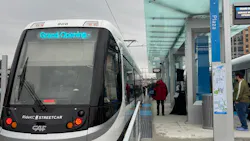
The Mid-America Regional Council (MARC) has released data on the impact the Kansas City Streetcar Authority (KC Streetcar) had on new construction permits and ensuing development.
According to the report, after the completion of the KC Streetcar extension to the University of Missouri–Kansas City (UMKC) in 2025, the system runs 5.7 miles along a single corridor from Main Street to the City Market to UMKC. Data revealed that for both the starter route from City Market to Union station and the UMKC extension, the pace of new construction roughly doubled following transit investment.
MARC looked at 10-plus years of construction permit data available through Kansas City’s Open Data KC portal. Permits were grouped and classified as residential (single-family, duplex, multi-family) or nonresidential (commercial, civic, industrial). MARC notes that permit activity jumped after the establishment of the downtown transportation development district (TDD), a specialized taxing district for the funding, building and maintenance of public transit infrastructure, in 2012. Permit activity jumped significantly once more after the establishment of the extension TDD in 2017.
In both the original starter route and the subsequent extension, MARC found that new construction projects roughly doubled after the TDD designation, growing from three to six per year for the starter route and from five to 11 for the extension.
Data shows that the starter route, located in the central employment corridor of downtown KC, drew permits focused more on commercial activity and high-density, multi-family housing. The extension, which runs through a more residential and less employment heavy corridor, produced a different mix of permit types that was in alignment with development patterns throughout the region. According to the report, almost 70% of permits drawn around the starter route were for commercial/high-density, multi-family construction while the extension saw 37% of permits drawn for single-family housing.
MARC also notes that the timeline for the starter route and the extension were different, four years for the starter route and eight for the extension, making different types of construction more or less viable.
The full report can be found on MARC’s website.